Wooden Deck Built in Toti at a Guest House

Wooden deck builder Durban

Click to enlarge

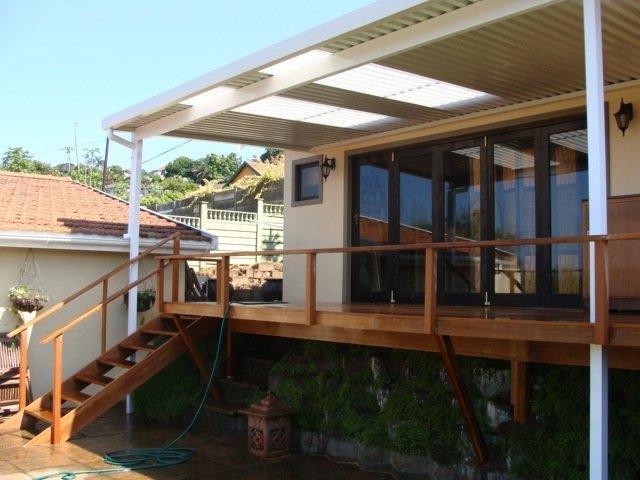
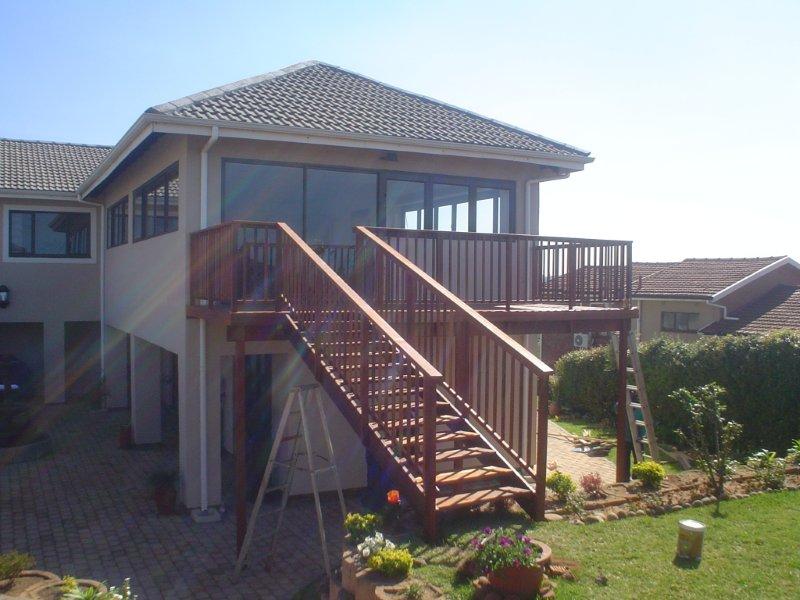
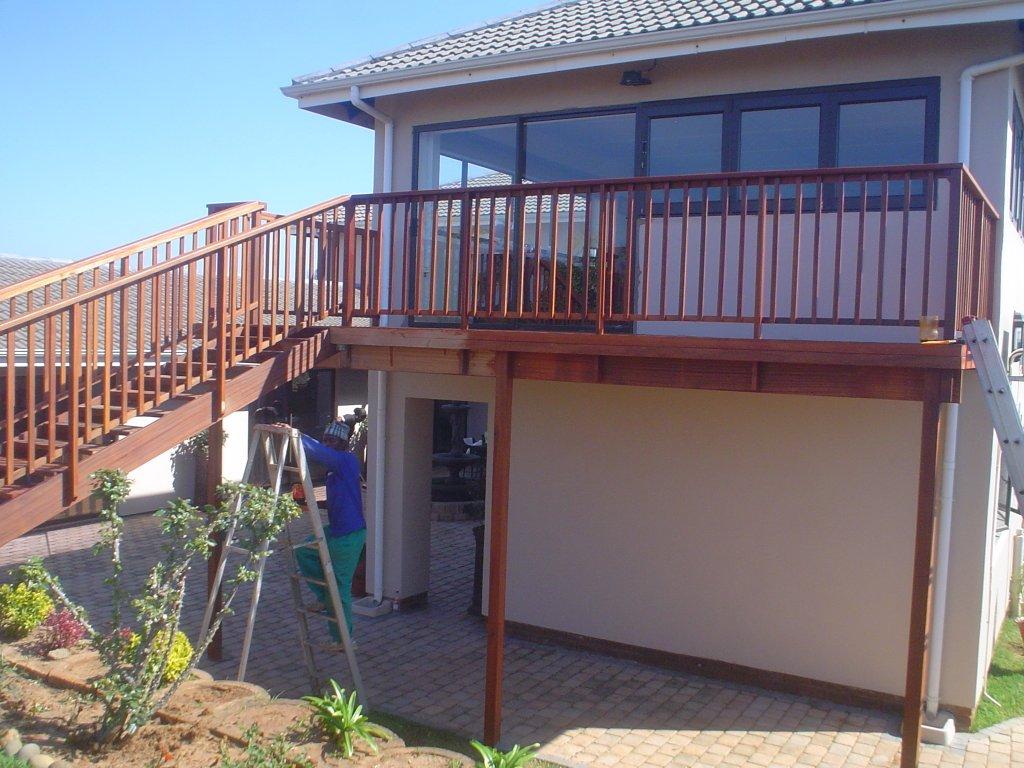
This was one of my first wooden decks in Durban that I undertook. The Guest House we built it for had just opened up the side of the dining room on the first floor with sliding doors and now wanted to extend the area by adding a deck of about 14m². It is always important to first break through the wall and install the sliding doors and then build the wooden deck. This way the deck builder can get the surface of the deck flush with the entrance to the room. I have built one deck before where the client insisted that I build the deck first and then they were going to break through. Although we did our best to measure where the inside floor was, there may still have been a small step up or down once they had broken through. On this build though it was done the right way around and the deck was flush with the floor inside the dining room.

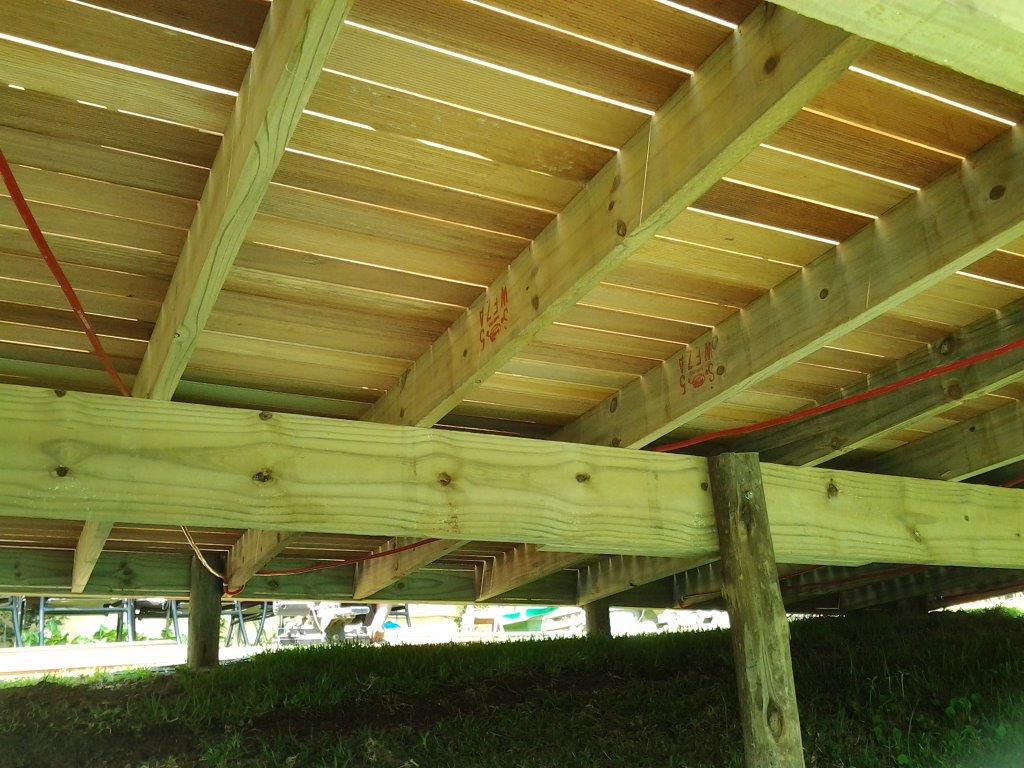
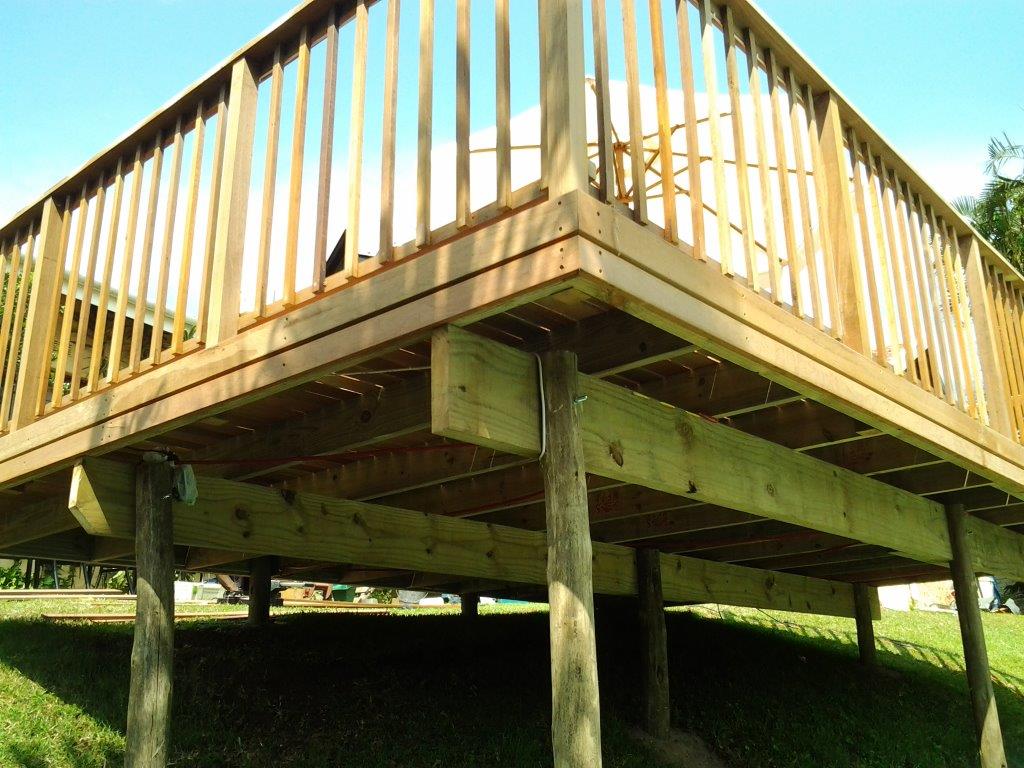
The deck was a normal cleat, beam and joist system where we secured a cleat to the wall with sleeve anchors, installed vertical posts and attached a beam to that and then ran joists between the cleat and beam with a small canter lever. We had to try to set our posts as far out as possible so as to create enough space under the deck that could be used.
Wooden deck builder Durban

Click to enlarge

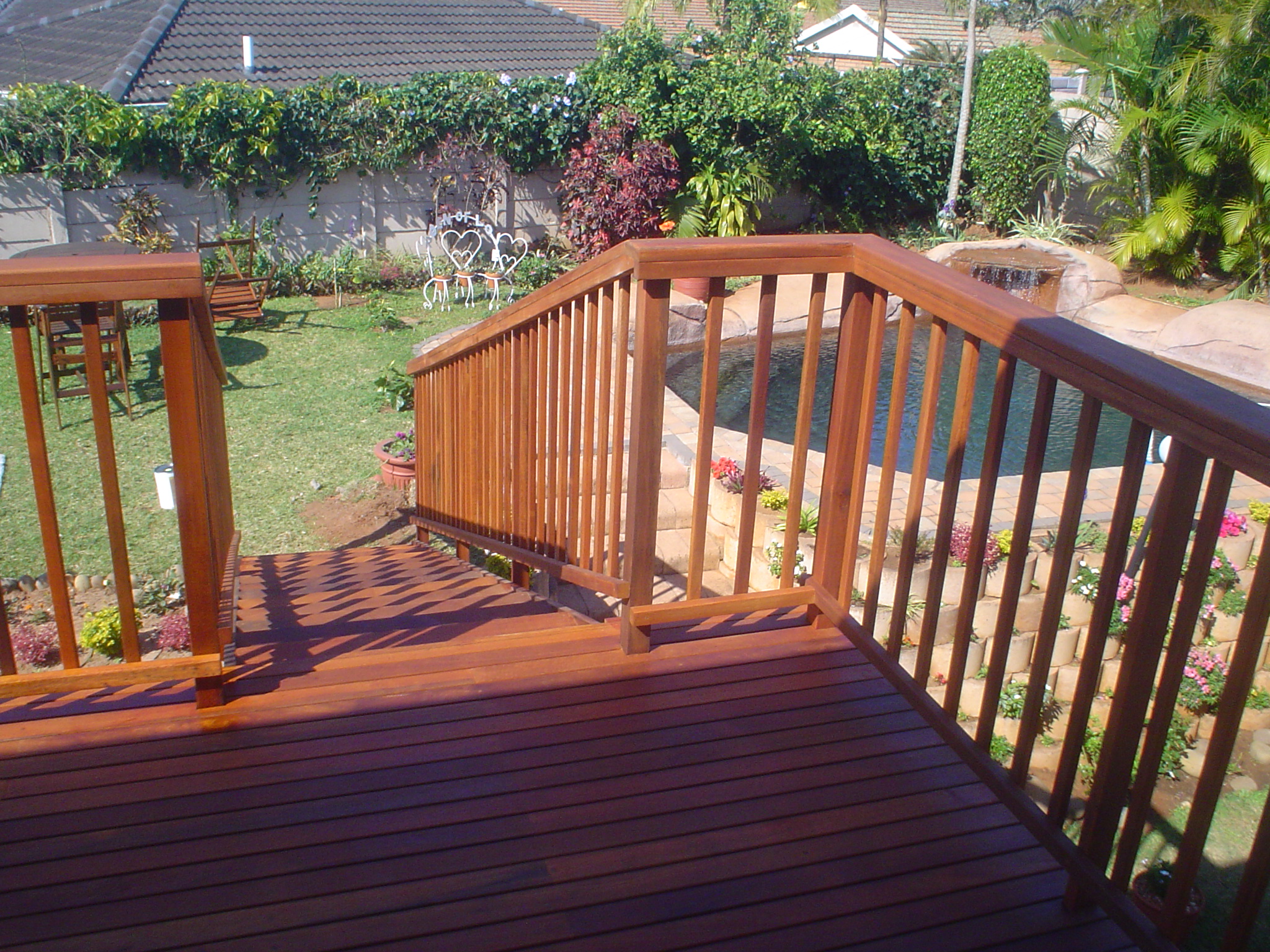
The balustrade was a normal picket style one. These are the safest and really the only one that is completely compliant with building regulations. Building regulations state that there should be no opening that is larger than 100mm. With all other balustrades there are some spaces that become greater than 100mm. Besides being non-compliant they are not that safe especially for small children. With the pickets running in a vertical direction it is more difficult for children, or adults, to climb up on the balustrade and fall over. The other designs offer more horizontal pieces that people can use to climb up on.

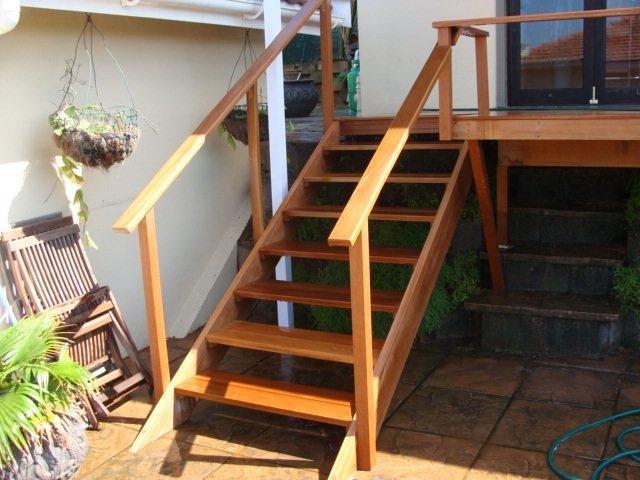
The stairs we built here joined the deck to the pool area which was about half a floor up from ground level. There were separate concrete stairs running from ground level to the pool area but the new wooden stairs we built could now be used to access the pool area, and the rest of the outside area, from the dining room. Because there was no way of supporting the stringer mid-way we had to ensure that we had the correct width of stringer so that it would not break over time. Most of the strength in a piece of wood is in the width and not the thickness as the downward force is exerted on the width.
Wooden deck builder Durban

Click to enlarge

We finished up by filling our holes with epoxy and sawdust and sealing with a Timberlife Satin Wood Base 28 Mahogany tint. In our decks we counter sink the screws which leave a small screw hole that water can get into. It is important to fill these so that no water can get in. If water does get in it can travel down the end grain and will cause the wood to rot much quicker at the point of the screw hole. Water travels through wood along the end grain rather than being absorbed from the face or side grain. Wood filler is also not suitable as it will pop over time due to the weather. Clear epoxy works well mixed with a little saw dust to match the colour. Once it’s dry, use a grinder with a sanding pad to flat it and then sand the grind marks off before finishing.

For a free no obligation quote on your deck or for some advice, please contact us on 082 496 5444 or complete the form below.

← Back

Thank you for your response. ✨

Wooden Balustrade Built in Everton – May 2013

Wooden balustrade

Click to enlarge

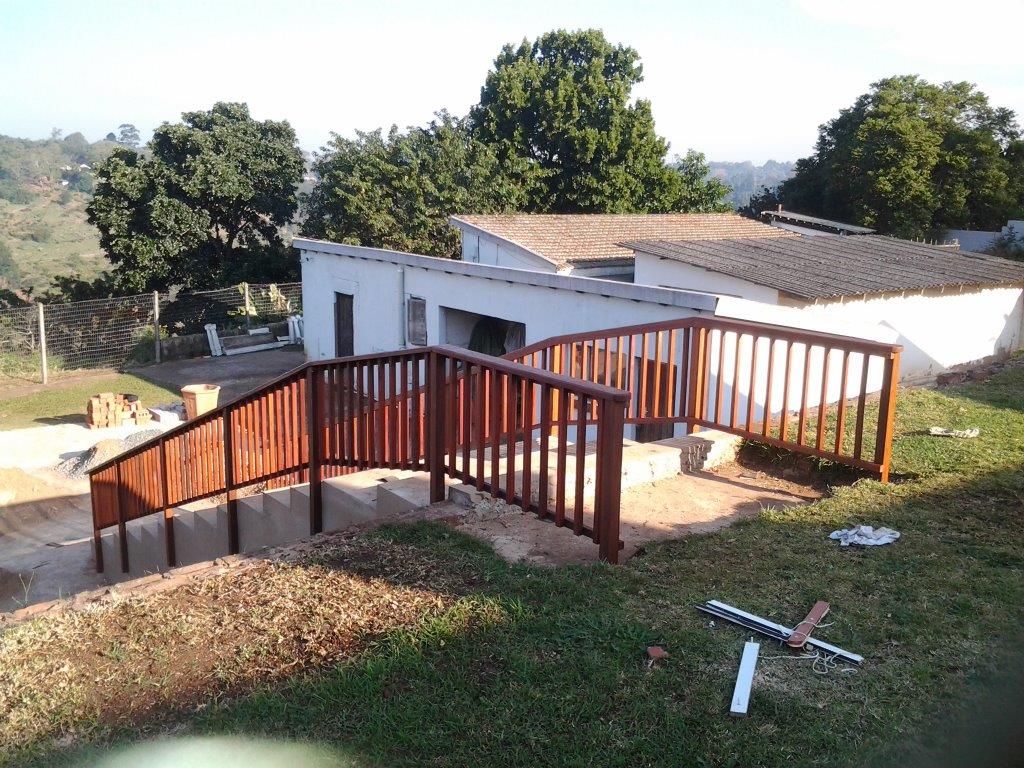
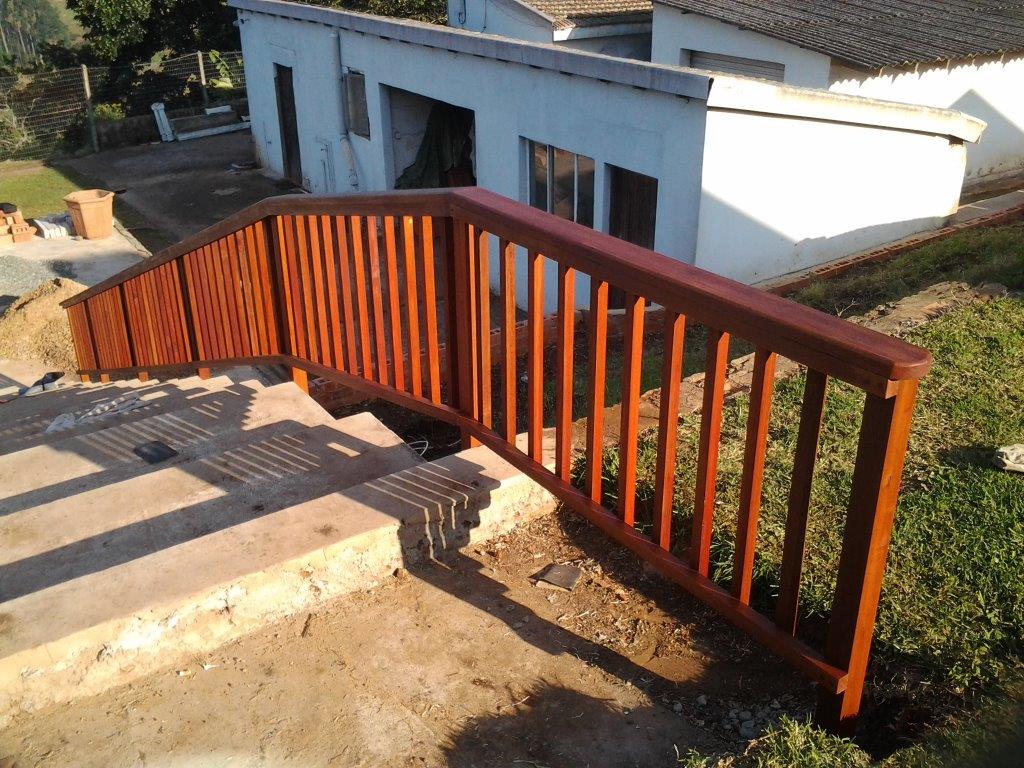
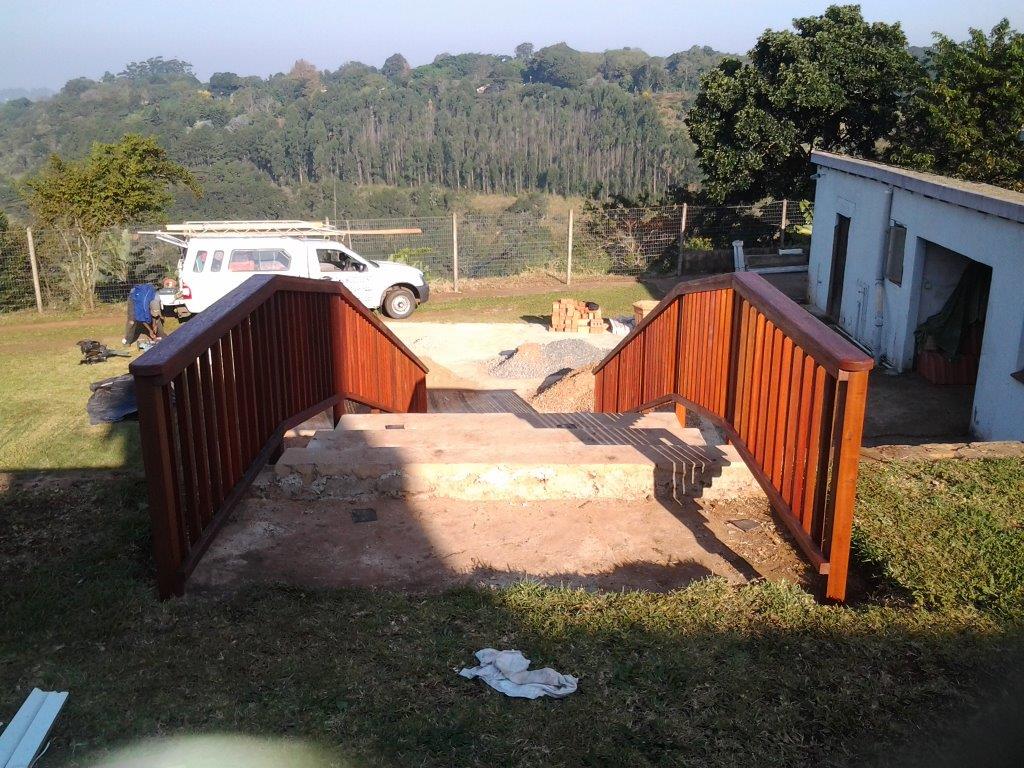
This wooden balustrade we built in Everton Kloof, Durban was for an established client of ours that we have done various amounts of work for in the past. She had had some stairs built in brick and concrete down the bank to access the lower level of her property. We had to wait a few weeks in order for the concrete to cure properly before we drilled into the side of it. It is always a pleasure installing a wooden balustrade onto a concrete substrate as opposed to a brick or block substrate. With concrete your holes can be drilled easily and the sleeve anchors used to secure the posts to the side of the stairs take nicely and bind properly. When drilling into bricks, or even worse blocks, the cavity that exists in the brick or block almost always creates a problem in that the sleeve anchor has nothing to set itself against and ends up turning on itself and not binding properly. It is most frustrating and sometimes results in drilling new holes to find a solid substrate or even going the chemical anchor route. If one is drilling into blocks with large cavities, it is sometimes better to go the chemical anchor route from the beginning.

Wooden balustrade

Click to enlarge

Chemical anchors come with sleeves that are inserted into the holes first and then the two-part chemical is squeezed into that and then a thread bar is inserted. The chemicals dry very quickly, in a few minutes or less, and the thread bar is then fixed securely in the wall. A post can now be pre drilled and inserted over the thread bar and washers and nuts fastened onto that. It is a much stronger bond than sleeve anchors, albeit more expensive. Currently chemical anchors can cost about R300-00 per tube, the size of a tube of silicone, and the sleeves are about R15-00 each.

This wooden balustrade needed to have a bend in it that can be seen from the pictures alongside as the top tread was deeper than the rest of the treads. There was a small landing at the top where the balustrade needed to be level with ground. This was the normal vertical picket style balustrade and we sealed it using our favourite Timberlife Satin Wood Base 28 in a mahogany tint. Using this product will result in lower maintenance costs going forward as no sanding will be required when re-sealing. You simply clean and re-seal.

Wooden balustrade

Click to enlarge

Balustrades are not the easiest thing to install. One needs to be very careful that both rails are parallel to each other and that they are parallel to the tips of the risers. Of course the tips of each riser will not necessarily be in a straight line. What we do is run a straight edge or fish line across all the risers to get an average line that we work from. The lower rail is then set parallel to this line and the top rail and hence the capping is set to this, again parallel. One also needs to be careful when taking corners. Often the distance between the capping and the steps can vary, especially if there is a landing involved. Where a balustrade arrives at a landing one needs to step the balustrade so that the capping will remain at the 1m mark above ground.

For a free no obligation quote on your wooden balustrades or other timber construction, please complete the form below and I will contact you or you can contact us on 082 496 5444.

← Back

Thank you for your response. ✨


Balau Screening in Cotswold Downs – June 2013

Balau or timber screening

Click to enlarge

We were called upon to quote on some balau screening in the Hillcrest, Durban area at a new development called Cotswold Downs.

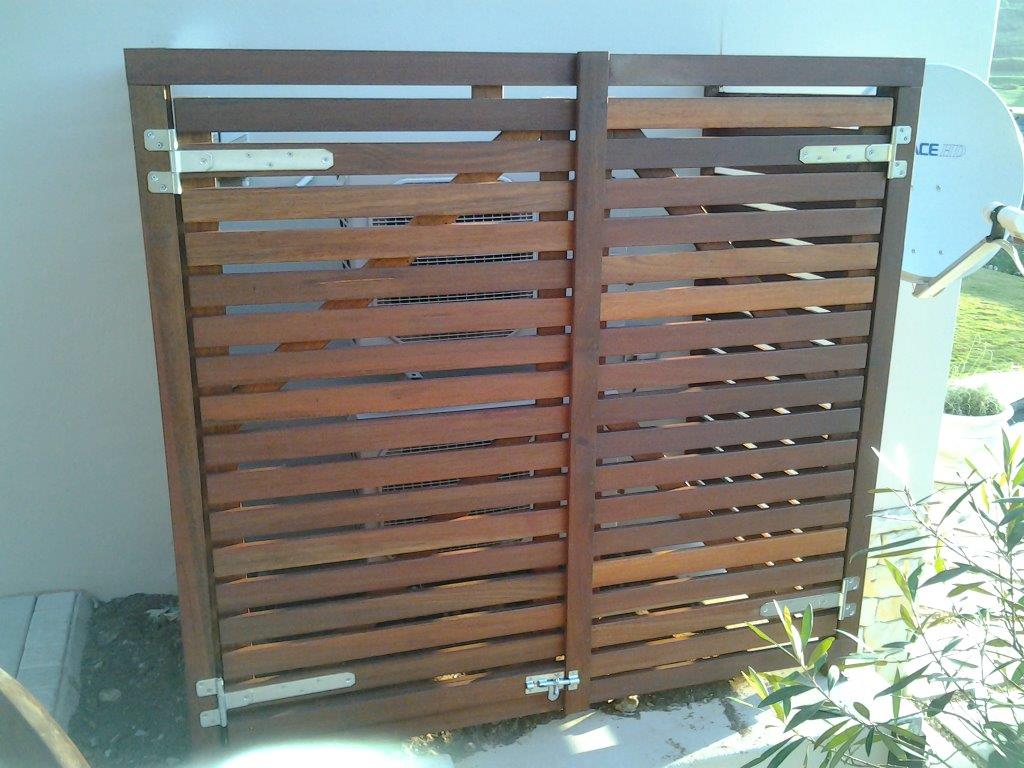
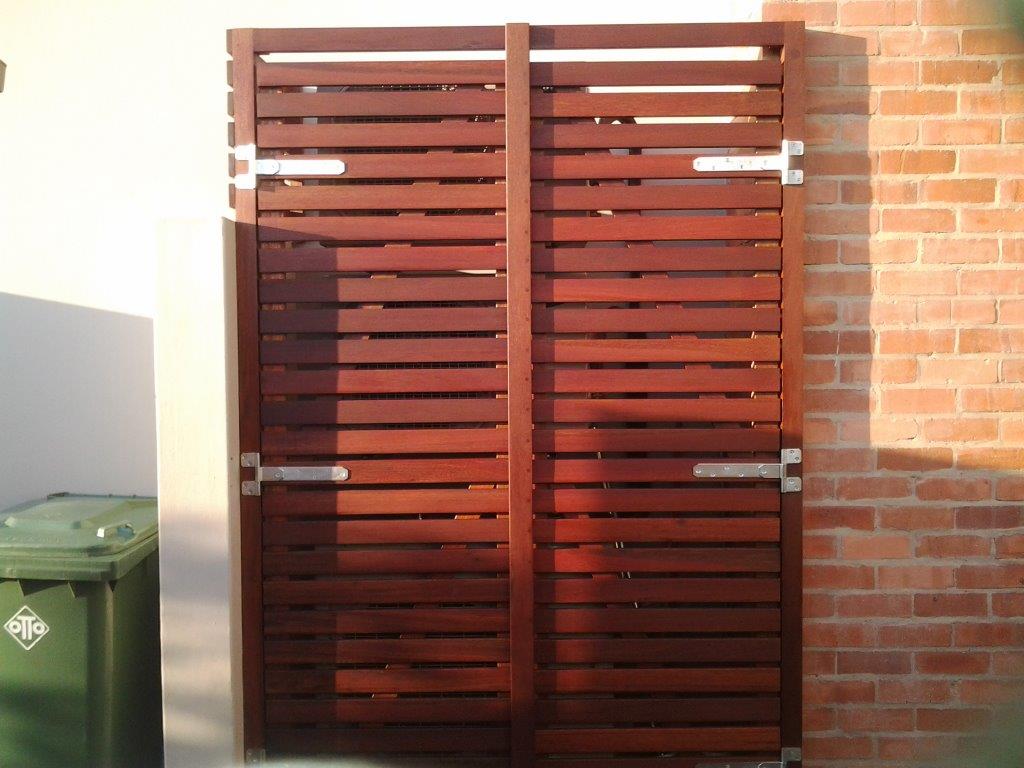
There were various aircons, heat pumps and gas bottles that needed to be clad or screened so as to conceal them.

We used balau 30 x 40 struts or cleats attached to the walls. In some instances we used hiltis as there was not much load on the cleat.   In other instances we used 10mm x 100mm sleeve anchors.  We built a frame using the 30 x 40 balau and then clad it using a standard deck board of 19 x 68 with a 19mm space between. The 19mm space is standard in screening or cladding as it provides enough coverage without being too tight in its appearance. A gap of 5mm, which is standard in building a deck, would be far too close and would give it an odd appearance.

Most of the structures we built here were simple enough with either two or three sides and a removable lid so that access could be gained to change gas bottles or service aircons. Some of them had to have fronts

Balau or timber screening

Click to enlarge

that were removable as well as tops so that access could be gained from above or from the front. Some were removable lids and fronts and some were hinged. One needs to be careful which hinges you chose as they need to be strong enough and weather resistant. Solid brass hinges are expensive and with the weight of the balau can be problematic. Solid stainless hinges with bearings are best if the weight of the door is quite large. On the smaller door we used aluminium hinges as the door wasn’t too heavy and the aluminium will stand up the weather.

There were two doors we made which measured 2.5m high and 750mm wide each. That size door in balau is quite heavy and we used three galvanised strap hinges on either side. The only problem with strap hinges is that they need to be placed on the side of the door that opens, so they were visible on the outside. Some may say it adds character to the door, but sometimes you don’t want to see them. Being galvanised steel they are difficult to paint but can be painted with a Hammerite product specially designed for galvanised steel.  The only other alternative to these were to use the galvanised strap hinges that have a bent arm and slot into another piece attached to the frame. However these would have resulted in a large gap between the frame and the door or gate. Normal butt hinges wouldn’t have been strong enough to hold the door due to the sheer weight of them in balau.

Balau or timber screening

Click to enlarge

When building this type of structure it is often easier to try to build the whole thing in situ. So a frame goes up first, then you set the braces at the back to the correct length and then start adding deckboards, leaving one side long which can be cut afterwards.  If it is quite large then the door needs to be built on the ground, leaving the ends long and hung, then cut in situ.

They are unlike a normal door in that they can’t be successfully planned to fit the frame because the end grain is on the side.

We finished them off by filling holes with epoxy, sanding flat and sealing with Timberlife Satin Wood Base 28 in a mahogany tint.

For a free no obligation quote or advice on your decking or screening requirements please complete the form below and I will contact you, or you can call us on 082 496 5444.

← Back

Thank you for your response. ✨

Jacuzzi Cladding – Umhlanga, Durban

Jacuzzi Cladding Umhlanga, Durban

Click to enlarge

Jacuzzi cladding is a nice job to get hold of because it allows one to use up a lot of off cuts that would otherwise be useless in building say, a 20 square metre deck, as most of them are less than 1m in length. A lot of wood is wasted when erecting a wooden deck because one will order a 3.3m piece of timber and only 3m or 2.9 will be required. Or the lengths required are not available from the supplier so a longer piece needs to be bought. Cladding Jacuzzis allows one to use these off cuts in the substructure and thereby recover some of the cost of the waste. The timber is still new and is not compromised and would need to be cut to that length anyway (so sorry no discounts because of this).

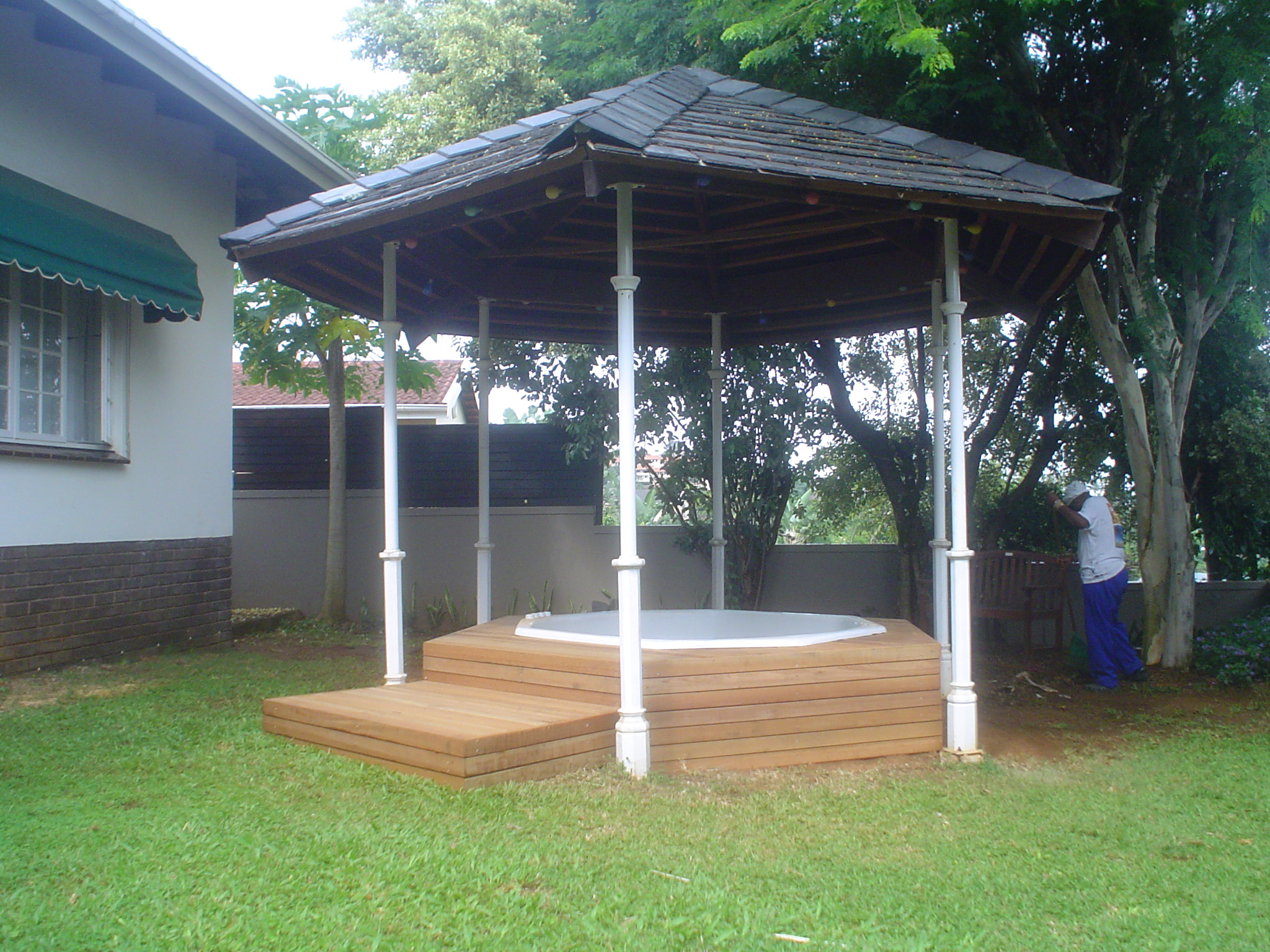
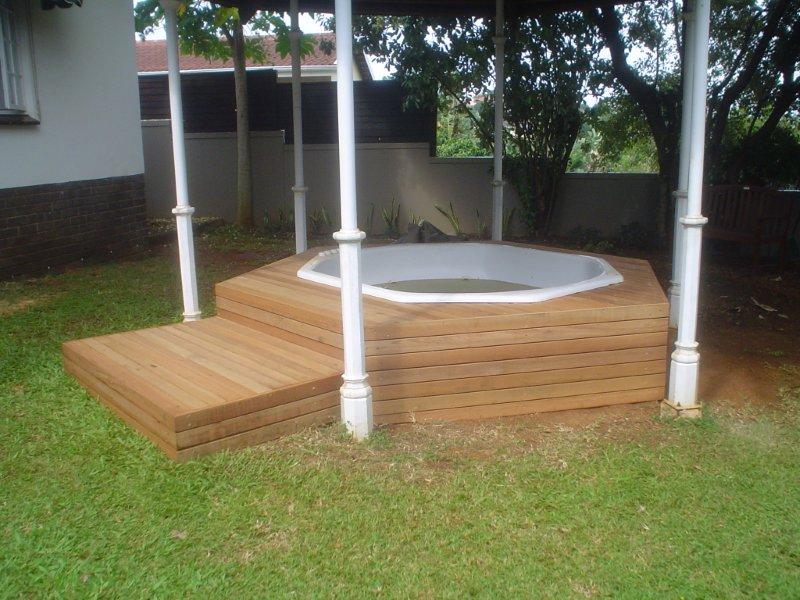
This Jacuzzi cladding was fairly simple in that there was an existing structure there that had deteriorated and was therefore removed and replaced with exactly the same shape structure. So there was no thinking involved really, we simply made sure that the existing structure was correct in its dimensions and then we replicated what was there.

When constructing these types of decks or cladding structures it is best to try to keep the deckboards running in the same direction. To make the deck boards all run parallel or perpendicular to the pool or Jacuzzi would be very tricky and may result in errors. Having said that we are busy with a wooden deck now in Westville where we have kept the deckboards parallel to the pool on all sides for various reasons. I will update you once that is finished, with pics.

Jacuzzi Cladding Umhlanga, Durban

Click to enlarge

The structure of this cladding went on well and we then clad it with normal standard deckboards. We created a 1m² step or landing so that once people had finished in the Jacuzzi they could dry off on this landing without having to try to balance on the edge. It provided a nice platform that remains relatively dry. The shelf or step on the side of the Jacuzzi provided a nice ledge to climb in and out of the Jacuzzi with and to place drinks or snacks on while relaxing.

All screw holes were plugged with a mixture of clear epoxy and saw dust (to match the colour as closely as possible) and then sanded flat. It was sealed using Timberlife Satin Wood Base 28, an outdoor wood sealer suitable for woods of low porosity. Maintenance is therefore kept to a minimum as this product penetrates the timber and does not dry on the top as do most shop bought sealers. The timber can be left unsealed but it will turn grey and any sealing thereafter needs to be done carefully by bleaching the timber first to get it back to its natural colour.

I haven’t done many Jacuzzi cladding jobs, but as mentioned above it is a useful way to get rid of off cuts that would otherwise be useless in a larger wooden deck. Our other use for off cuts is shower duckboards and pot plant holders, for the much smaller pieces. They keep the pot plants off the deck which prevents that piece of the deck being exposed to excessive or continual wet. The duckboards are useful for getting in and out of the shower. We sell those at the cost of timber in an effort to recover a bit on the waste.

For a free quote or advice on your wooden deck or Jacuzzi cladding please complete the form below and we will contact you.  Or you can call us on 082 496 5444.

← Back

Thank you for your response. ✨

Wooden Sundeck, Toti, Durban

Wooden Sundeck Installer Durban

Click to enlarge

We built this wooden sundeck in Toti using CCA Pine, for the first time, as our substructure and decked it using balau deckboards. For a long time I have been using only balau as a substructure. But after some careful investigation I have accepted that a CCA treated pine substructure is as good if not better than a balau one.

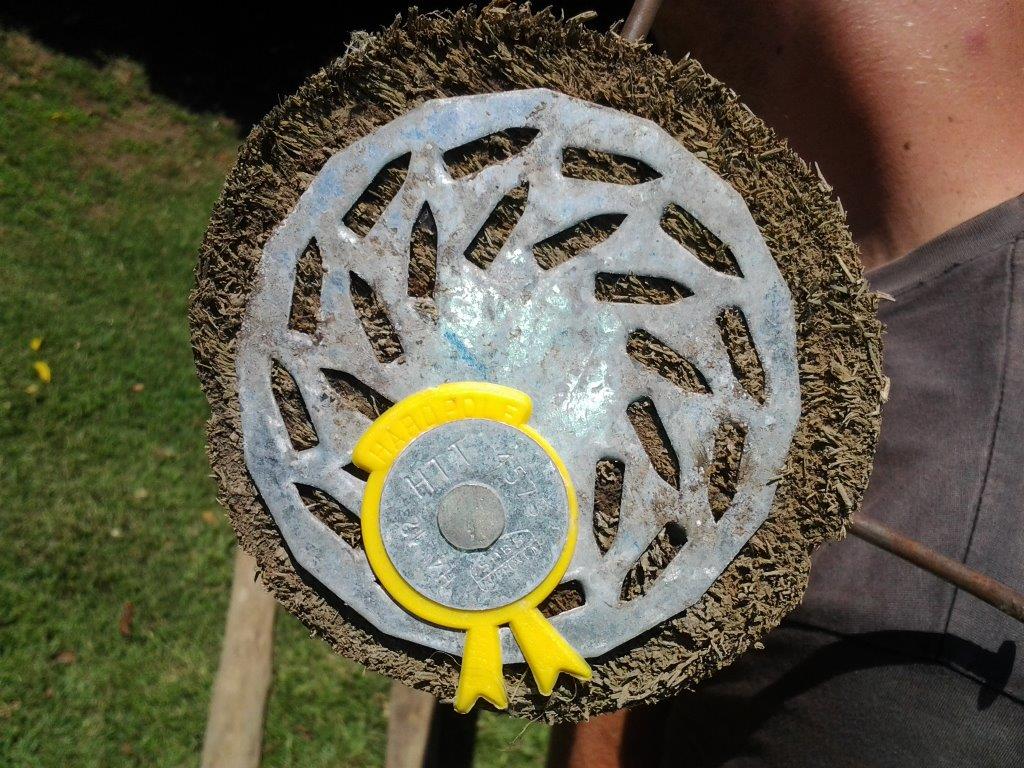
The manufacturers of the solution that is used to pressure treat the timber guarantee their product for between 30 to 50 years depending on which manufacturer you use. Provided the company doing the pressure treatment treats it correctly and provided the correct Hazard Level (H level) is used in the correct application, the timber will be guaranteed against rot and insect infestation by the manufacturer of the solution. I will write another more detailed article on CCA pressure treatments, but for the purpose of this article you will need to know what it broadly means.

Wooden Sundeck Installer Durban

Click to enlarge

H2 CCA Treated pine is good for roof trusses where it is not exposed to the elements such as rain. H3 treated is good for outdoors such as decks and H4 is good for in the ground or in contact with wet soil. H5 is good for in salty water and is normally a combination of CCA and creosote treatment. H2 is commonly sold off the shelf at most timber yards. H3 and H4 is more specialised so one needs to find a supplier who is regularly treating to H3 or H4. Under no circumstances should H2 be used as a substitute. It will rot within a few years. Simple. Do not use it in decks, keep it for the roof.

Wooden Sundeck Installer Durban

Click to enlarge

In order to activate a guarantee against the manufacturer one would need to take photos of the deck going up ensuring that the correct H level is used, an audit process would need to be completed on the company treating the timber and the build would probably need to be registered with the manufacturer and possibly inspections conducted during the build. So although it is possible to activate a guarantee, it is not really practical as the substructure will go up in 2 days and the deck will be done in 5 days. However, if the manufacturer is willing to offer this sort of guarantee, then we can safely assume that the timber we are using will hold up to its promise. In a nutshell, H3 or H4 treated CCA Pine is suitable for a substructure for a deck and may very well outlast a balau substructure. I would not be too keen to use it as deckboards for two reasons. Although it won’t rot or get eaten by ants, it will expand and contract a lot more than balau which will result in checking, cracking, warping, bowing etc. over time. The second reason is that because it is half as dense, one needs to use a 32mm thick deckboard as opposed to a 19mm deckboard in balau. So twice as much timber is used and the cost is actually slightly more in pine per square metre than balau. So why not use balau in the surface? It is much better looking and much more stable (i.e. it remains flat for many more years).

Wooden Sundeck Installer Durban

Click to enlarge

The cost saving in using CCA pine vs. balau in the substructure is great and this allows me to keep my prices low whilst still providing a quality product. The CCA Pine will last as long if not longer than the balau substructure if the correct H grade of CCA pine is used.

All areas that have pine exposed are clad with deckboards so that the pine is not visible. Balustrades remain full balau.

For a no obligation quote on wooden decks, balustrades, pergolas and any other outdoor timber construction, please complete the form below and I will get back to you.  Or you can call us on 082 496 5444.

← Back

Thank you for your response. ✨

Sundeck Installed in Durban Bluff

Wooden sundecks Durban

Click to enlarge

This sundeck I installed in Durban I actually subbed out because I had too many new builds on the go at the same time to be able to do it quickly enough. I use a very good subbie who charges reasonable rates, has his own transport and tools and skilled labour. He has actually been building sundecks in Durban for a lot longer than me and I can therefore leave him to his own devices and let him get on with the job. We follow him to fill sand and seal the deck after he has constructed it.

This deck was built off the bar area and canter levered over the retaining wall above the pool. It went around the corner to a braai area and had a set of stairs for access. An awning was first installed by an awning company and we then decked around the posts of this awning.

It was installed flush with the entrance to the bar which only allowed us about 150mm between the top of the deck and the existing concrete slab on which we were installing it. As a result there was not enough space for any under beams and we employed a slightly different method to a deck on the first floor.

Wooden decks Durban

Click to enlarge

The substructure is first built on the ground and is then attached to the wall using sleeve anchors. It results in the entire substructure being flat and in the same plane. This as opposed to a beam that supports a joist sitting on top of it. So to start with a 30 x 102 is cut to length to fit the length of the building to which it will be attached. Joists, at 550 centres, are then T’ed off this and secured from behind using two kalgard screws. A last fascia beam is secured in the same way resulting in a grid type substructure which is then lifted into place, chocked if need be, and secured to the wall using sleeve anchors. The front edge is then supported by short legs which rested directly onto the concrete. There was no need to dig through the concrete as it was solid enough to support the weight of the deck. On the front edge where we have canter levered it we had to drop longer posts down onto the retaining wall and concrete these into the retaining blocks.

The balustrade was an unconventional balustrade as can be seen from the pic. Because the client didn’t want to obstruct his view when in a seated position, we reduced the height of the balustrade to 500mm instead of the normal 1m. We also left the balustrade open and no pickets or cross pieces were installed resulting in a very simple straight lined balustrade. It worked well and looked quite neat afterwards.

Stairs were installed at 1m wide with the same style balustrade or hand rail running up each side.
This deck was intentionally left unsealed so that it would weather. When balau weathers it turns a very attractive grey colour. It’s a personal preference I suppose. Some like it, some don’t. It looks more rustic without looking too tatty. It must be noted though that if one decides to seal it afterwards, then it must be bleached and prepared properly otherwise it will turn very dark, almost black. The greying is actually black algae that grows on the surface of the wood and although it won’t necessarily result in rot, needs to be bleached and removed with a high pressure cleaner before sealing. This is also applicable to decks that have been sealed and are now to be re-sealed and have started greying.

For a free no obligation quote to construct your sundeck please complete the form below and I will get in touch with you.  Or you can call us on 082 496 5444.

← Back

Thank you for your response. ✨

Timber Deck Installed in Queensburgh, Durban

Sundeck installer Durban

Click to enlarge

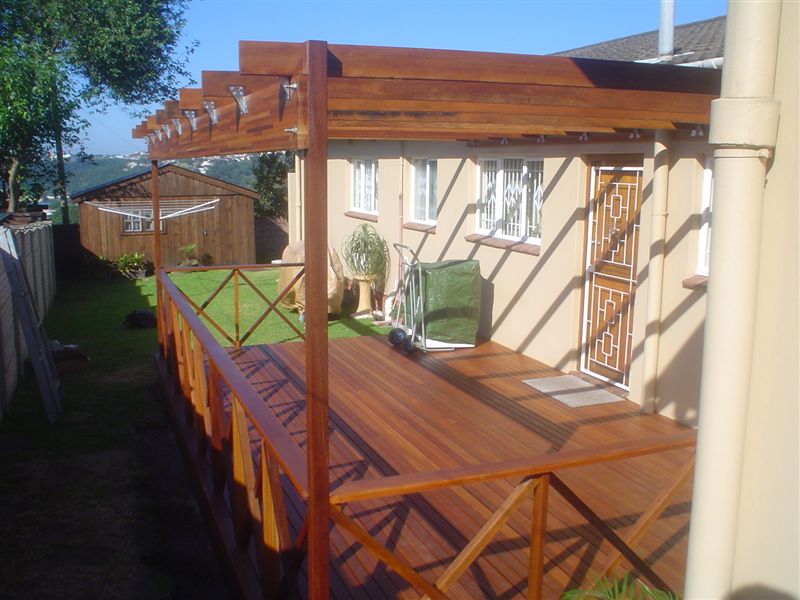
This was our second deck we installed in Durban and this time around we got the spec right and didn’t spend all our money on timber. The deck was pretty much on ground level but still required normal 30 x 102 joists as it was not supported by a concrete base. Should there have been a concrete slab on which to support it then we could have used smaller batons instead of joists. We still sued a cleat and beam system although later in my Sundeck installer career I learned the other method of a joist as the cleat attached to the wall with the joists Téd off that and a fascia beam on the front.

There was a fair amount of digging to get the garden to the correct level as the one side was quite a bit more elevated than the other.
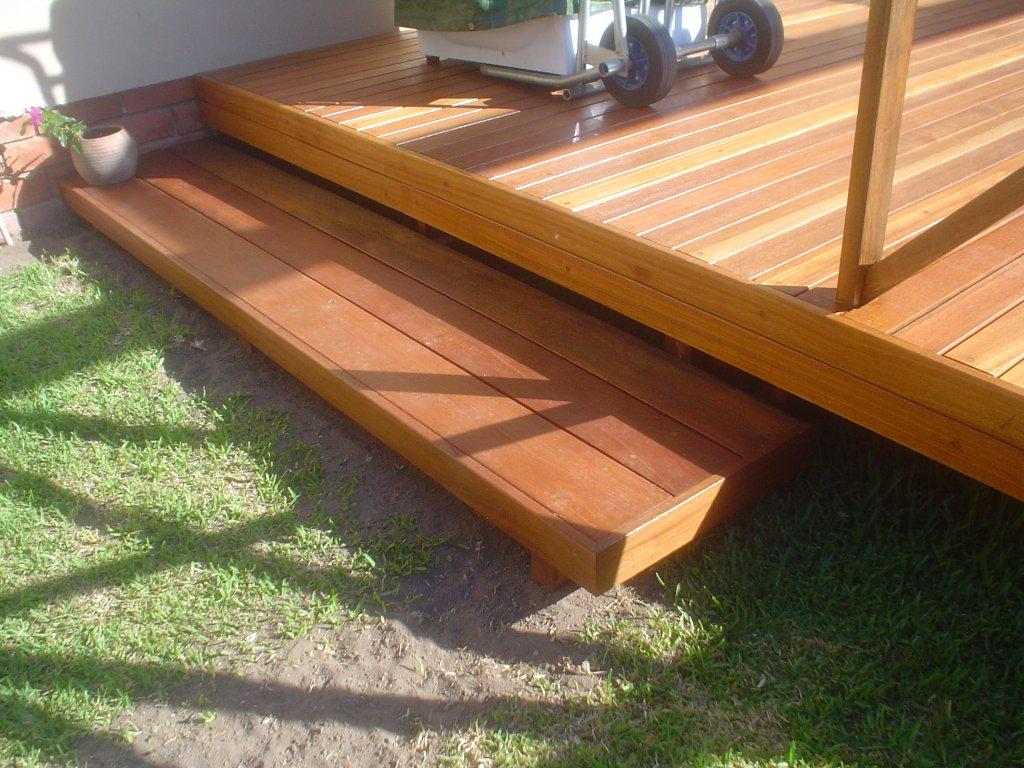
This deck had a floating step which was quite large, bigger than a normal tread. It worked very well in that it appears that the step is not attached to the deck at all and is large enough to step down comfortably on to it.

Sundecks builder Durban

Click to enlarge

Being our second deck we set everything out and started decking it. Half way through our deckboards we realised that the front beam was not straight. It bowed inwards and as the deck boards went down it became more and more noticeable. So all the deckboards came off, the beam was straightened and back they went. A costly mistake in time but a lesson learnt that will ensure that that mistake never happens again. A simple piece of fish line or builder’s line must be placed along the front edge of the beam when fastening the joists to ensure that it is straight. A false joist can be used here in the middle of the beam attached in the same direction as the joists will lie to hold it in place while the joists go down. The same rule applies for joists. When I joist is placed down it must also be square off the wall and the rest of the joists must be parallel to that one. Timber will always be bowed in one direction or another, some more than others. But they must be pulled straight before being attached. In the case of joists this will ensure that they screw line on the deckboards is straight and more appealing to the eye. Also it keeps the distance between joists exactly 550 between centres for the entire length of the joist. This is particularly important on joists that are placed on the end of the deck as the deckboards will be cut there and if not straight then the deckboards will either not be straight or they will form a lip where the joist bows inwards or outwards.

Sundecks Durban

Click to enlarge

The balustrade on this deck was pretty straight forward to. We notched the cross pieces so that they fitted snuggly together in the same plane rather than overlapping them. We built a pergola in balau above which eventually took a roof. The client however attended to the roof sheeting.