Wooden Stair Case Build Durban

Wooden stair builder

Click to enlarge

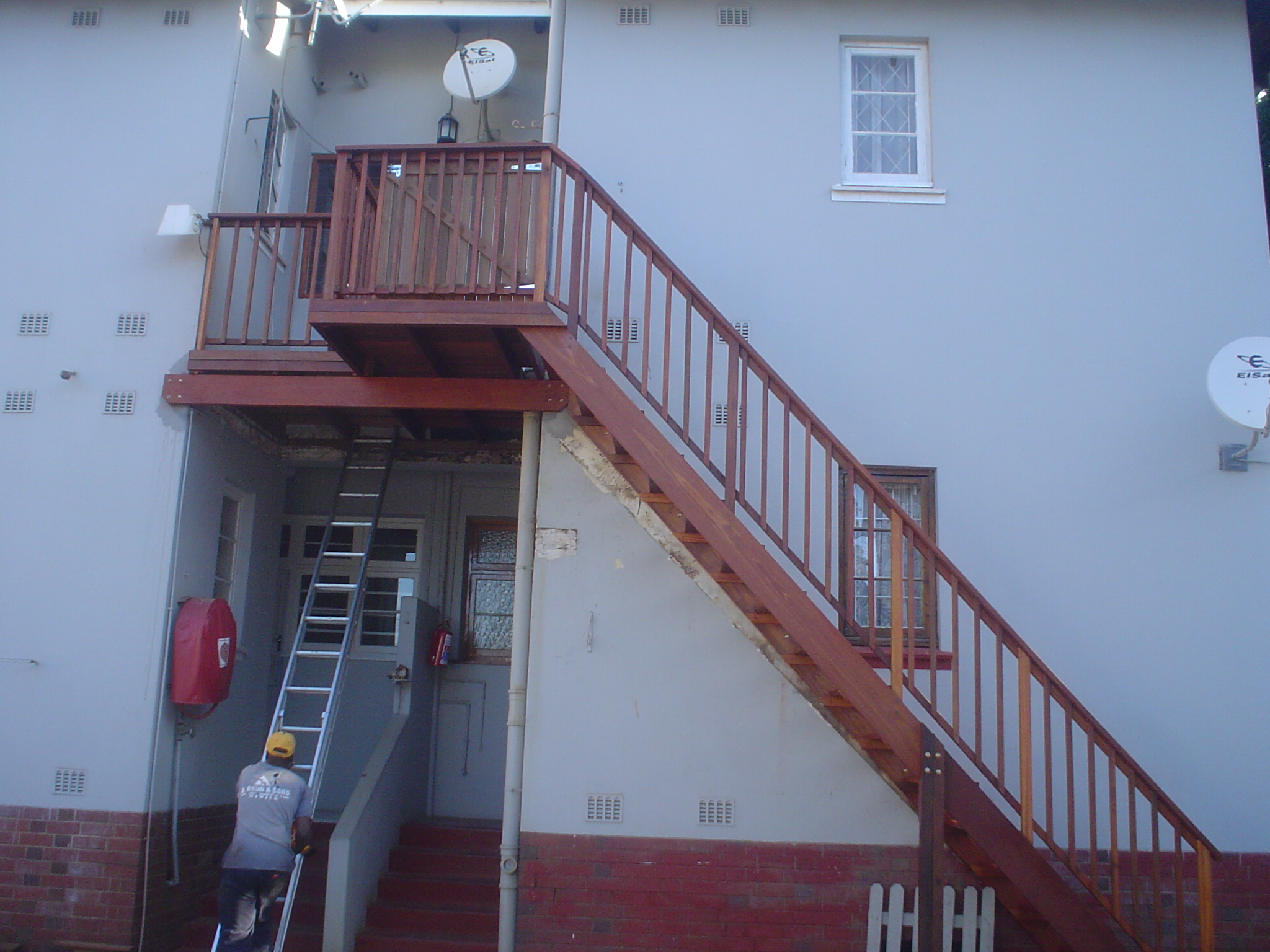
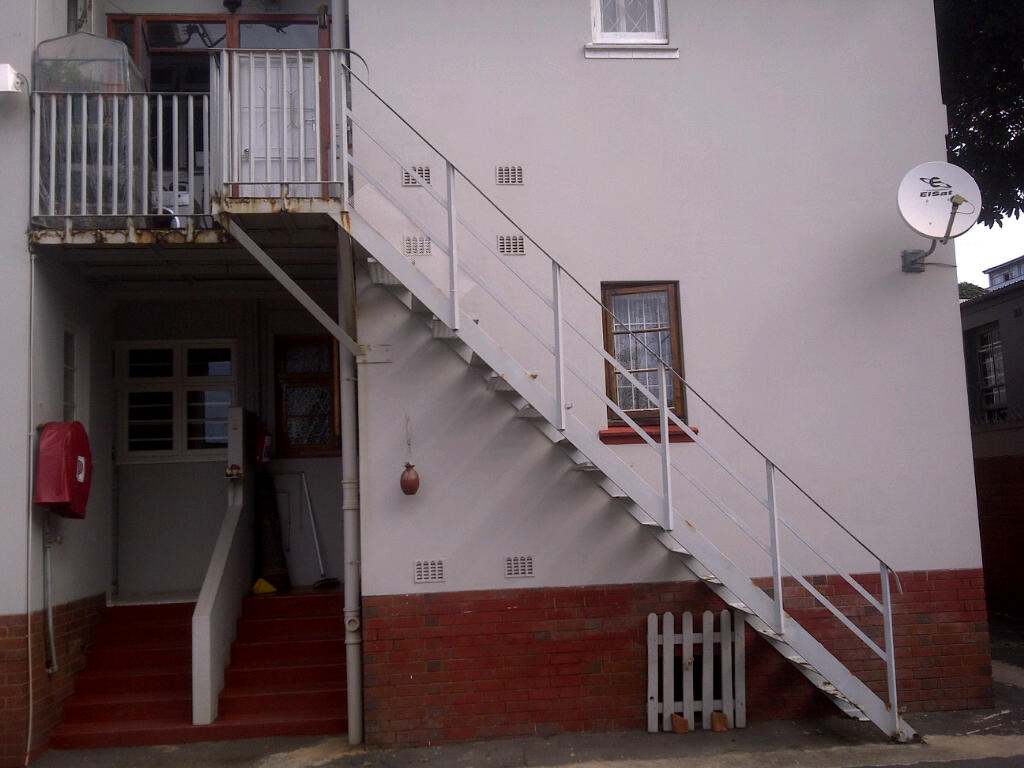
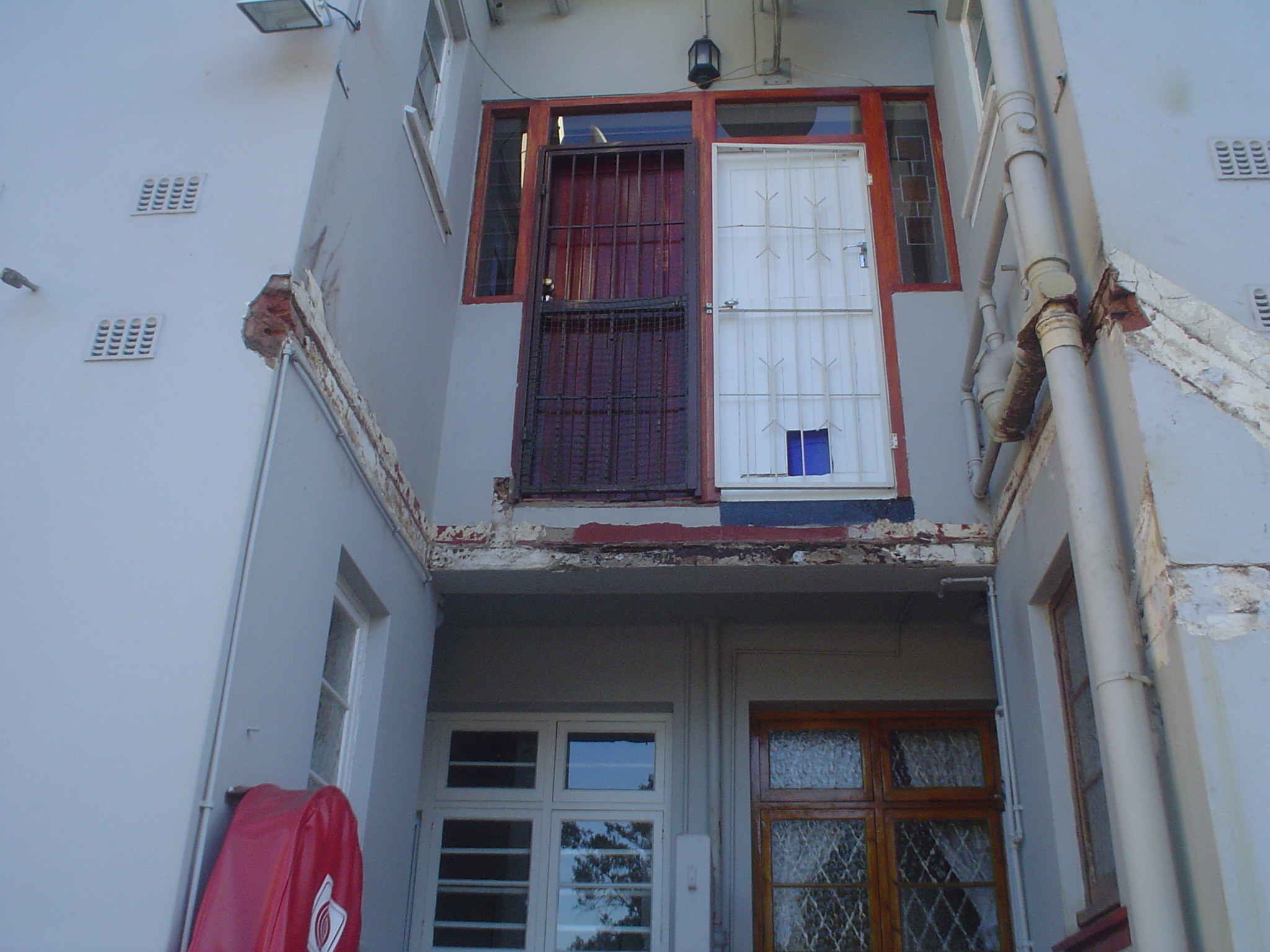
This wooden stair case build by The Wood Joint in Durban was a tricky one. The client was a committee member on the body corporate for a small block of flats in Durban. There were about 4 units in the block and the existing steel fire escape had rusted to a point where it was unsafe. So first we had to remove the steel structure. With a little help from my friends, we came in and chemical anchored stainless eyes into the wall on both sides above the steel platform you see in the pics. From there we rigged up some climbing equipment to be safe and started cutting sections out of the steel structure and lowering them slowly to the ground. We had to cut small sections as the steel was 10mm thick and we didn’t want to damage the walls, windows or doors on the way down. We managed to get most of it down in one day with a small piece remaining for day two. We battled slightly in getting the main support off as the sewage pipes had been installed after the steel so we had to cut the steel out around the pipes so as not to damage the pipes. In removing it we inadvertently damaged a corner of the wall as the rawl bolts there were quite large, rusted and pretty much part of the building by now. We patched that using structural grout which was hard and strong enough to support our main beam to.
Wooden stair builder

Click to enlarge

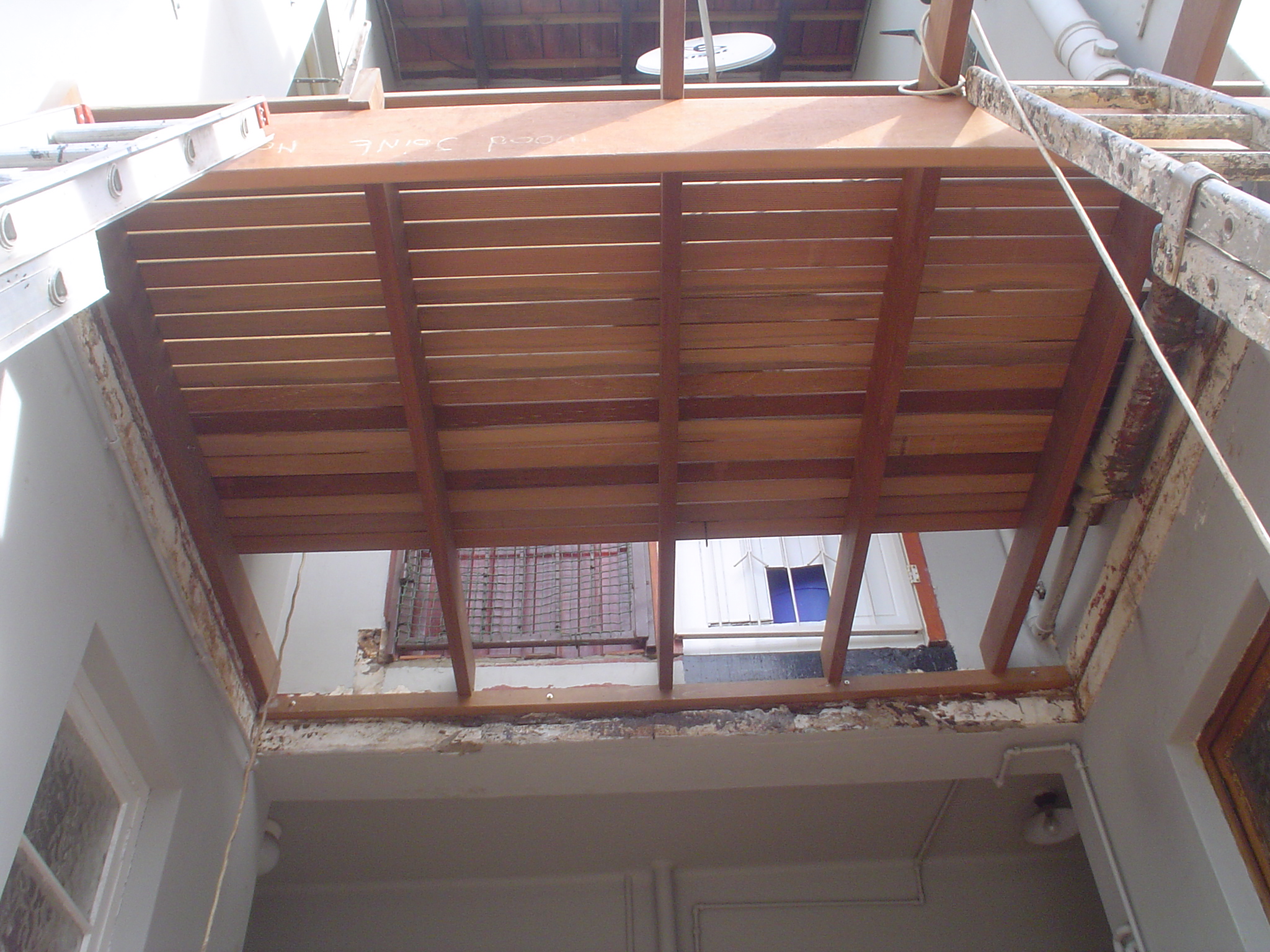
With the steel gone, we set out to build a wooden stair case and landing that could act as a fire escape. The small landing part was easier enough and we canter levered it so as to keep our posts out of the way below for parking. In these smaller blocks of flats in Durban space is very limited so posts need to be kept well out the way of parking space. Because we were canter levering it we needed to use 30 x 140 joists of balau rather than our normal 30 x 102 joists.

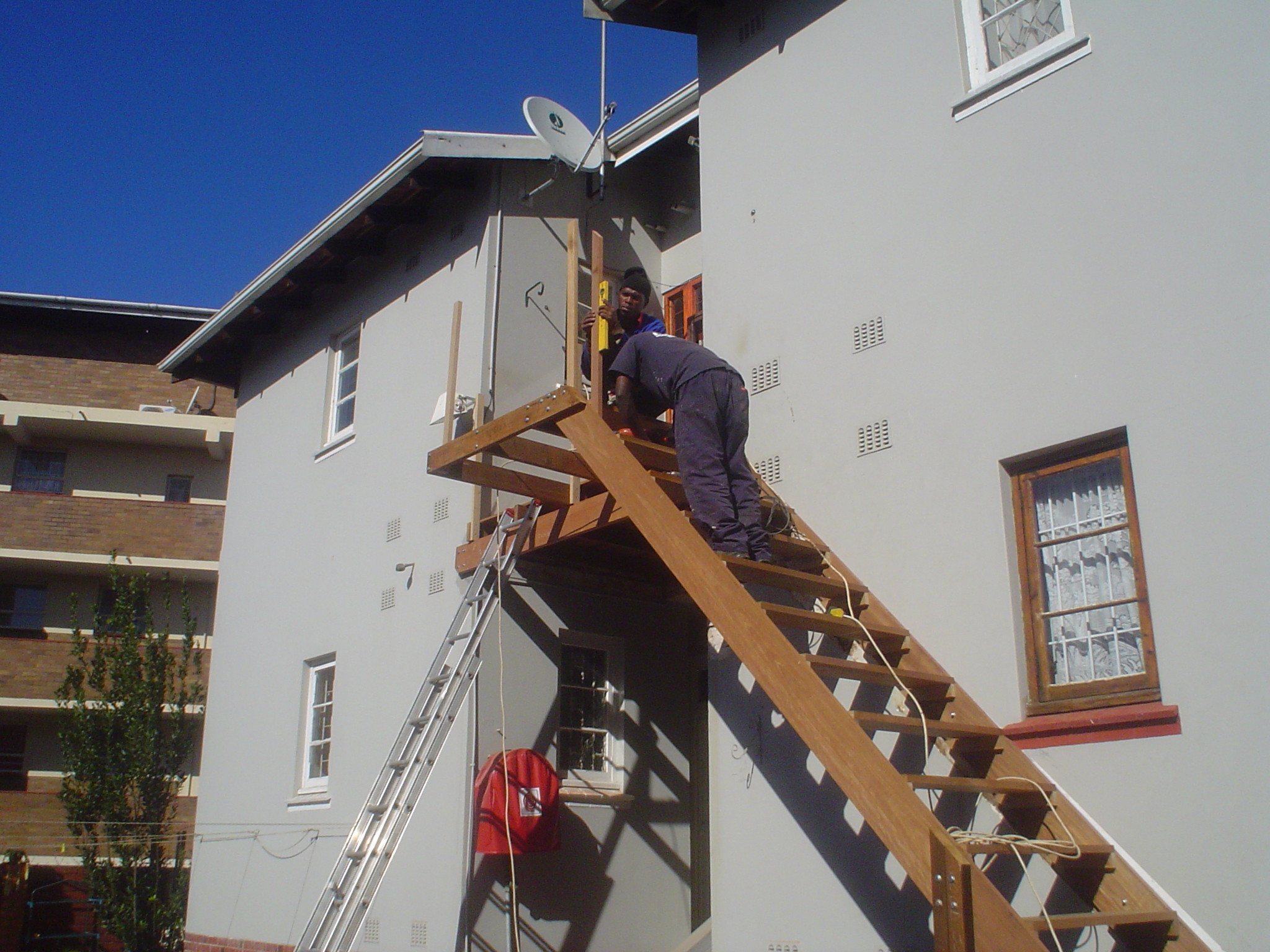
The stringers for the stairs were also tricky as we had to follow the original line of the stringers because there was a window beneath that we couldn’t cover and we could only protrude to the end of the wall without obstructing the driveway. This resulted in our stringers being placed at 45 degrees which resulted in our risers being of equal length to our runs or treads. It is not ideal as it makes the stairs very steep but we had no option due to space and height. We were a total of about 4m in the air to the landing.

The treads went on alright, the balustrade too and we had to join the stringer on the outside with two independent posts to ground to support it as the timber we could get wasn’t long enough to run the full length of the stringer.
Wooden stair builder

Click to enlarge

We went back there a year or two later as one of the treads had popped a screw. Sometimes the timber moves more than one wants it to and breaks the screw off. We do however put additional back up screws in each piece we secure so they are safe in the event that one screw does break.

For a free no obligations quote on wooden stairs or any other outdoor timber construction please complete the form below or you can call us on 082 496 5444.
Wooden stair builder

Click to enlarge

Wooden stair builder

Click to enlarge

Go back

Your message has been sent

Warning
Warning
Warning
Warning
Warning

Warning.

Timber Stairs Built Hawaan Forest Estate, Durban

Timber stairs Durban

Click to enlarge

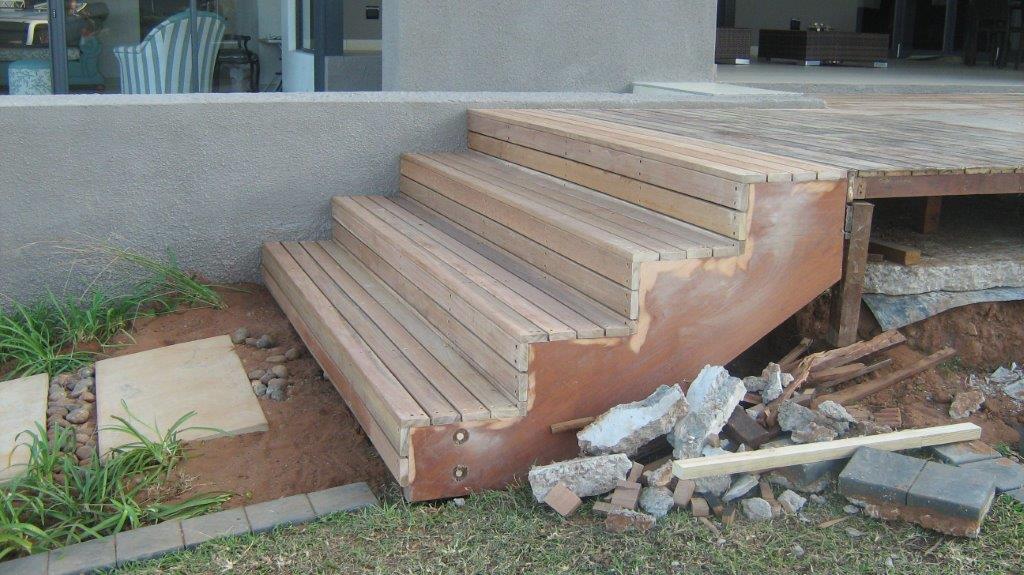
These timber stairs I built-in Durban were the first stairs I built. This was towards the beginning of my deck building career and I had no idea really what to do. I had been involved in carpentry for a fair while so I had an understanding of timber, how it behaves and how to construct and manufacture items, but I had no idea of what needed to be done to build stairs both effectively and affordably. I resorted to Google and surprisingly, or not, I found hundreds of videos on how to make stairs. Mostly American videos so a few adaptions to our local conditions and I had a good idea of what was required.

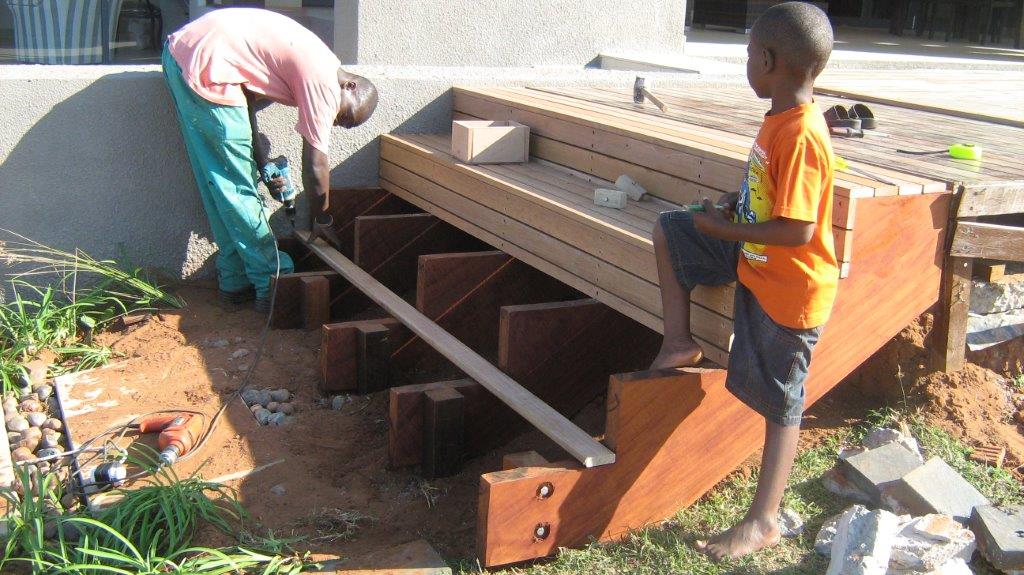
I used the more conventional, more expensive method of building stairs. I took three pieces of 50 x 220 stock and cut my treads and risers out of the timber (see the diagram attached). This is done by first calculating the riser and tread based on the height of the deck that you need to reach with the stairs. Although an optimal height of each riser is about 190mm and the tread about 280mm, it will vary depending on the vertical height so as to keep each riser and tread the same height and length.

Timber stairs Durban

Click to enlarge

Once these two measurements have been calculated, one uses a large steel square to draw the risers and treads on the stock. The square is simply placed on the stock and the two points are marked off on each end of the square resulting in a right angle where the tread meets the riser. The trick was cutting through the 50mm wood with a hand-held skill saw. My skill saw has a small blade so it kept jamming and burning the wood. In hindsight I would have used 40mm stock or even less as the strength of the timber exists in the width, not the thickness. So a 30 or 40 by 220 would have been much more affordable and much easier to work with. Nevertheless, we persevered and eventually had 3 lovely stringers cut and ready for installation.

From there it was a matter of placing the stringers in place with the tread level and securing them in place with posts concreted into the ground. The inner most stringer was secure directly to the wall using sleeve anchors and this became our starting point from which we set the others, level to that and to ground. With all our stringers in place we decked the surface using 19 x 68 deckboards. We added a bit of substructure to the sides to accept our cladding, clad it and sealed it using a Nova product. Nova produces some top quality timber preservatives, but be careful not to mix them up with the varnishes. Varnish is a no go on any deck as it will peel and flake as the sun breaks it down. To get it off afterwards is near impossible and varnishing over it again results in a blotchy effect. One can’t use anything other than varnish once it has been varnished so stay away from varnish or anything that dries on the surface, with the exception of water based sealers. An article on sealing decks can be found here.

You can find a large reference base on Wikipedia about stairs here.

For a free no obligation quote please complete the form below and we will contact you.  Or you can call us on 082 496 5444.

Go back

Your message has been sent

Warning
Warning
Warning
Warning
Warning

Warning.

Timber Stairs Built in Hillcrest – February 2013

Timber stairs Durban

Click to enlarge

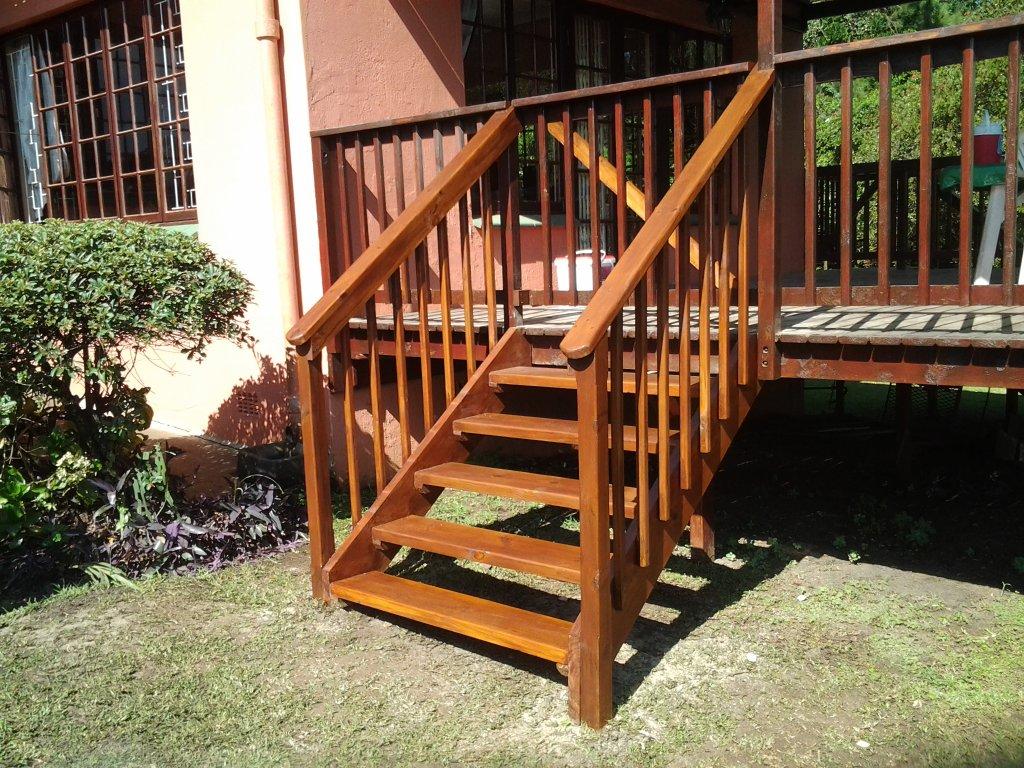
As a deck builder and timber stair builder in Durban I have had to learn how to build timber stairs the hard way, through trial and error (and a bit of Googling).  Timber stairs have always been a tricky one for me and I have battled to build them in the past. At first I Google’d ‘building timber’ stairs and found a few videos on the topic which explained it quite nicely. Most of the videos online though are American and they therefore explain it in inches. But after converting it the technique and calculation used to work out your runs and risers becomes quite clear.

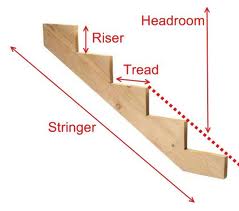
The riser is the vertical piece of the step and the run (or tread) is the horizontal piece. Building regulations in South Africa state that the riser can be no more than 200mm high and the tread or run can be no shorter than 250mm. Timber, either in pine or balau, will come standard at either 140mm wide or 220 wide. One should therefore use two pieces of 140 wide stock in order to get a tread of 280mm wide. I have seen stairs built using 220 wide stock which although is not completely according to building regulations can work if a gap is left between the front of the top tread and the back of the tread below that. The gap should be at least 30mm to get back to your minimum of a 250mm wide tread, although building regulations state that this gap should be no bigger than 20mm. Because the stairs are open, one can normally get away with this as your foot will be able to move past the back-end of the tread as you climb the stairs. Be sure to check with building regulations before designing your stairs to ensure you are compliant or that your contractor is adhering to these regulations.

Timber stair builder

Click to enlarge

First you need to calculate the exact height of your riser and the exact width of your tread. I will use 1,1m as the height of the stairs for the example below.

Assuming a riser of about 200mm or less divide 1, 100mm by 200mm. You get 5.5 risers. Increase this to 6 risers because if you take it back to 5 risers you riser will be more than 200mm.

So 6 risers and therefore 5 treads. The top tread of course being the deck itself.

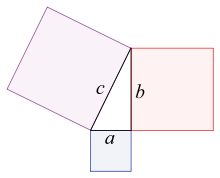
1, 100mm divided by 6 risers give you an exact riser height of 183.3mm. 5 treads of 280mm each will result in a total floor length of 1, 4m. From this you can work out the length of the stringer. a²+ b² = c². Remember him? Yeah!!! The stringer by the way is the piece that runs down diagonally from the deck to the floor and to which the treads are attached.

Now lay the stringer flat on the ground, starting your markings a comfortable distance from the end to allow for cutting to the correct angle and possibly notching the end to accommodate any lip that may exist on the deck. Deckboards can either be set flush with the joist or they can hang slightly over which will dictate whether or not the stringer needs to be notched so that it can be fastened to the joist or beam.

Timber stairs Durban

Click to enlarge

With the stringer flat on the ground, take a large square with markings on both sides (the big black square) and slide it along the one side of the stringer so that you reach the 183.3mm mark on one side and the 280mm mark on the other side. Of course you would round this to the nearest millimetre. One can buy little clamps that clamp to the sides of the square to make this job easier. In fact sophisticated stair stringer squares can be bought but the big black square works just as well. With your riser height and tread width marked on the stringer you can now draw a line around the square at the corner. This is where your riser and tread will be. Move the square down to the end of the marks and repeat to mark the next one. Continue until the end of the stringer. Cut the top end of your stringer off parallel to the riser at the correct distance to attach to the joist. The bottom of the stringer will be cut, either parallel to the riser or tread depending on whether you want a vertical or horizontal end which will either attach to the concrete ground (horizontal) or be set into the soil using a post and concrete (horizontal or vertical).

If you have as much difficulty understanding this as I did, then you are not alone. Try it and you will find it becomes second nature.
Now it’s just a matter of attaching your treads and job done. If you have a balustrade running down the sides of your stairs this can be attached now. Care should always be taken where the balustrade capping and cross supports, on the stairs, meet the same on the deck as they are running at different heights. It is better to take the balustrade up, level out whilst still on the stairs and then meet the horizontal.

Timber Deck Installed in Queensburgh, Durban

Sundeck installer Durban

Click to enlarge

This was our second deck we installed in Durban and this time around we got the spec right and didn’t spend all our money on timber. The deck was pretty much on ground level but still required normal 30 x 102 joists as it was not supported by a concrete base. Should there have been a concrete slab on which to support it then we could have used smaller batons instead of joists. We still sued a cleat and beam system although later in my Sundeck installer career I learned the other method of a joist as the cleat attached to the wall with the joists Téd off that and a fascia beam on the front.

There was a fair amount of digging to get the garden to the correct level as the one side was quite a bit more elevated than the other.
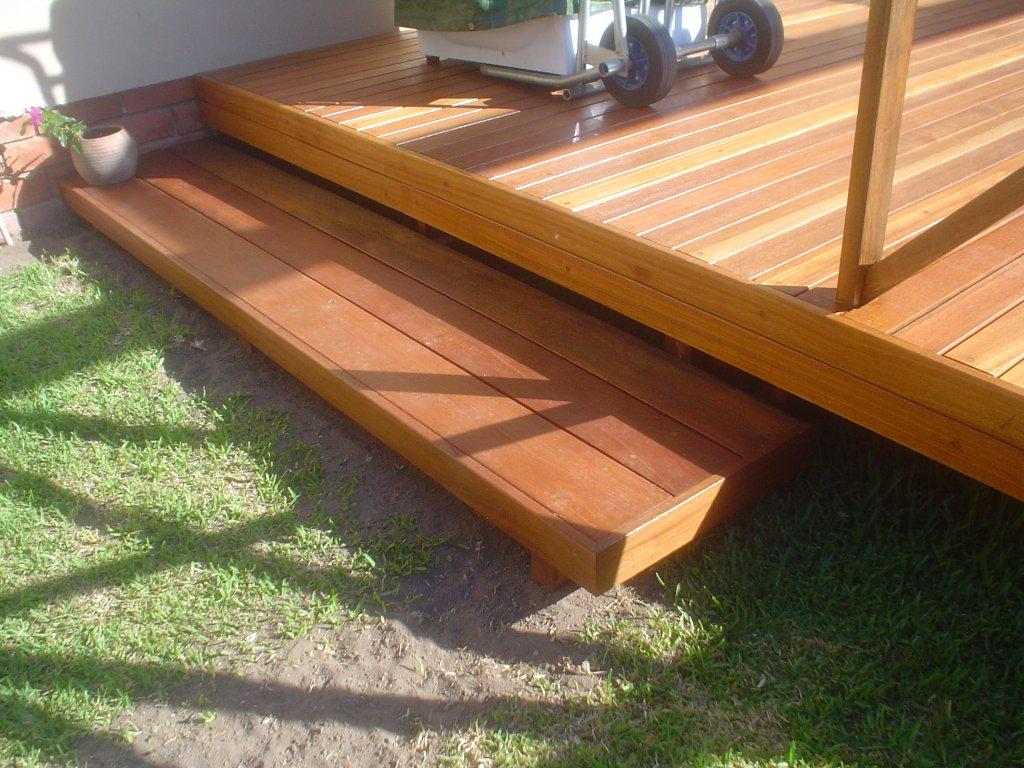
This deck had a floating step which was quite large, bigger than a normal tread. It worked very well in that it appears that the step is not attached to the deck at all and is large enough to step down comfortably on to it.

Sundecks builder Durban

Click to enlarge

Being our second deck we set everything out and started decking it. Half way through our deckboards we realised that the front beam was not straight. It bowed inwards and as the deck boards went down it became more and more noticeable. So all the deckboards came off, the beam was straightened and back they went. A costly mistake in time but a lesson learnt that will ensure that that mistake never happens again. A simple piece of fish line or builder’s line must be placed along the front edge of the beam when fastening the joists to ensure that it is straight. A false joist can be used here in the middle of the beam attached in the same direction as the joists will lie to hold it in place while the joists go down. The same rule applies for joists. When I joist is placed down it must also be square off the wall and the rest of the joists must be parallel to that one. Timber will always be bowed in one direction or another, some more than others. But they must be pulled straight before being attached. In the case of joists this will ensure that they screw line on the deckboards is straight and more appealing to the eye. Also it keeps the distance between joists exactly 550 between centres for the entire length of the joist. This is particularly important on joists that are placed on the end of the deck as the deckboards will be cut there and if not straight then the deckboards will either not be straight or they will form a lip where the joist bows inwards or outwards.

Sundecks Durban

Click to enlarge

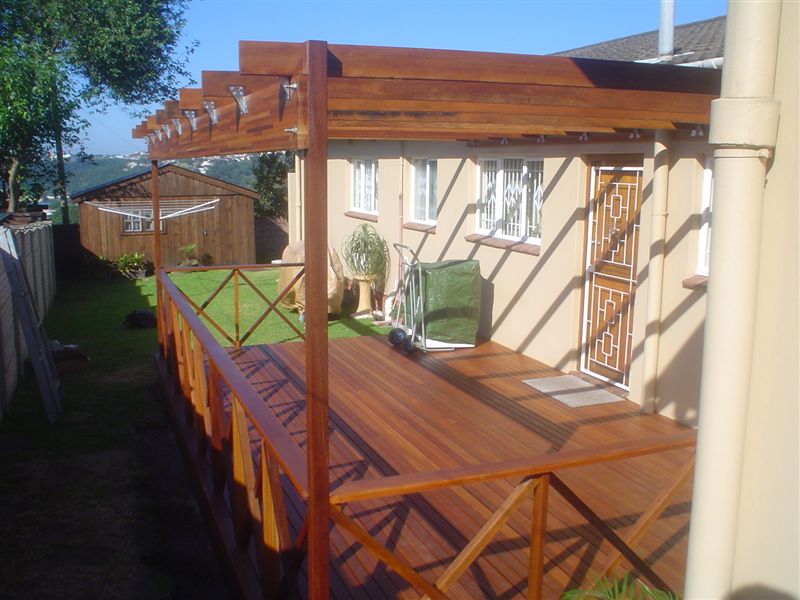
The balustrade on this deck was pretty straight forward to. We notched the cross pieces so that they fitted snuggly together in the same plane rather than overlapping them. We built a pergola in balau above which eventually took a roof. The client however attended to the roof sheeting.