Wooden Stair Case Build Durban

Wooden stair builder

Click to enlarge

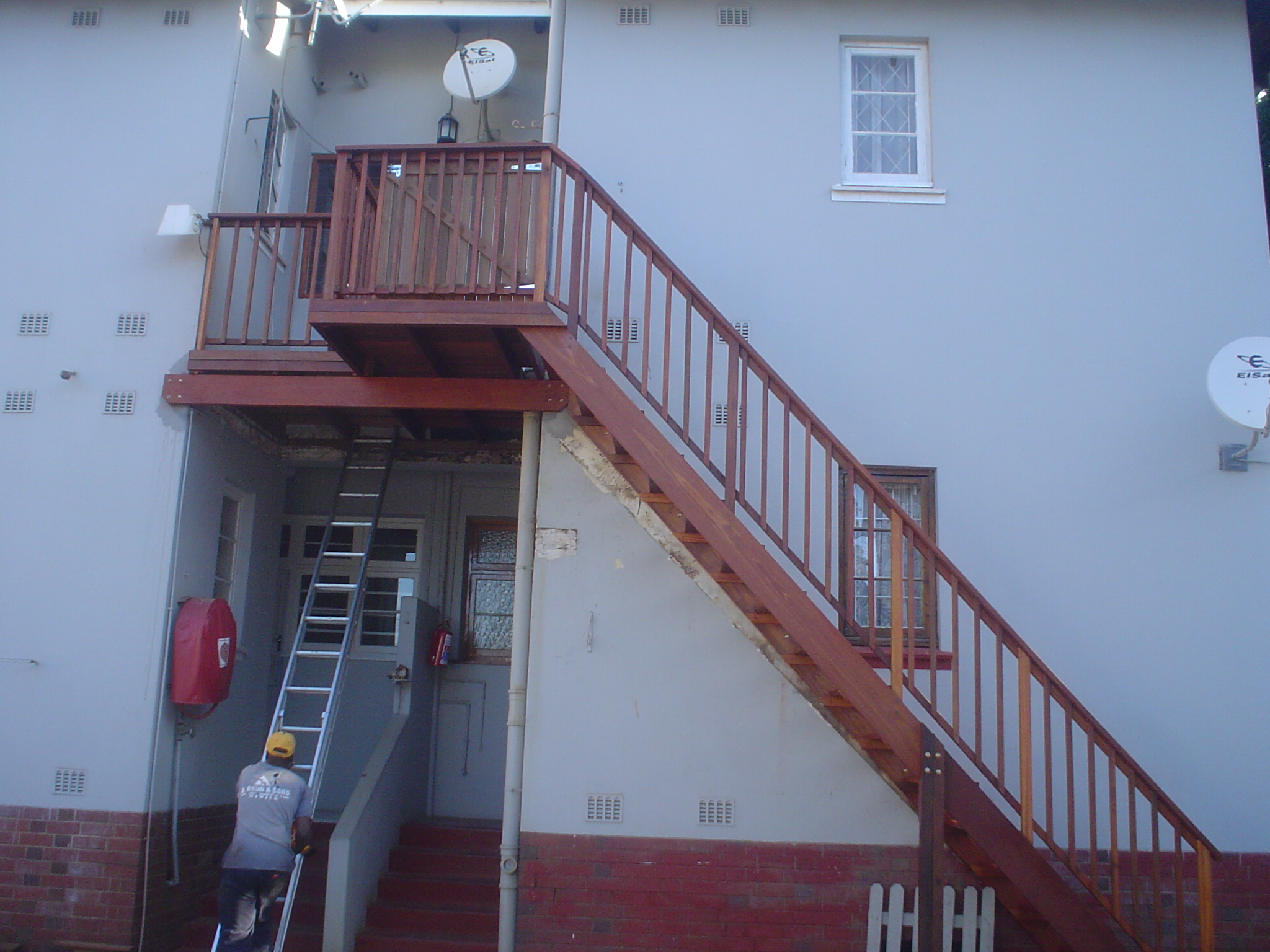
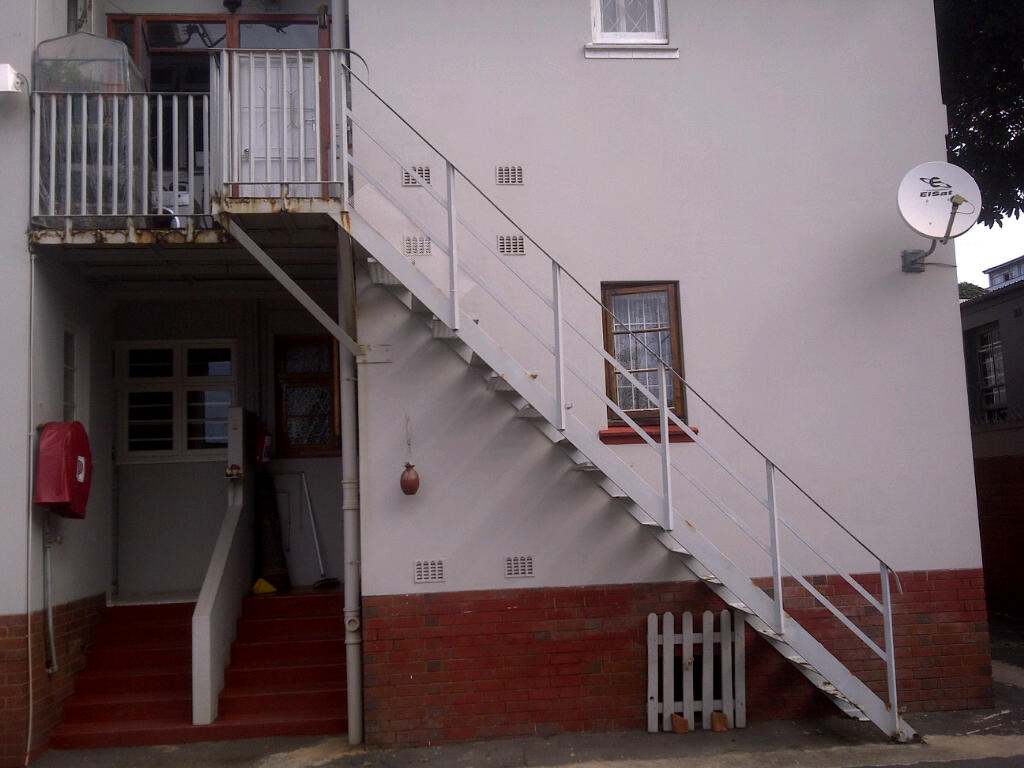
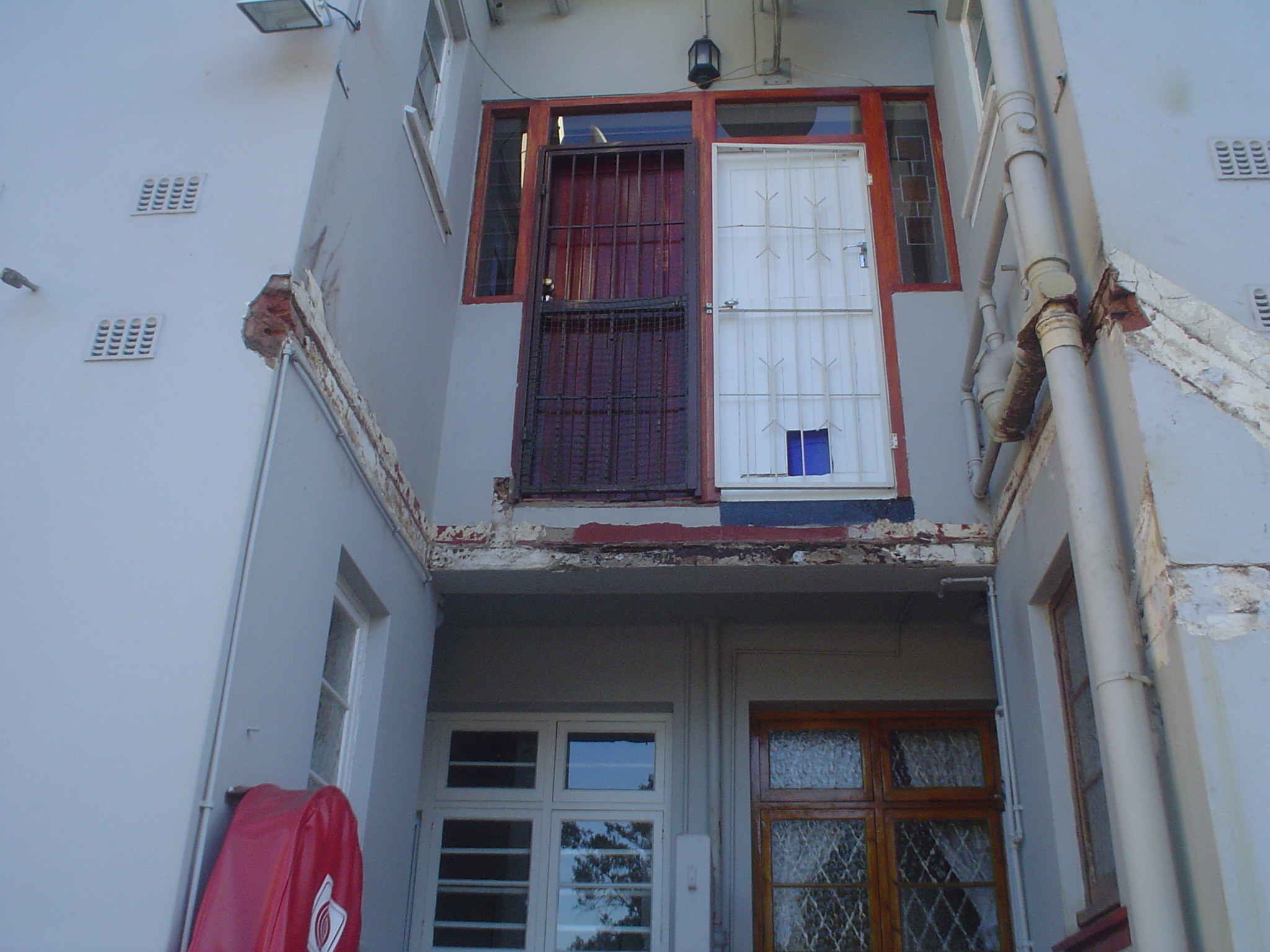
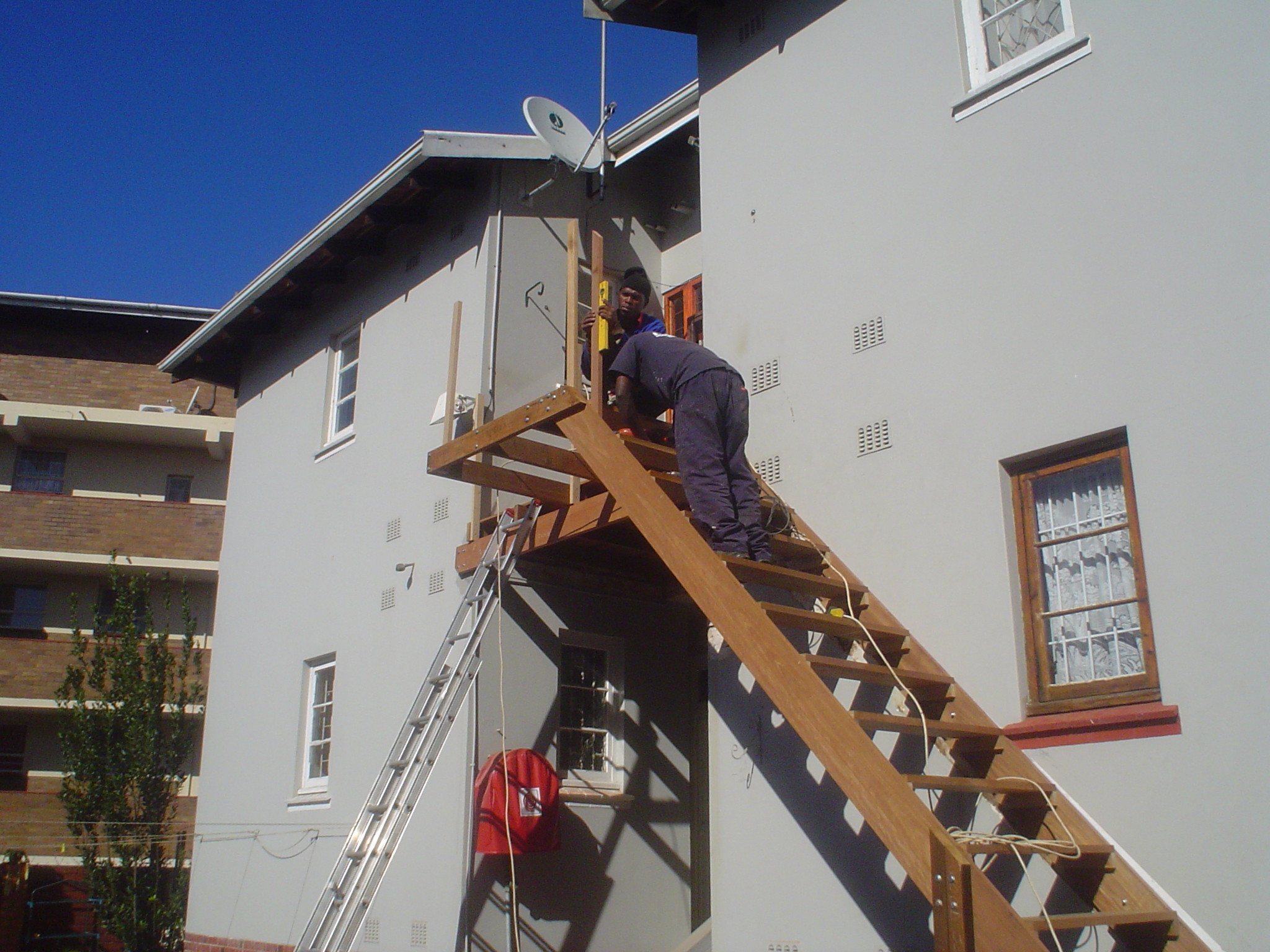
This wooden stair case build by The Wood Joint in Durban was a tricky one. The client was a committee member on the body corporate for a small block of flats in Durban. There were about 4 units in the block and the existing steel fire escape had rusted to a point where it was unsafe. So first we had to remove the steel structure. With a little help from my friends, we came in and chemical anchored stainless eyes into the wall on both sides above the steel platform you see in the pics. From there we rigged up some climbing equipment to be safe and started cutting sections out of the steel structure and lowering them slowly to the ground. We had to cut small sections as the steel was 10mm thick and we didn’t want to damage the walls, windows or doors on the way down. We managed to get most of it down in one day with a small piece remaining for day two. We battled slightly in getting the main support off as the sewage pipes had been installed after the steel so we had to cut the steel out around the pipes so as not to damage the pipes. In removing it we inadvertently damaged a corner of the wall as the rawl bolts there were quite large, rusted and pretty much part of the building by now. We patched that using structural grout which was hard and strong enough to support our main beam to.
Wooden stair builder

Click to enlarge

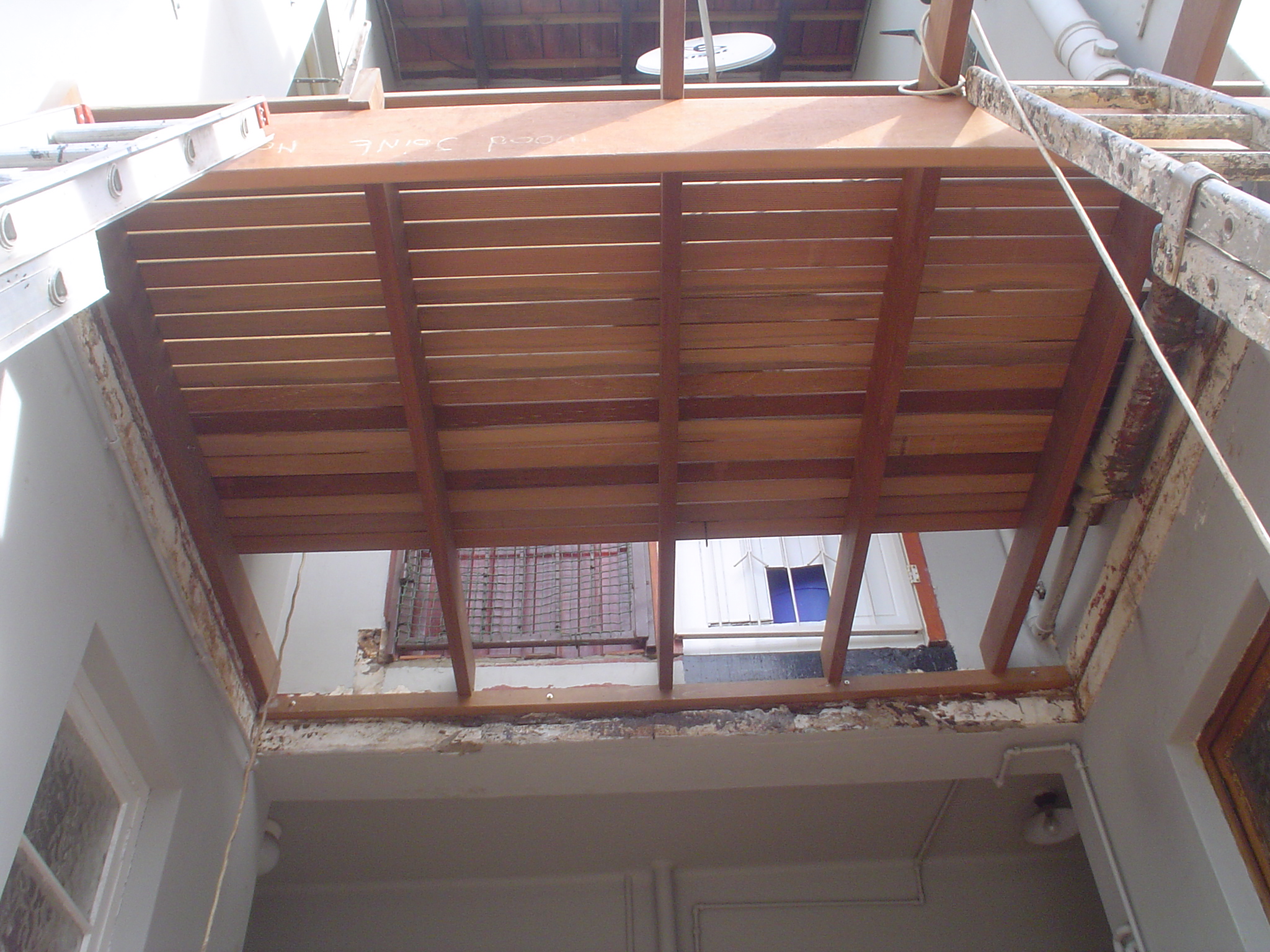
With the steel gone, we set out to build a wooden stair case and landing that could act as a fire escape. The small landing part was easier enough and we canter levered it so as to keep our posts out of the way below for parking. In these smaller blocks of flats in Durban space is very limited so posts need to be kept well out the way of parking space. Because we were canter levering it we needed to use 30 x 140 joists of balau rather than our normal 30 x 102 joists.

The stringers for the stairs were also tricky as we had to follow the original line of the stringers because there was a window beneath that we couldn’t cover and we could only protrude to the end of the wall without obstructing the driveway. This resulted in our stringers being placed at 45 degrees which resulted in our risers being of equal length to our runs or treads. It is not ideal as it makes the stairs very steep but we had no option due to space and height. We were a total of about 4m in the air to the landing.

The treads went on alright, the balustrade too and we had to join the stringer on the outside with two independent posts to ground to support it as the timber we could get wasn’t long enough to run the full length of the stringer.
Wooden stair builder

Click to enlarge

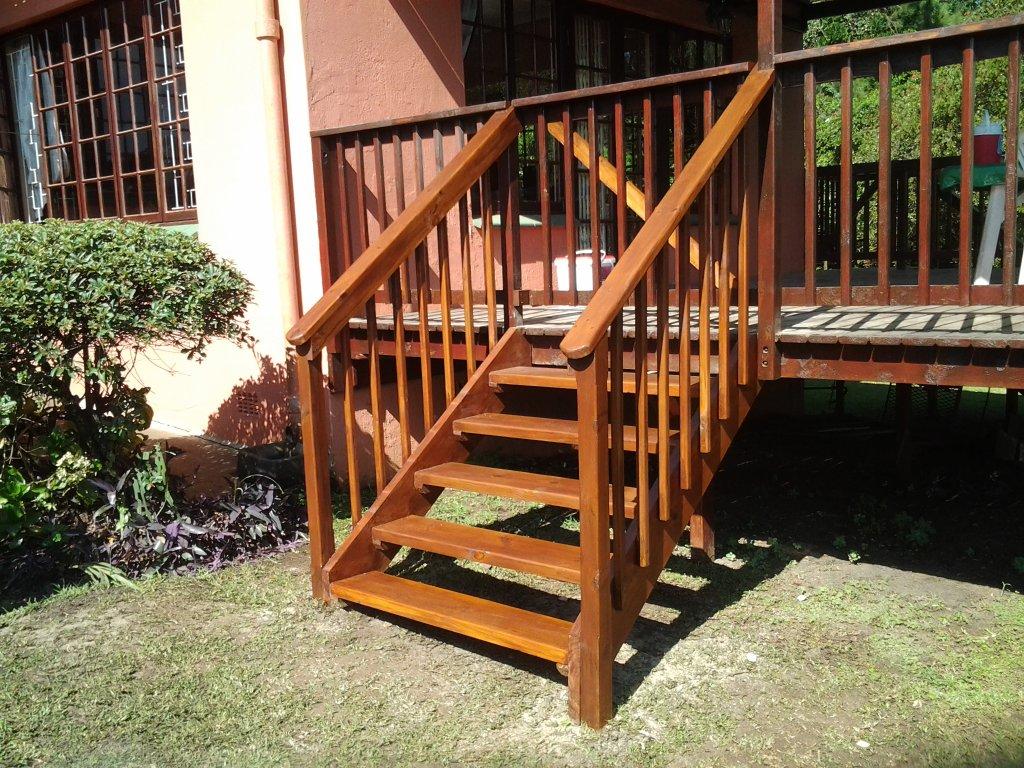
We went back there a year or two later as one of the treads had popped a screw. Sometimes the timber moves more than one wants it to and breaks the screw off. We do however put additional back up screws in each piece we secure so they are safe in the event that one screw does break.

For a free no obligations quote on wooden stairs or any other outdoor timber construction please complete the form below or you can call us on 082 496 5444.
Wooden stair builder

Click to enlarge

Wooden stair builder

Click to enlarge

← Back

Thank you for your response. ✨

Timber Stairs Built in Hillcrest – February 2013

Timber stairs Durban

Click to enlarge

As a deck builder and timber stair builder in Durban I have had to learn how to build timber stairs the hard way, through trial and error (and a bit of Googling).  Timber stairs have always been a tricky one for me and I have battled to build them in the past. At first I Google’d ‘building timber’ stairs and found a few videos on the topic which explained it quite nicely. Most of the videos online though are American and they therefore explain it in inches. But after converting it the technique and calculation used to work out your runs and risers becomes quite clear.

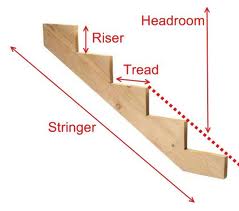
The riser is the vertical piece of the step and the run (or tread) is the horizontal piece. Building regulations in South Africa state that the riser can be no more than 200mm high and the tread or run can be no shorter than 250mm. Timber, either in pine or balau, will come standard at either 140mm wide or 220 wide. One should therefore use two pieces of 140 wide stock in order to get a tread of 280mm wide. I have seen stairs built using 220 wide stock which although is not completely according to building regulations can work if a gap is left between the front of the top tread and the back of the tread below that. The gap should be at least 30mm to get back to your minimum of a 250mm wide tread, although building regulations state that this gap should be no bigger than 20mm. Because the stairs are open, one can normally get away with this as your foot will be able to move past the back-end of the tread as you climb the stairs. Be sure to check with building regulations before designing your stairs to ensure you are compliant or that your contractor is adhering to these regulations.

Timber stair builder

Click to enlarge

First you need to calculate the exact height of your riser and the exact width of your tread. I will use 1,1m as the height of the stairs for the example below.

Assuming a riser of about 200mm or less divide 1, 100mm by 200mm. You get 5.5 risers. Increase this to 6 risers because if you take it back to 5 risers you riser will be more than 200mm.

So 6 risers and therefore 5 treads. The top tread of course being the deck itself.

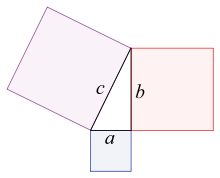
1, 100mm divided by 6 risers give you an exact riser height of 183.3mm. 5 treads of 280mm each will result in a total floor length of 1, 4m. From this you can work out the length of the stringer. a²+ b² = c². Remember him? Yeah!!! The stringer by the way is the piece that runs down diagonally from the deck to the floor and to which the treads are attached.

Now lay the stringer flat on the ground, starting your markings a comfortable distance from the end to allow for cutting to the correct angle and possibly notching the end to accommodate any lip that may exist on the deck. Deckboards can either be set flush with the joist or they can hang slightly over which will dictate whether or not the stringer needs to be notched so that it can be fastened to the joist or beam.

Timber stairs Durban

Click to enlarge

With the stringer flat on the ground, take a large square with markings on both sides (the big black square) and slide it along the one side of the stringer so that you reach the 183.3mm mark on one side and the 280mm mark on the other side. Of course you would round this to the nearest millimetre. One can buy little clamps that clamp to the sides of the square to make this job easier. In fact sophisticated stair stringer squares can be bought but the big black square works just as well. With your riser height and tread width marked on the stringer you can now draw a line around the square at the corner. This is where your riser and tread will be. Move the square down to the end of the marks and repeat to mark the next one. Continue until the end of the stringer. Cut the top end of your stringer off parallel to the riser at the correct distance to attach to the joist. The bottom of the stringer will be cut, either parallel to the riser or tread depending on whether you want a vertical or horizontal end which will either attach to the concrete ground (horizontal) or be set into the soil using a post and concrete (horizontal or vertical).

If you have as much difficulty understanding this as I did, then you are not alone. Try it and you will find it becomes second nature.
Now it’s just a matter of attaching your treads and job done. If you have a balustrade running down the sides of your stairs this can be attached now. Care should always be taken where the balustrade capping and cross supports, on the stairs, meet the same on the deck as they are running at different heights. It is better to take the balustrade up, level out whilst still on the stairs and then meet the horizontal.

Wooden Sundeck Built in Forest Hills Durban

sundecks Durban

Click to enlarge

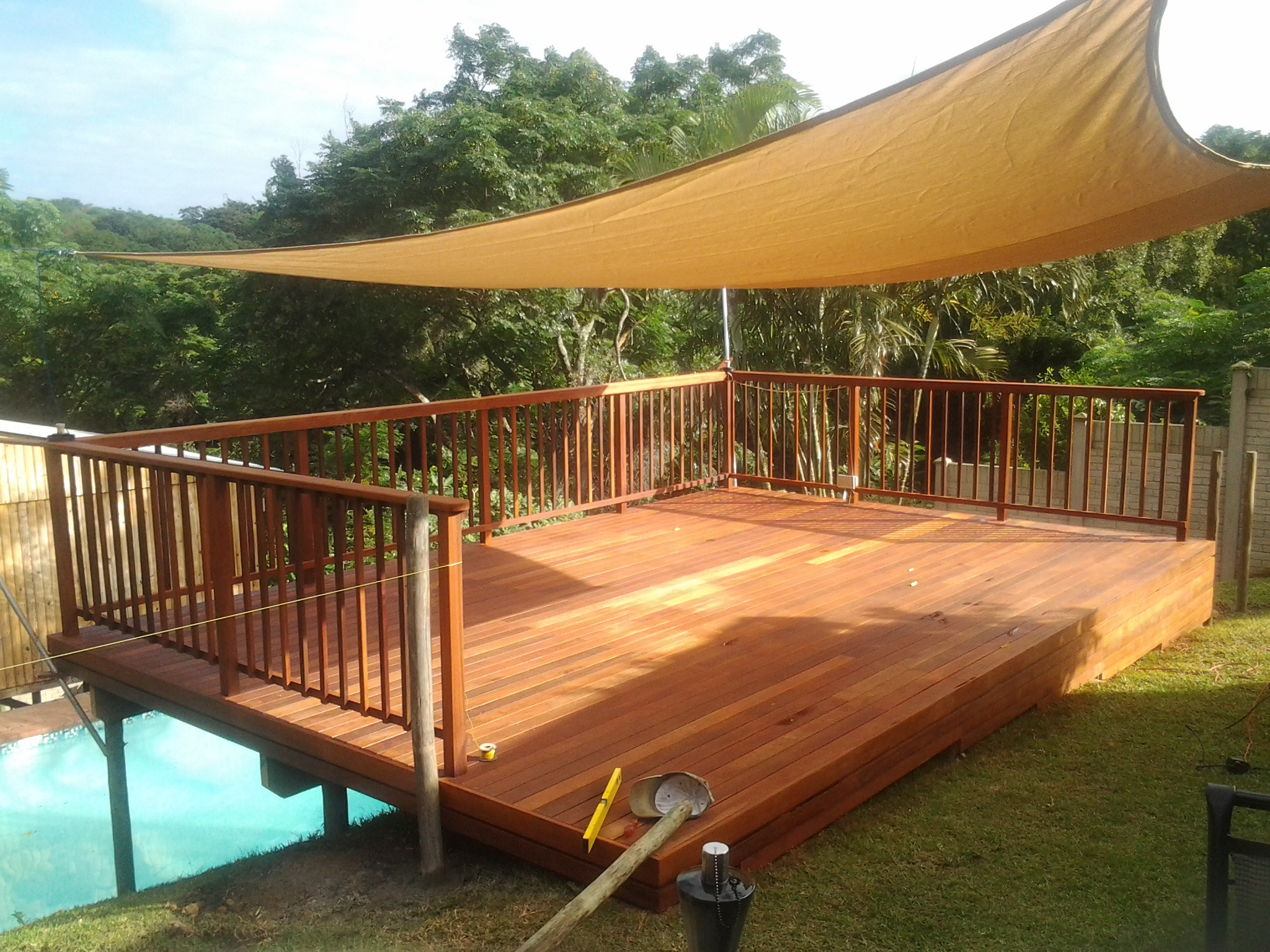
This sundeck we built in Forest Hills Durban was an add-on to a deck we completed in 2012. The client initially built a 20 odd square metre deck off the front of his grant flat. It was then decided to extend the deck around the corner to tie up with the kitchen door.
We needed to decide which way the deck boards should run. Traditionally they should have run the length of the deck extension, but because of the way the existing deck had been built, it would have resulted in an odd line that would have been visually unappealing. Had the extension been built at the same time as the deck then the deckboards could have met at a 45° angle to turn the corner. Instead they would need to either meet at a 90° angle or they would need to run the same way (i.e. the width of the deck rather than the length). It was decided to run them the same way as the existing deck resulting in them running the width of the deck rather than the length.

With this in mind we set out to lay the substructure which consisted of long joists of about 9.2m. The width of the deck was 1.2m so we set 2 joists and a cleat along the wall. The challenge in setting such long joists of course is to ensure that they are set straight. Our joists were each 4.5m long so had to be joined in the middle without allowing them to bend or bow at the join. It was easier to join the joists beforehand, set a false deckboard of pine to hold them at their 1.2m width and then dig our holes for posts. We used H4 CCA gum poles as posts as they would not be visible from the outside and budget did not allow for balau posts. The poles were half checked to accept the joists, secured to the joists using kalgard 60mm screws and concreted in with 6 inch nails hammered into the base to prevent the post from sinking over time. A dry mix was used so as to be able to work with the post and joist immediately after setting them.

wooden decks Durban

Click to enlarge

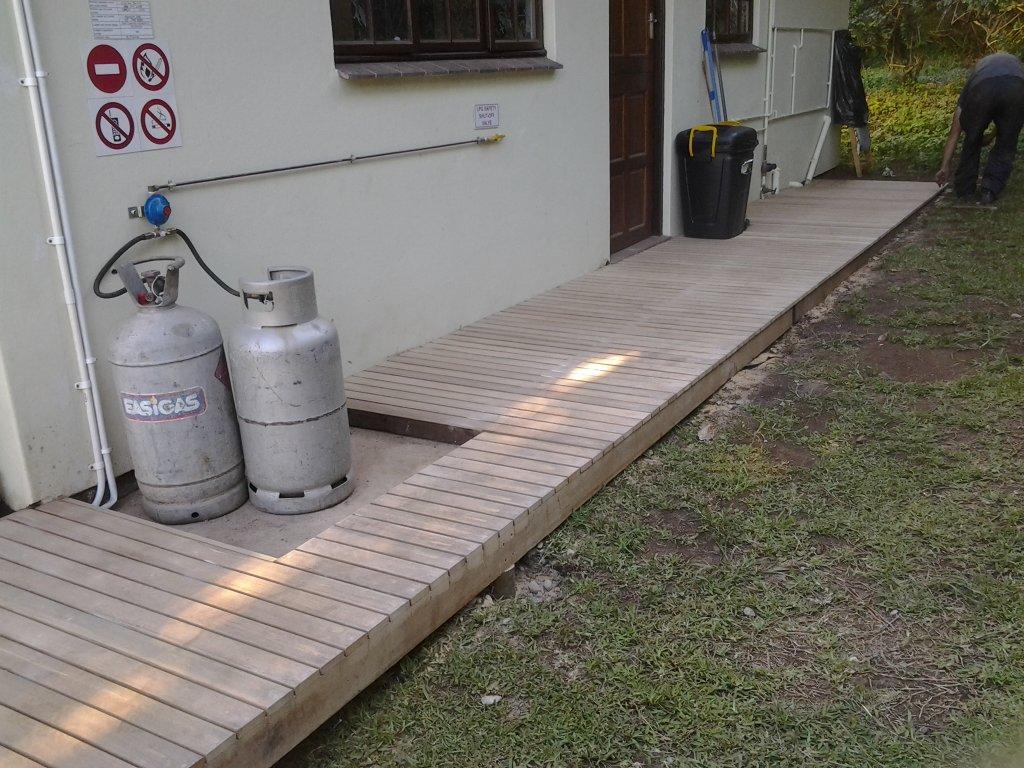
There was a concrete gas bottle plinth that was not decked and we had to deck around that and fill the vertical surfaces with balau cladding for aesthetics. Also the plinth that existed directly outside the kitchen door was slightly higher than we would have liked and as such we could not use our 30 x 102 joist and had to use a 30mm baton to arrive at the same height as the rest of our joists.
Once the substructure was down it was relatively plain sailing as our rough pre-cut balau deckboards were screwed down. We intentionally left them slightly long and after they were all down, snapped a chalk line along the edge and cut with a skill saw to get a straight line.

We cladd a few ends to close it all in, epoxied our screw holes to prevent water collecting in them and being soaked up by the end grain. Once dry we sanded flat and sealed using a top quality timber preservative with an oak tint.
A few pot plant stands were thrown in from the scrap off cuts which will now keep the pot plants off the deck and allow the water to drain away quickly and prevent accelerated degradation of the balau.

10m² took us 2 days to complete. The crew received a nice bonus based on square meterage and it was off to the next job.

For a free no obligation quote, or simply for an advice, please use the form below to contact me or you can call us on 082 496 5444.

← Back

Thank you for your response. ✨

Timber Sundecks in Durban

Wooden decks Durban

Click to enlarge

“Summertime ….. And The Livin’ is Easy “… Or it CAN be !! …Yes, with the South African summer right on the doorstep now, what’s the best Christmas present you could give to your family (and yourself)? (This one won’t fit into a Christmas stocking however …)

Ponder and Dream of how ‘lekker’ it would be to have a good quality sundeck in our sunny climate, leading off your lounge, and onto your pool or into your garden… and yes, in South Africa a sundeck is as important as your lounge, or more so because of our outdoor lifestyle.

Who to get to build it?
The benefits of having it professionally installed versus a ‘fly by night builder’, or tackling this mammoth task yourself; the importance of the maintenance of your valued product and the importance of what wood type to use in its construction are all considerations to take into account when planning to invest in this forever “best thing I ever did” choice. Make it your Christmas gift to the whole family, all in one!

Wooden decks Durban

Click to enlarge

Materials used in the construction include the following. All are good quality materials, able to weather the weather (pun intended) if properly maintained. An example:

• Balau (an imported hardwood from Indonesia, extremely dense, contains toxins that prevent termite damage and resins which repel water to prevent rot).
• Kalgard screws (similar to epoxy coating where the coating on the screw is baked on
• Stainless Steel Screws
• Epoxy to fill screw holes where the screw has been counter sunk to prevent water getting in the little hole which slows down rot
• Timber preservative rather than varnish (varnish sits on top and cracks and flakes from the UV in the sun’s rays, whereas timber preservative soaks into the wood nourishing it thereby preventing flaking and peeling of varnish.)
The Wood Joint pays special attention to detail in all products and places great importance on durability and longevity in their products by applying sound techniques and slightly over engineering most products.

Wooden decks Durban

Click to enlarge

They pride themselves in their quality workmanship and use only top quality timber sourced from reputable suppliers.

A sundeck is a valuable addition to any home and will not only provide many years of enjoyment, but will also enhance the value of your property.

With the correct care, maintenance costs can be kept to a minimum and the life span of your deck increased.

The Wood Joint will assist you in a design that will be cost effective and will best suit your needs taking into account the existing structure that is in place.

With years of experience in the deck building industry, The Wood Joint can advise, design, maintain and erect your deck in the most cost effective and structurally best methods.

Other Products, Other Timbers …
“We have listed the three most commonly used timbers to construct decks which have been selected due to their structural strength, longevity and cost effectiveness. There are however other timbers that can be used and these can be discussed individually.”
The Wood Joint (www.thewoodjoint.co.za) from my experience and that of many is dependable, reliable, knowledgeable and professional … View their website to see the quality and standard of their Sundecks and a wider portfolio of other specialities their experience encompasses:

• Sundecks
• Balustrades
• Pergolas
• Walkways
• Garden Bridges
• Pool Decks
• Screens (vertically installed to provide privacy)
• Cladding (on walls mainly for aesthetic purposes)
Wood
Balau

The most commonly used, and most cost effective timber, is Balau which is sourced from south East Asia. It is a yellow – brown to dark brown timber with a fine texture and interlocked grain and is extremely durable under tropical conditions.

It is a fairly heavy timber weighing between 800 kgs and 1, 000 kgs per cubic metre when dry.

It can be sealed or left unsealed. Unsealed it weathers to a grey colour. It can also be stained easily using a variety of tints to change the colour.

Garapa

Garapa is also a popular decking material as it is hard, heavy, tough and strong and is naturally resistant to rot, decay and insect attack. Found most commonly in Argentina, Brazil, Venezuela and Eastern Peru.

It normally weighs between 800 kgs and 960 kgs per cubic metre when dry. A fine grained timber varying in colour from yellowish to yellow – brown / yellow – pink.

It is, to a degree, scratch resistant reducing sanding during scheduled maintenance.

Massaranduba

Sourced form the West Indies and Central and South America, this timber is suitable for decks due to its hardness.

It is extremely heavy weighing in at about 1, 050 kgs per cubic metre when dry.

The texture is fine and uniform. The grain is usually straight but sometimes interlocked.

The heartwood is light red to rose red.

Keruing

Keruing is naturally found in South East Asia.

The timbers vary in colour from pinkish-brown to dark brown and look rather characterless. Grain is straight or shallowly interlocked and the texture is moderately coarse and even. All of the species contain oleo-resins and many of them will exude it onto surfaces during drying or when exposed to heat or sunshine when in use.

The weight is variable too but is generally within the range 720 to 800 kg/m3 when dried.

It is moderately durable.

For free quotes and more information on The Wood Joint’s various wooden products contact us on 082 496 5444 or complete the form below.

← Back

Thank you for your response. ✨


Wire Rope Balustrades

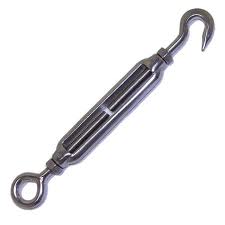
A turnbuckle

Wire rope balustrades are quite common nowadays especially if a modern and sophisticated look is required.

There are two types of wire rope balustrades available.  The first is a 5mm stainless steel cable or rope attached to the uprights of the balustrade which should be balau of about 60mm x 60mm.  This is attached using a turnbuckle as depicted in the image and can be tightened as time goes by and the wire rope stretches slightly.  The tension of this rope should be taught but not too tight.  This 5mm cable or rope can normally turn corners and hence less turnbuckles are required per length of wire rope.

The second method, and my preferred one, is a 4mm marine grade stainless steel wire rope with button heads on either end.  The 4mm wire rope is normally of a higher grade than the 5mm rope and tends to tarnish less over time.  I have found the 5mm rope to often contain one rogue strand which will tarnish and spoil the look of your balustrade.  This method requires button heads on either end but the 4mm rope normally cannot turn corners and more button heads are therefore required.  Each length of rope should run in one continuous straight run and a new length started once a corner is encountered.  A hole is simply drilled into the balau uprights, the button head inserted and the wire rope threaded through and crimped.  It too can then be tightened and again it should be taught rather than too tight.

Care should be taken to drill level holes that are equidistant as the slightest difference will be noticeable.  Particular care should also be taken when drilling holes on uprights that are on diagonal stairs.  A trick is to snap a chalk line the total length of the required wire rope and then drill the balau upright from both ends with the holes meeting in the middle.  One cannot see any kink in the wire rope inside the timber but it is more noticeable where it enters and exits the balau upright.

It is normally better to install the wire rope balustrade after the balau has been sealed or coated as this will eliminate the chance of accidentally coating or sealing the button heads or turnbuckles.

Both methods require a crimping tool to crimp the button heads or turnbuckles on either end.  This can be purchased often at a considerable price or one can be made using a large bolt cutter and adapting the head.  However, only attempt making one yourself if you have the skills and the correct tools, as the correct crimping is vital to ensure that the wire rope does not pull out of the button head or turnbuckle, resulting in a fresh length of wire rope having to be used.

The capping on top depends on choice but I have mostly used a 30 x 102 balau capping which is fastened using kalgard screws to the top of the uprights.  Again use as long a length as possible in any one straight run and if a join is necessary ensure that a 45° angle is cut to reduce lifting on the join.

Timber or Wooden Balustrades

Wooden Balustrades

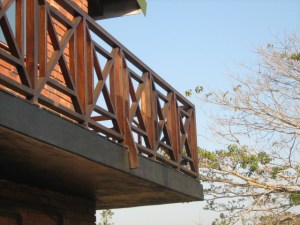
A classic criss cross style balustrade

Timber balustrades are built in various designs and various different timbers can be used. The most affordable hardwood of course being balau with more expensive options being Massaranduba, keuring etc. The pieces required for balustrades are most commonly found in balau as they form part of the structural pieces stocked by most timber merchants. Massaranduba, keuring etc. are largely supplied in deckboards only and are used for the actual decking with balau being used as the substructure. All three of them are equally as durable and strong and only really differ in colour and grain.

In this article we will discuss the picket style balustrade.

PICKET STYLE

This type of balustrade is often the only one that completely adheres to standard building regulations as the gap between any two pieces is, or can be made, less than 100mm. It should be designed with a cross horizontal support at the top and bottom to give the pickets a support to be attached to. The bottom horizontal support is normally set about 100mm from the ground and secured to each vertical post in as long a length as possible. The top horizontal support can either be set at the top of the post and directly beneath the capping or set 100mm down from the capping to provide a gap between it and the capping. The former being my personally preferred method as it then gives the capping a more rigid support and will reduce bowing and cupping of the cap.

Each picket is then attached to these horizontal supports so that the gap between vertical pickets is equal. Care should be taken in setting the first and last one as the width of each picket needs to be taken into account when calculating the centre of each picket due to the first and last one being the vertical post itself. Pickets can be pre routed on the corners to give it a profile or left square. They can also be routed in situ resulting in the router not running all the way to the end of the picket.

A capping is then placed and secured on top of the horizontal support and posts, or just to the posts if the latter method was used. This capping can then be routed over the edges to break the sharp corner. This capping should also be secured in as long a length as possible to avoid joins wherever possible. If a join is necessary it should be joined with a 45° join directly above a vertical post. This will reduce lifting on the joint.