Balau Screening in Cotswold Downs – June 2013

Balau or timber screening

Click to enlarge

We were called upon to quote on some balau screening in the Hillcrest, Durban area at a new development called Cotswold Downs.

There were various aircons, heat pumps and gas bottles that needed to be clad or screened so as to conceal them.

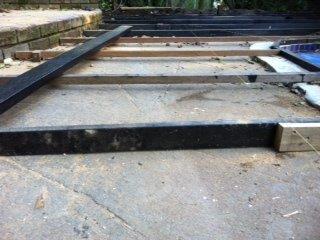
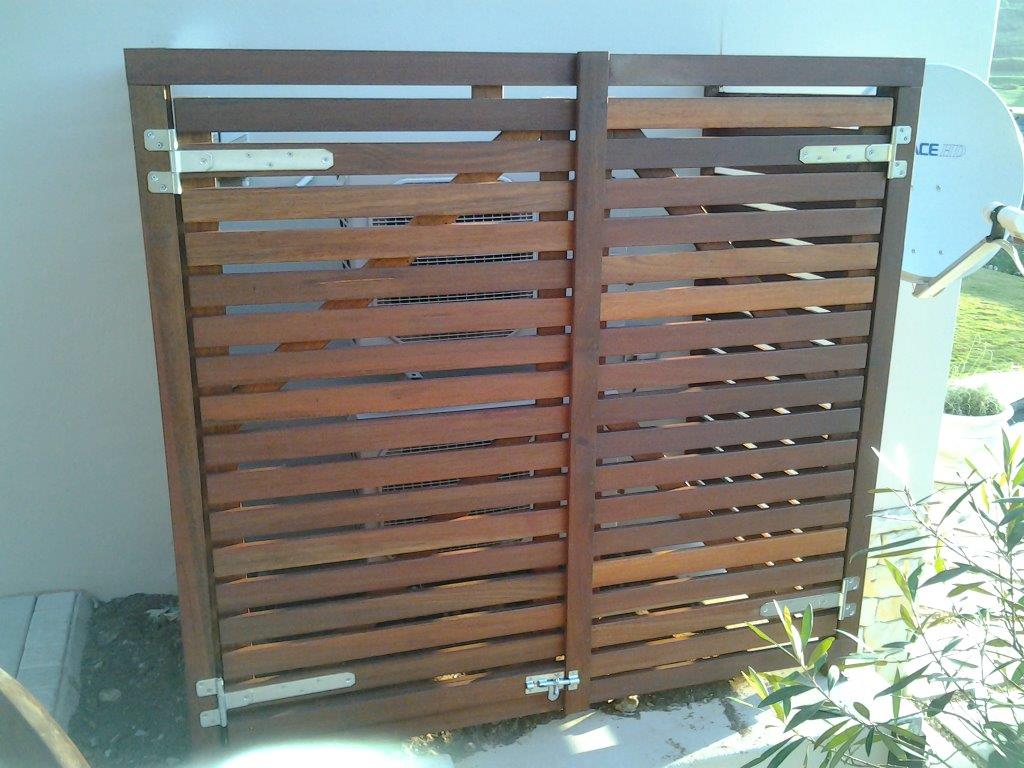
We used balau 30 x 40 struts or cleats attached to the walls. In some instances we used hiltis as there was not much load on the cleat.   In other instances we used 10mm x 100mm sleeve anchors.  We built a frame using the 30 x 40 balau and then clad it using a standard deck board of 19 x 68 with a 19mm space between. The 19mm space is standard in screening or cladding as it provides enough coverage without being too tight in its appearance. A gap of 5mm, which is standard in building a deck, would be far too close and would give it an odd appearance.

Most of the structures we built here were simple enough with either two or three sides and a removable lid so that access could be gained to change gas bottles or service aircons. Some of them had to have fronts

Balau or timber screening

Click to enlarge

that were removable as well as tops so that access could be gained from above or from the front. Some were removable lids and fronts and some were hinged. One needs to be careful which hinges you chose as they need to be strong enough and weather resistant. Solid brass hinges are expensive and with the weight of the balau can be problematic. Solid stainless hinges with bearings are best if the weight of the door is quite large. On the smaller door we used aluminium hinges as the door wasn’t too heavy and the aluminium will stand up the weather.

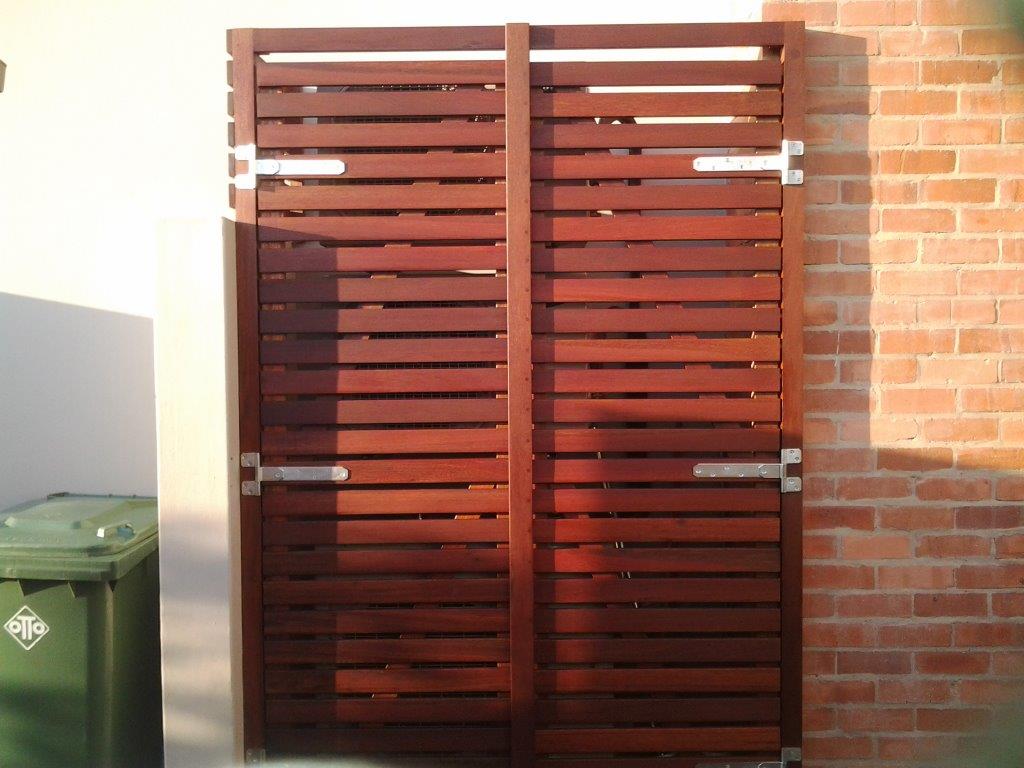
There were two doors we made which measured 2.5m high and 750mm wide each. That size door in balau is quite heavy and we used three galvanised strap hinges on either side. The only problem with strap hinges is that they need to be placed on the side of the door that opens, so they were visible on the outside. Some may say it adds character to the door, but sometimes you don’t want to see them. Being galvanised steel they are difficult to paint but can be painted with a Hammerite product specially designed for galvanised steel.  The only other alternative to these were to use the galvanised strap hinges that have a bent arm and slot into another piece attached to the frame. However these would have resulted in a large gap between the frame and the door or gate. Normal butt hinges wouldn’t have been strong enough to hold the door due to the sheer weight of them in balau.
Balau or timber screening

Click to enlarge

When building this type of structure it is often easier to try to build the whole thing in situ. So a frame goes up first, then you set the braces at the back to the correct length and then start adding deckboards, leaving one side long which can be cut afterwards.  If it is quite large then the door needs to be built on the ground, leaving the ends long and hung, then cut in situ.

They are unlike a normal door in that they can’t be successfully planned to fit the frame because the end grain is on the side.

We finished them off by filling holes with epoxy, sanding flat and sealing with Timberlife Satin Wood Base 28 in a mahogany tint.

For a free no obligation quote or advice on your decking or screening requirements please complete the form below and I will contact you, or you can call us on 082 496 5444.

Go back

Your message has been sent

Warning
Warning
Warning
Warning
Warning

Warning.

Wooden Stairs Built in Cowies Hill, Durban

Wooden stairs Durban

Click to enlarge

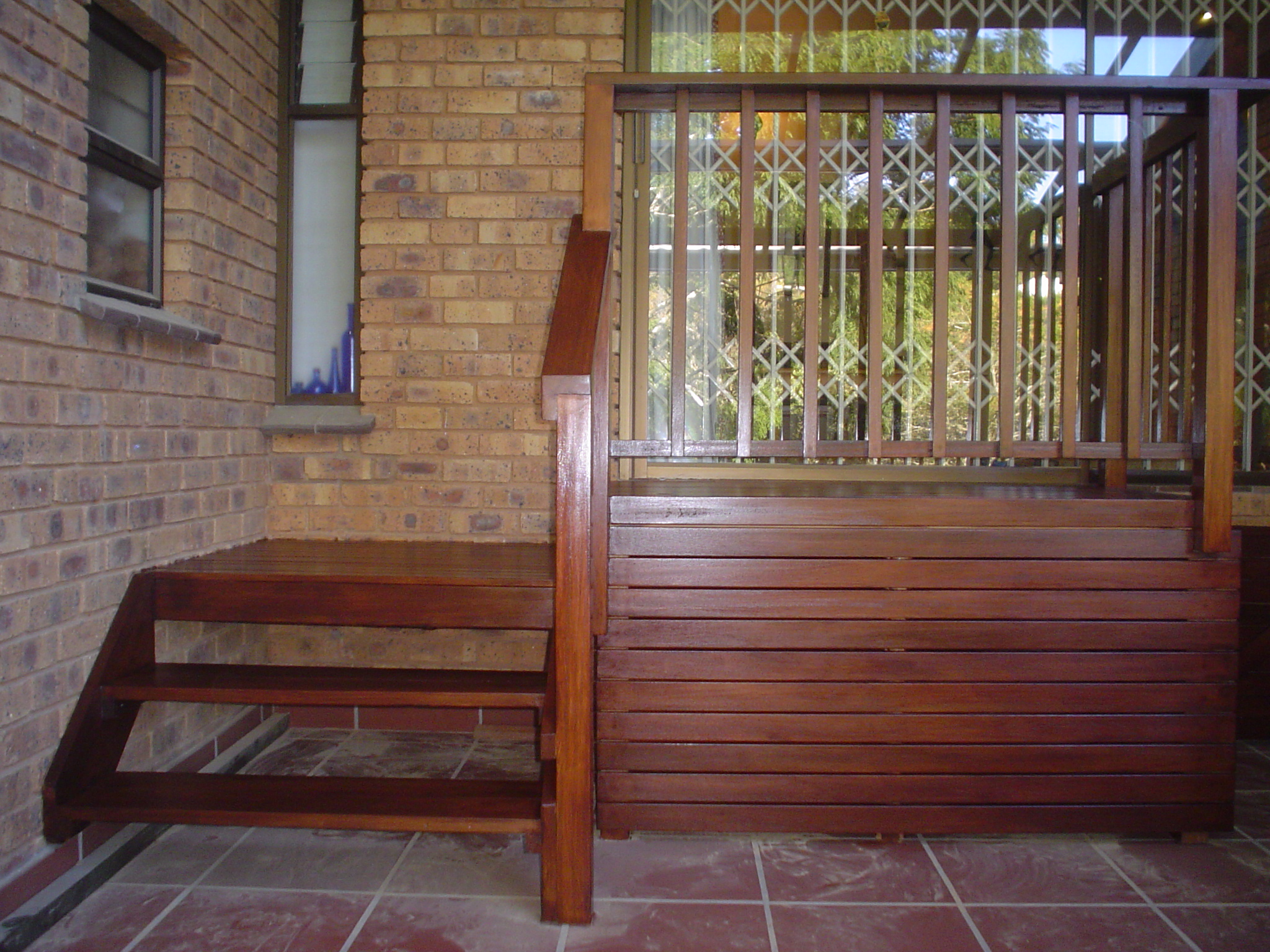
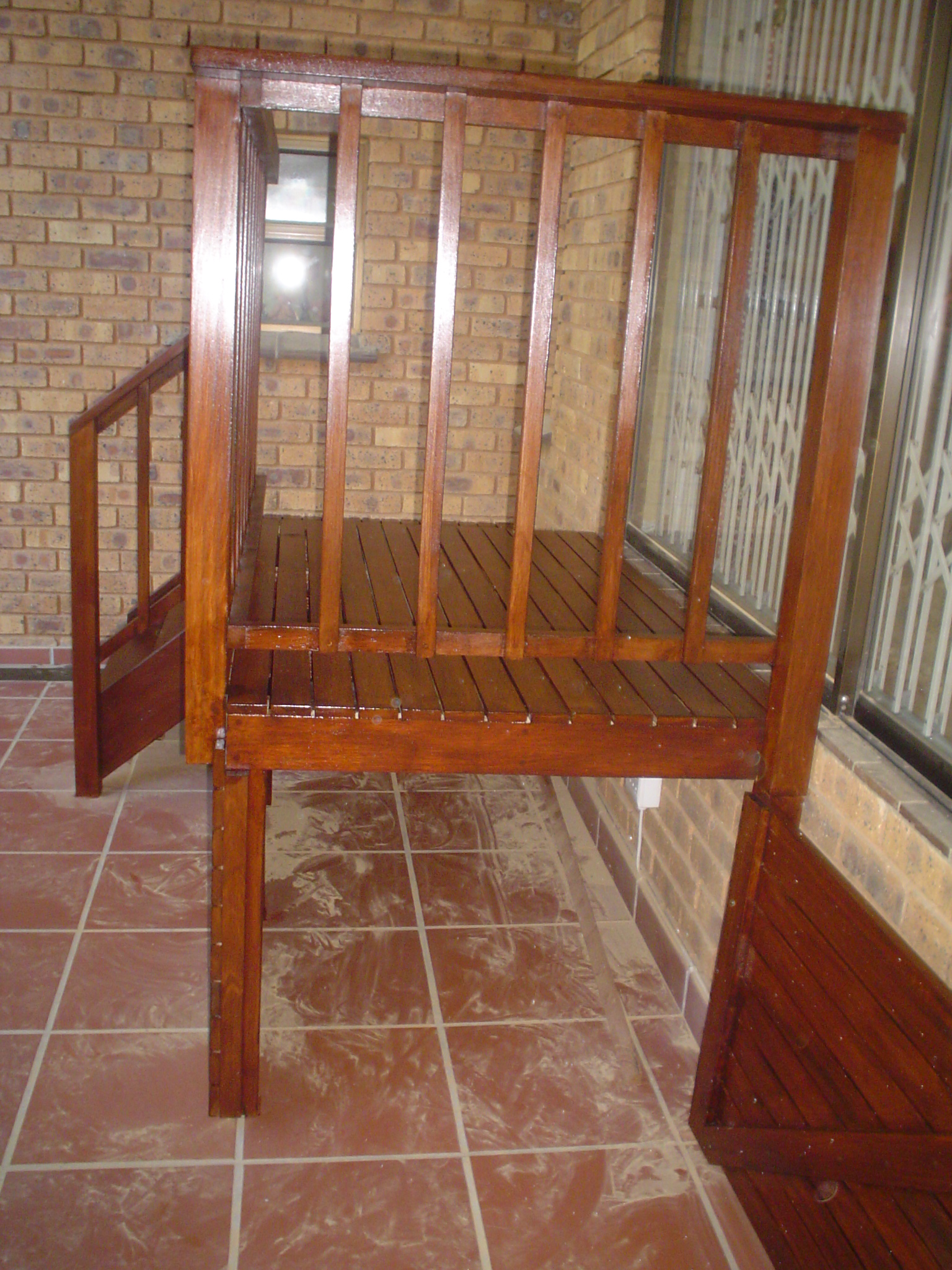
These wooden stairs we built in were quite interesting because the client had a dining room which was raised about 600 from the patio outside. He wanted to be able to access the dining room through the new sliding doors. So we designed a small landing and some stairs to fit snugly in on one side so as to not take up too much space on the patio yet still allow a safe passage down the stairs. There were only a total of two treads plus the landing. It not only added value by creating an access point but also added charm with wood.

We built the entire landing on the ground from balau, screwed it all together and then lifted it into place and attached it to two walls of the house using sleeve anchors. This method also kept the whole landing in the same plane i.e. no cleat and joist system but rather a joist and fascia beam system. Each method has their own applications. If it is a fairly large deck where it would be impossible to attach each joist to the beam and then lift it into place, then one would need to use a cleat, beam and joist system. However where it is possible to attach each joist to the beam or fascia beam then it can be semi pre assembled and lifted into place. This can also successfully be done with a deck that is quite close to ground as the ends of the joists can be supported quite easily while the other ends are attached to the fascia beam which is then attached to the wall. However a deck that is raised off the ground would pose problems in trying to support each joist individually while attaching them and then lifting the entire structure up. The fascia beam system also allows one to keep the structure in the same plane and if space beneath the deck is limited then this is a better option.

Wooden stairs Durban

Click to enlarge

We clad or screened the underside of this landing to create a storage area with a hinged door on one side so that it could be closed and locked.

This one we finished with Timberlife Ultra Care Gold as it was not exposed to direct sunlight. The Timberlife Satin Wood Base 28/28 has a much lower wax content so tends not to blemish that easily in direct sunlight. The Ultra Care Gold however has a much higher wax content and the UV in the sunlight tends to make it go a bit blotchy which can result in you having to sand it all off when it comes to maintenance. The key to low maintenance in wooden decks is to apply the correct finish correctly. To sand an entire deck back to wood and remove all traces of finish is almost impossible and at times I have thought it would be cheaper to simply replace the entire deck.

This was a small day which took us a day to complete. We also added a small gate for him on the existing deck, so in total it was a two-day job with sanding and sealing.

For a free no obligation quote on stairs or other wooden structure please complete the form below and we will contact you or you can call us on 082 496 5444.
Go back

Your message has been sent

Warning
Warning
Warning
Warning
Warning

Warning.

Wooden Sundeck Built in Gillitts – April 2013

Timber deck builder Durban

Click to enlarge

This was our second deck we built in Durban using CCA pine as a substructure. I can confirm that there is a substantial cost saving using pine as a substructure and provided it is CCA treated to the correct Hazard Level (H level), then it is guaranteed by the supplier and manufacturer against rot and insect infestation for up to 50 years. So at least H3 must be used which is good for outdoors, exposed to the elements and if there are parts of it that are making contact with ground then H4 is better. In fact the cost difference between H3 and H4 is so slight that I am tending to just use H4 throughout as a matter of course to err on the side of caution.

This deck extended from the house outwards about 5m. Half of that 5m length was on existing tiles and concrete so we placed batons of 38 x 76 and the rest of it dropped down about a metre onto soil. We chose 76mm as our width of baton because it brought us up to exactly where we wanted to be in terms of height of the deck in order to clear the bottom of the door. We therefore had very little space between joist and the tiles so there was very little packing to do. When we place batons on the ground as joists, we fix them using a hilti. The hilti is really just to stop the joist moving sideways and not really up or down as once the deck is built the weight of it keeps it from lifting up. However the hilti provides enough fixing power in both directions so sleeve anchors are not necessary. Often the ground on which you are fixing these batons / joists to, is not completely flat and in order to get the surface of the deck level, one needs to shim one end of the baton or joist. This results in one end being higher than the concrete ground level and as such a gap exists between the baton and the ground. Because these batons are relatively thin (between 38mm and 76mm) they are not strong enough in their width to support the deck. They therefore need to be packed with structural grout or a building sand / cement mixture to take up the gap between the baton and the ground.

Timber deck builder Durban

Click to enlarge

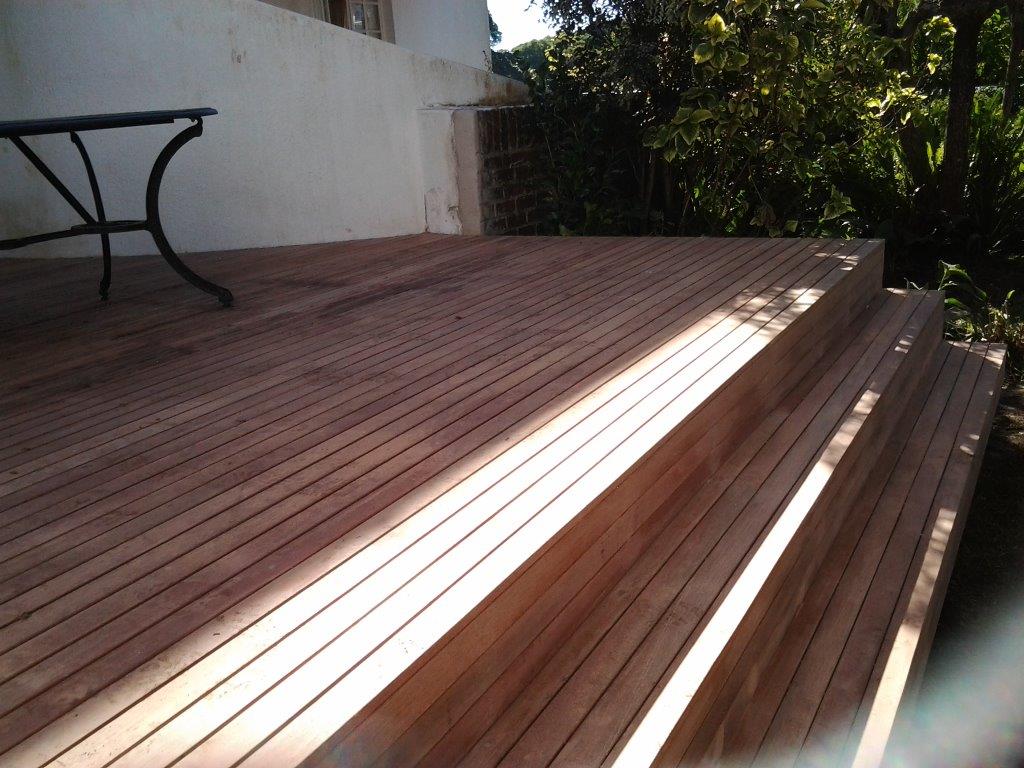
The rest of the deck was elevated about 1m off the ground so from that point we installed 38 x 114 joists with a main beam running the width of the deck (parallel to the stairs in the picture). We set that back 300mm so that our span between beam and wall was only 1.9m which is the maximum I am happy to go with a 38 x 114 joist.  The rest of the deck was therefore cantilevered by about 300mm.

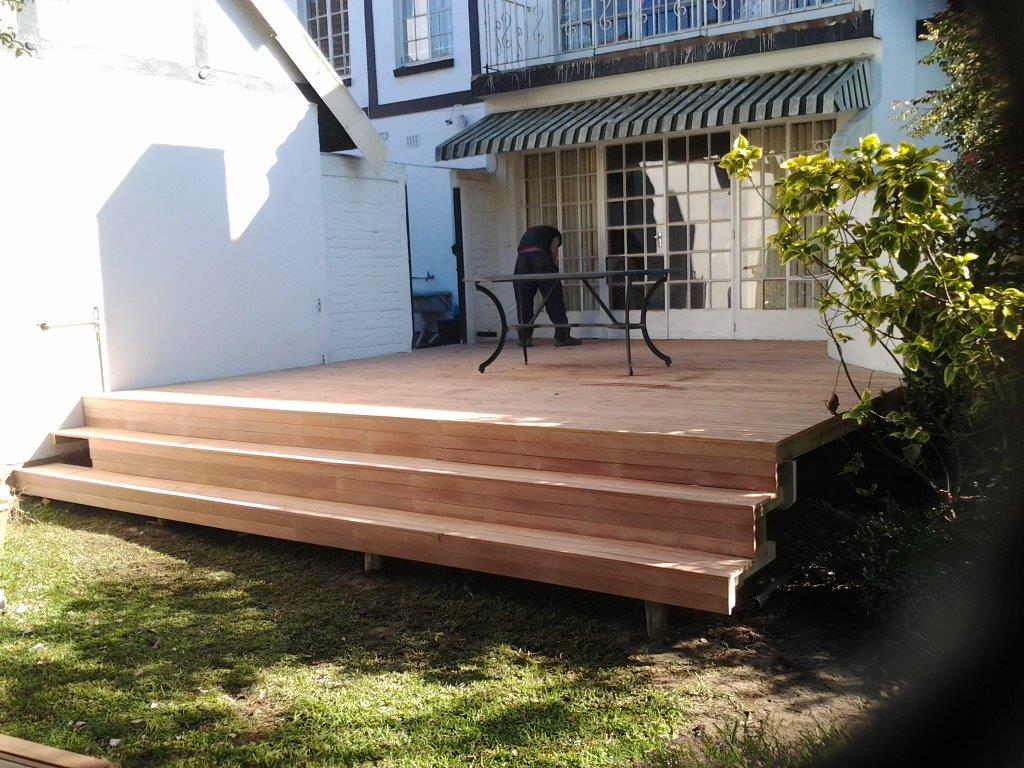
Deckboards went on without a problem, and we then built the stairs that you can see in the picture. We took a different approach to the stairs that we normally do, or have done in the past. In the past we have secured a beam all the way along the front of each riser. In this case we built treads and risers in line with each joist and then only on the front riser we fixed a fascia beam which was then secured to posts that had been set in concrete in the ground. It was much quicker than, and just as stable as our previous method. The structure that we built can be seen on one of the pics alongside.  The client wanted to leave the sides open as he is planting some indigenous plants alongside to cover the gap thus allowing his access beneath the deck if need be, but once the plants grow they will cover the sides.

Timber deck builder Durban

Click to enlarge

This deck was left unsealed as the client wanted the greying effect. I will re-visit it in a few months’ time and if the client is agreeable we can bleach it and high pressure clean it in order to bring it back to its natural colour.

For a free, no obligation quote please complete the form below and I will contact you.  Or you can call us on 082 496 5444.

Go back

Your message has been sent

Warning
Warning
Warning
Warning
Warning

Warning.

Wooden Sundeck Installed – Oriel Place, Bluff, Durban

Wooden sundeck Durban

Click to enlarge

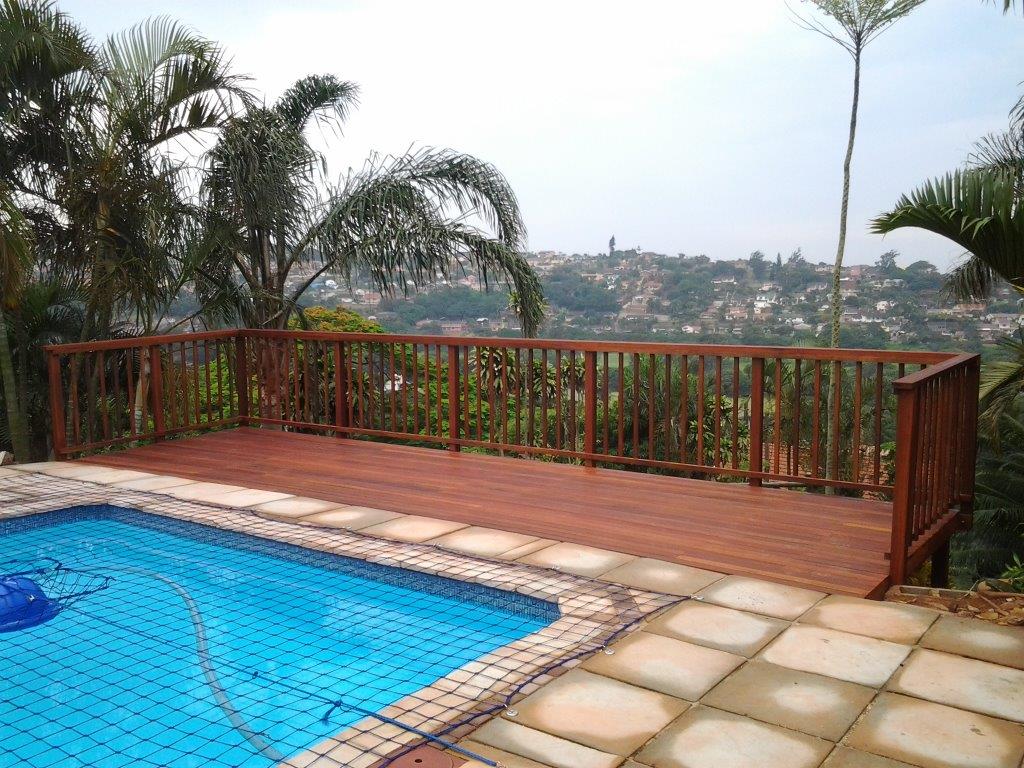
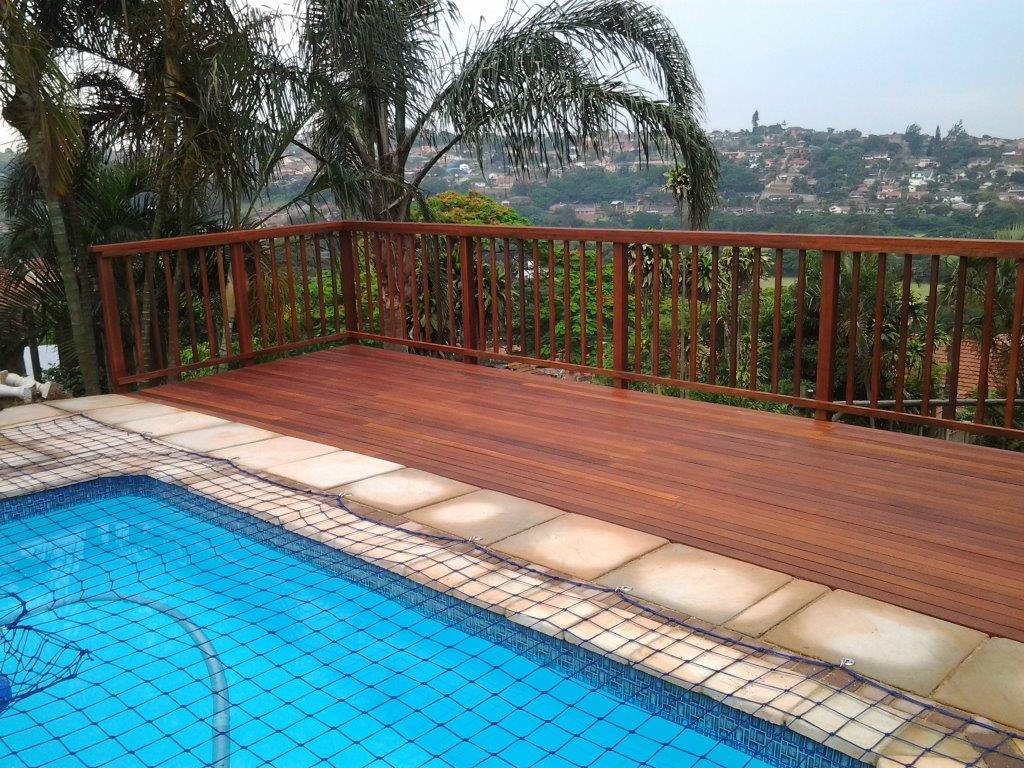
This sundeck we installed in Durban was a relatively simple one to build. The client wanted to extend the area around the pool to create more space. It was a simple cleat, beam and joist system with a fascia beam on the front to attach the balustrade uprights to. There was one challenge in that the retaining wall that runs below the paving next to the pool was not parallel to the paving and as such not parallel to the edge of the deck. A bit of fancy timber work was required with supports, small posts and sleeve anchors which created a substructure that became parallel to the pool, paving and resulted in the sundeck being parallel too.

Many of the properties in the Bluff are on situated on steep slopes and decking allows the home owner to reclaim a lot land that would not have been utilised. Terracing the garden is one option and decking over those can add extra space to one’s garden and therefore value to one’s property. I’m not sure if you have noticed, but a garden that has even a few stairs tends not be used as much as a garden that flows on the same level. It is important therefore to design the deck in such a way that you try to keep it all to one plane or the same level. This will result in more of the garden being used. If stairs are necessary one should consider staggering it over a longer length rather than 1m wide stairs.

Wooden sundeck Durban

Click to enlarge

On this build posts had to be set again in the cavities of the loffelstein retaining wall. It was a relatively small deck and only took a few days to complete. I am sure the owners are now enjoying it through the last two summers and it has created a lot more space that they can now use in their garden.

It was sealed using a Timberlife Satin Wood Base 28 sealer with a mahogany tint. This sealer soaks into the timber rather than leaving a varnish type finish on the surface. There are two types of this sealer, one for woods of high porosity (pine) and one of timbers of low porosity (balau). Be careful to select the correct one. It is relatively low in wax content compared to their other products which is better for the horizontal surfaces that tend to get hammered by the hot African sun. The higher wax content sealers are good for vertical surfaces such as balustrades, screens, cladding etc. It is very easy to apply as it is very viscous and because it doesn’t dry on the surface, brush marks and runs are impossible to achieve. It simply soaks in. 2 to 3 coats are recommended and in the first year of the decks life it will be necessary to reseal it every 3 to 4 months. As time goes by the maintenance intervals will become longer as the timber is continually being nourished with this sealer.

It is inexpensive and is easy to use so re-sealing every 3 or 4 months in the first year is also inexpensive. There is no need to sand the deck before each application. Simply clean it, high pressures clean it if you wish, and re-seal. I will go into more detail in another article on sealing decks and maintaining them as it is a subject that warrants its own platform. Since writing this I have written and article on deck sealing which can be found here.

For a free no obligation quote or to discuss the design of your deck, please complete the form below and we will contact you.  Or you can call us on 082 496 5444.

Go back

Your message has been sent

Warning
Warning
Warning
Warning
Warning
Warning

Warning.

Pool Deck Built in Northdene, Durban

Pool Deck Builder Durban

Click to enlarge

This pool deck we built in Northdene was in excess of 100 square metres. Pool decks can be quite difficult to measure as the pool is sometimes not square and the area to be covered is often an irregular shape. Care should be taken to measure it properly to avoid an underestimate of area for both the client and the contractor. No one, the client nor the contractor, wants to realise half way through the job that it has been grossly under, or over, quoted.

There were two levels on this deck. An area of about 1m running around the pool was in concrete while the rest of the deck was to be laid on soil. Also there was an area towards the steps where the existing concrete sloped upwards in an effort to get rain water to run towards the pool instead of collecting near the wall. This area ran almost up to pool level, so in order to get the deck level at the height we wanted we had to cut our baton at a wedge shape.

We placed posts in concrete throughout the soil area and where we got to the concrete plinth around the pool we switch to a 30mm baton. In total we decked about 100m². It took time to lay these joists and make sure that the tops were all flat and level. Deckboards also took time as we laid them down without a single joint line.

Pool deck builder Durban

Click to enlarge

Where a deckboard ends and new one starts, creates of course a join in the surface. What one needs to do is sort of finger the deckboards so that the join is alternated on each adjoining deckboard. This is not only more pleasing to the eye but also prevents lifting in one single line. If a deckboard is going to lift it will almost always lift on the join. If all those joins are in a straight line then it will lift along the entire line. If they have been staggered then it won’t be as noticeable or as serious. So they took longer to deck but are done the correct way.

We built a small hut around the pool pump and heater that came off an adjoining wall. The hut had its own doors and roof and finished it off neatly to cover the pump and filter.

Around the edge that was exposed to the pool water we planned some deckboards to 10mm thick which allowed us to bend them around the curve of the pool. This fascia will protect the deckboards from excessive water from the pool and will ensure they last longer. Wood has a tendency to take in water from the end grain. Picture it as a bunch of straws held together. The water will travel up the end grain and this is where rot will start. Wood takes in very little water from side or face grain and it is therefore imperative to seal the ends off properly. When timber is purchased one will always find that the ends have been sealed using a wax substance. This is done in order to prevent the wood taking in water during transport, often by ship. Once it gets to site, it is cross-cut and this seal is lost. It is important therefore to apply plenty of sealer to this end grain.

Pool deck builder Durban

Click to enlarge

For a free no obligation quote please complete the form below and we will contact you.  or you can call us on 082 496 5444.
Go back

Your message has been sent

Warning
Warning
Warning
Warning
Warning

Warning.