Driveway Gate Clad in Balau Wood

Driveway gate clad in balau

Click to enlarge

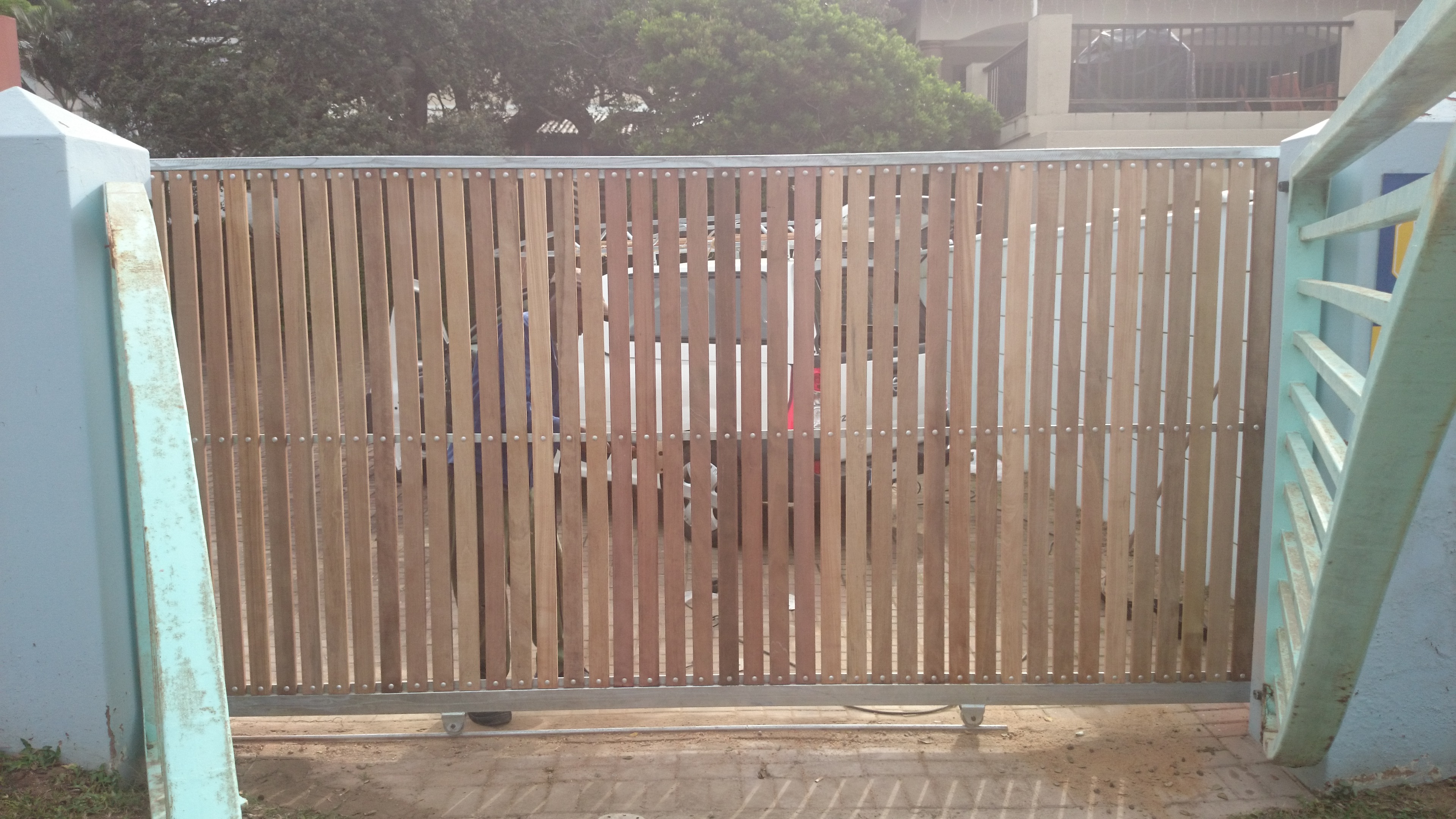
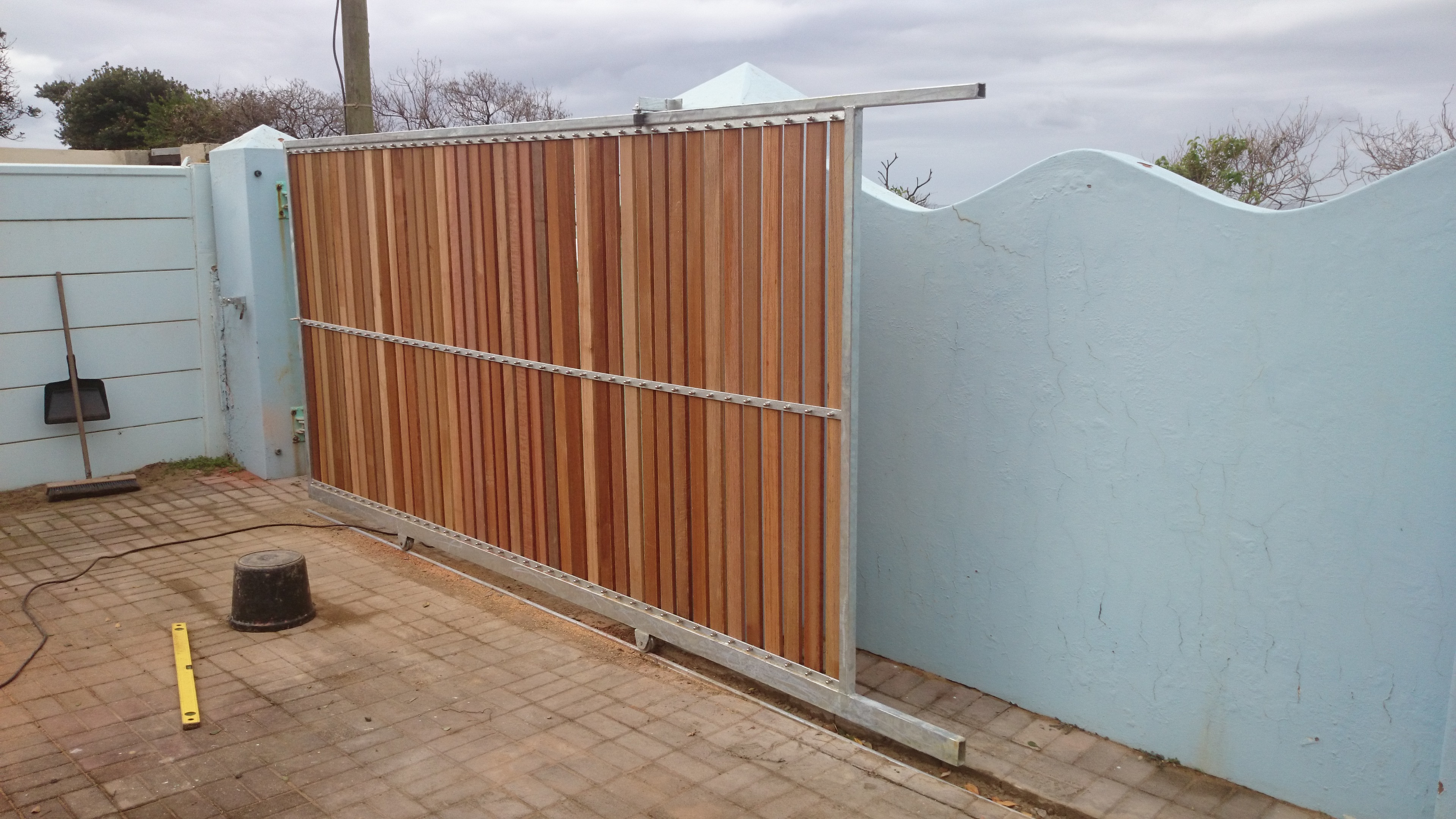
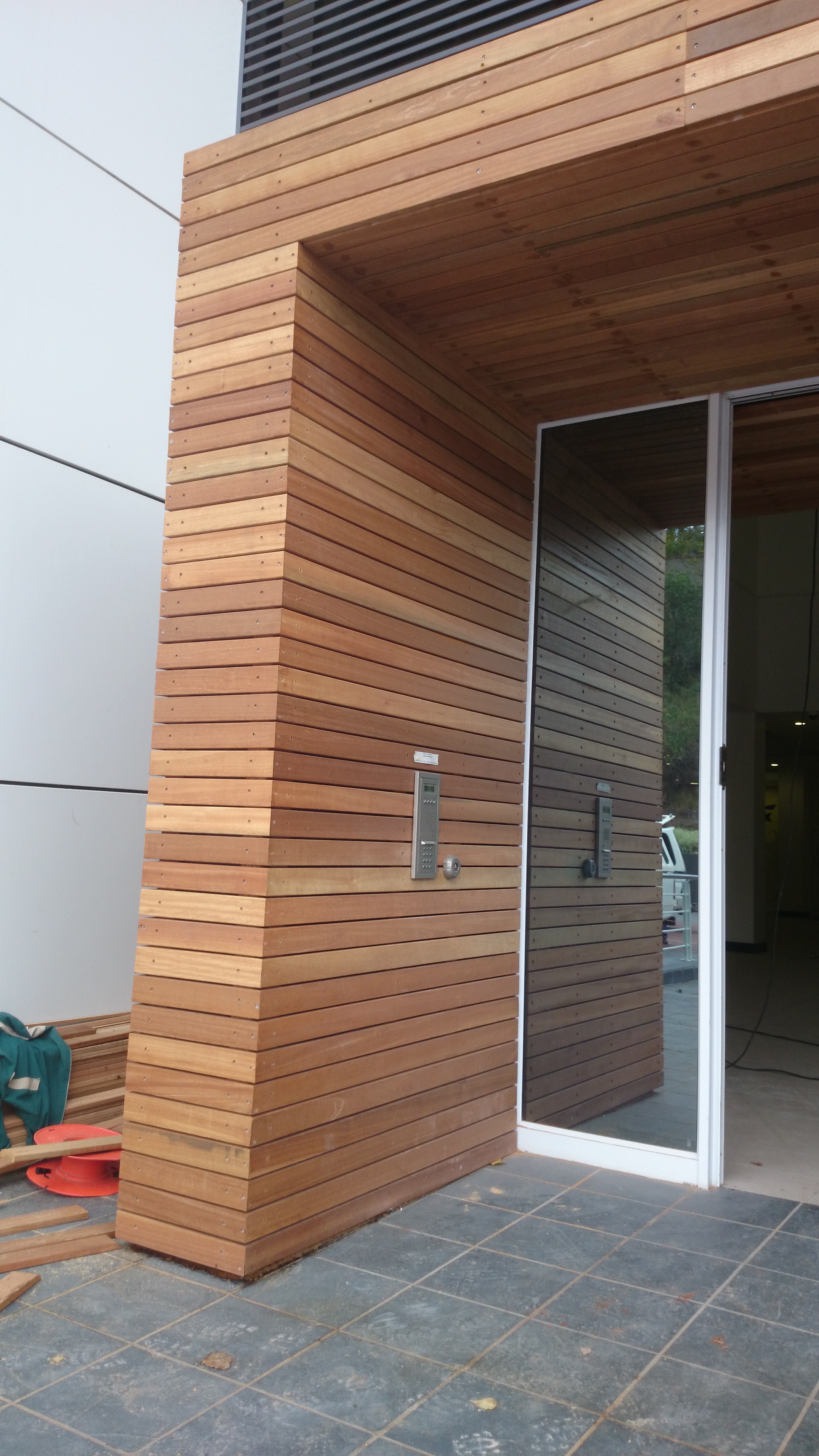
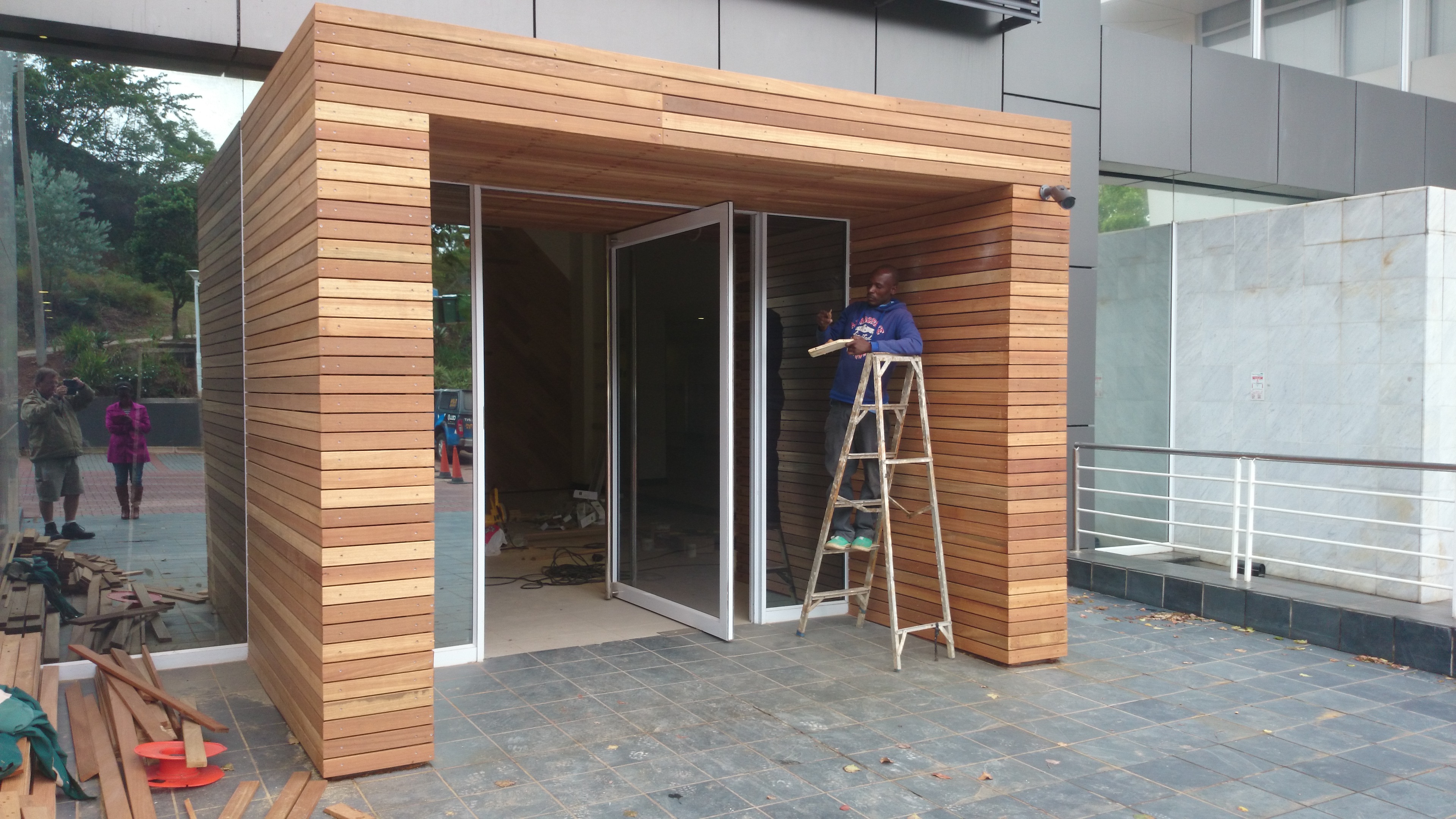
Here’s another driveway gate that we clad in balau in Umdloti, North of Durban. In the pics you can see the old gate which we left in place while we installed the new balau timber clad driveway gate and them removed it afterwards and scrapped it. Because this gate is right on the road facing the beach it had rusted beyond repair.

The steel gate was designed using 38mm x 76mm rectangular tube as a rectangular outer frame which then had a cross flat bar of 5mm x 30mm running horizontally across from one side to the other. At the top and bottom we welded flat bar on to the rectangular tube which had pre drilled holes in it to accept our deck boards. The horizontal cross flat bar was there to stop the deck boards bowing over time. It was all hot dip galvanised. I don’t recommend painting the galvanised steel. It can be done quite successfully but will always be a maintenance issue and will need re-painting every year or 18 months.

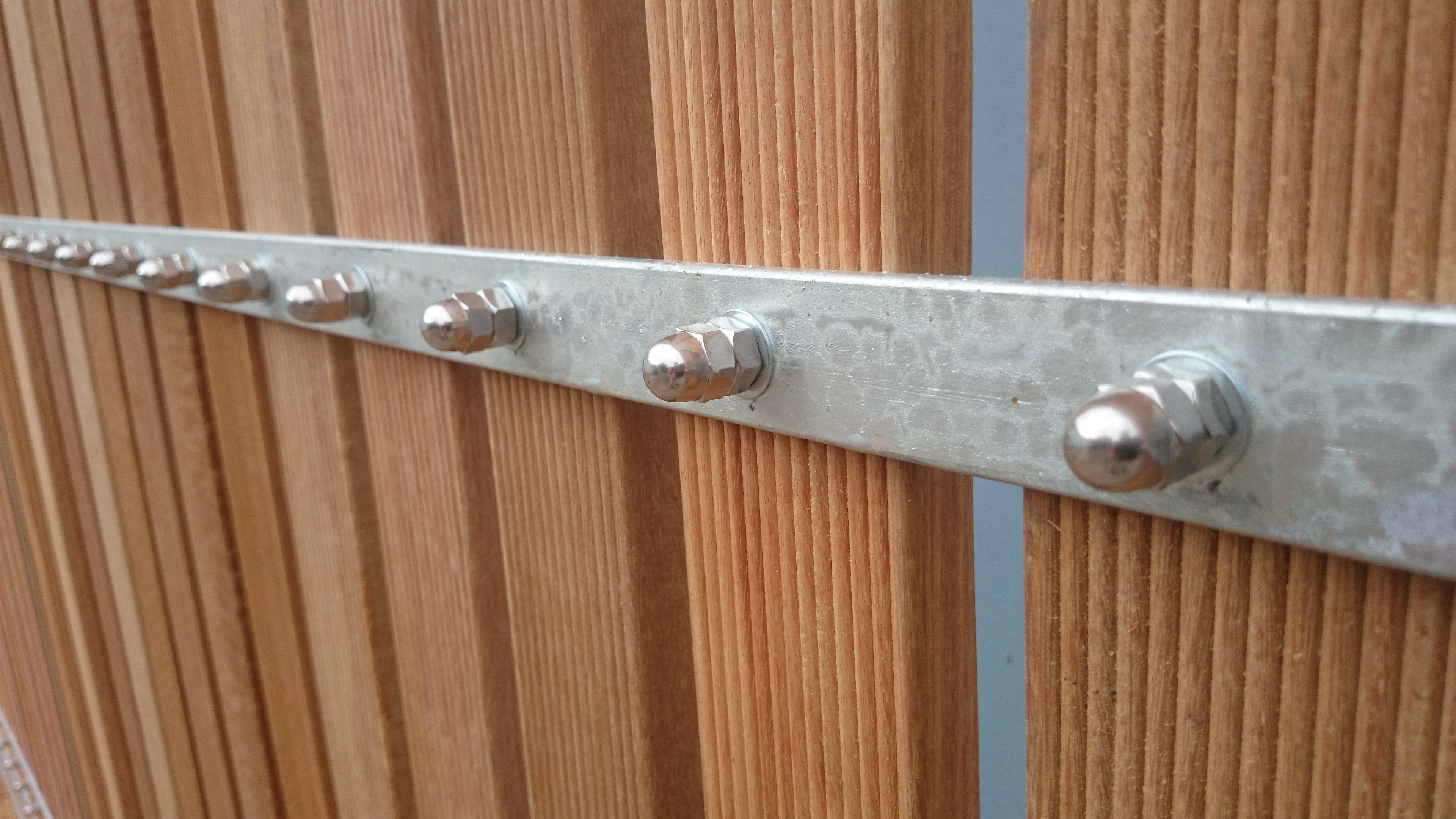
We set he track in concrete and attached the brackets which keep the gate plumb and then set the gate on its track. Only once it was on its track did we attach the deck boards to the flat bar on the top and flat bar on the bottom by lining up the board with equal spaces and drilling a hole through the wood. We used a 40mm galvanised hex bolt with a nut on the back-end and then finished it off with a stainless steel dome nut. It would be better to use stainless throughout, that is the bolt, washers nuts and dome nuts as they won’t rust.

Driveway gate clad in balau

Click to enlarge

We left the timber unsealed as the client wanted it to turn natural grey. It doesn’t really affect the longevity of the timber. Balau contains natural resins and oils which slow down the process of rot considerably compared to other woods.

The trick in setting these deck boards is to make sure that they are equally spaced. It is fairly simple because the pre drilled holes are calculated to be dead centre so theoretically each hole should be drilled through the centre of the board. Practically though you need to still be careful to get the space between boards equal even at the cost of not drilling dead center of each board. The time-consuming part of this job is pre-cutting the deck boards to exactly the correct length to fit snugly in below the top and bottom tube.

The flat bar on the top and bottom, to which the board is attached, is set off centre so that the steel on the front of the gate is flush with the deck boards once they are installed. i.e. the deck boards are recessed.

When measuring for the steel frame you want to get the whole frame visible when the gate is in a closed position. You always set your boards so that the good side is on the outside.

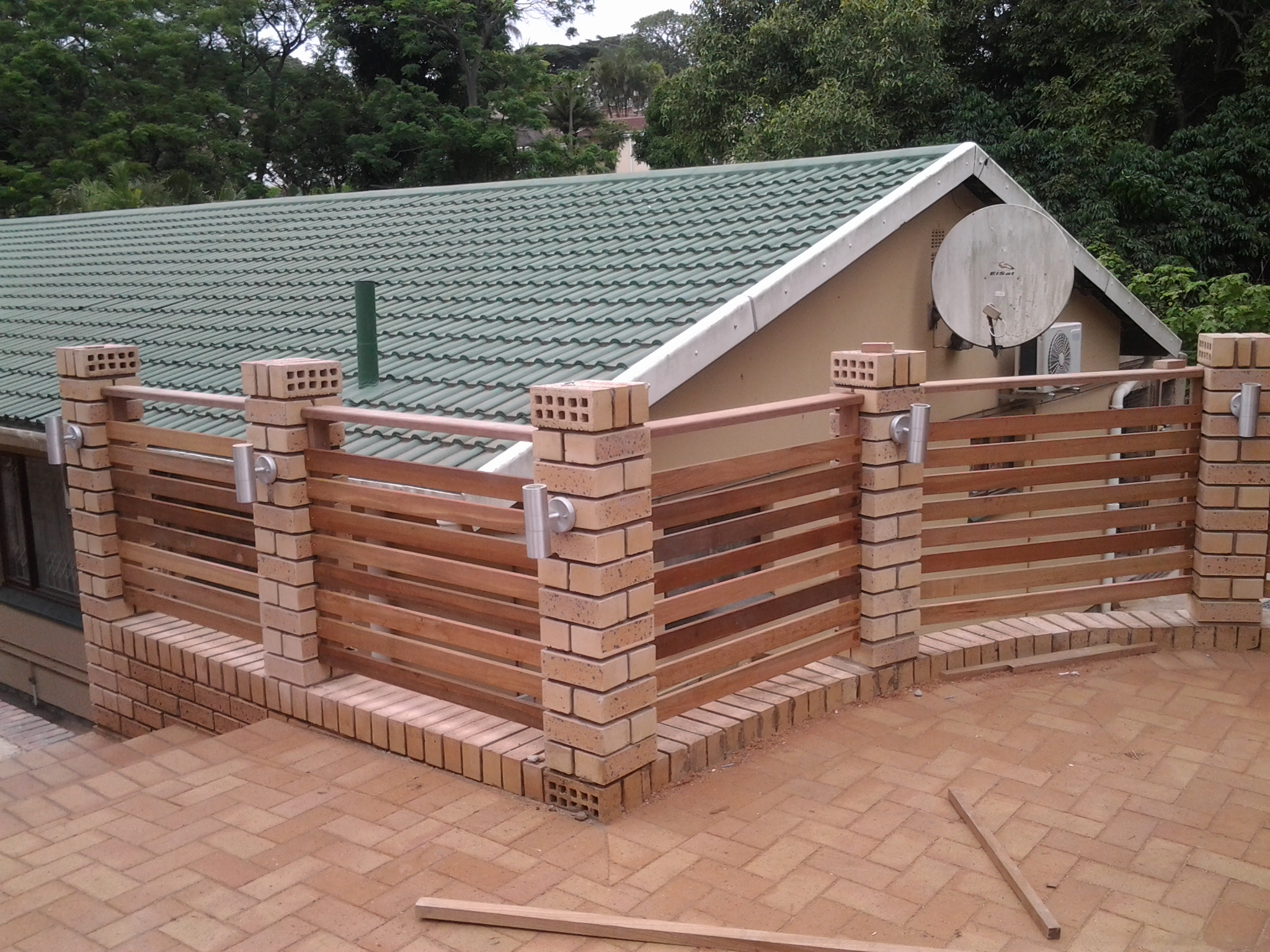
What goes very nicely with these types of gates is matching timber in fills on a masonry boundary wall.

Driveway gate clad in balau

Click to enlarge

For a free no obligation quote for driveway gates clad in balau or other timber, timber in fills on boundary walls and all your outdoor timber construction, please contact us on 082 496 5444 or use the contact us form below.

Go back

Your message has been sent

Warning
Warning
Warning
Warning

Warning.

Wooden Pergola Built in La Lucia, Durban

Wooden Pergola Durban

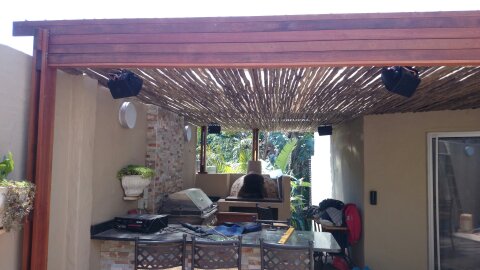
Wooden pergola with thatching laths

This was an interesting wooden pergola we built in Durban. Most often pergolas are built using planed all round pieces (PAR) in the traditional pergola design which is vertical posts to support the structure and horizontal purlins of varying width and thickness to cover the top. Wooden pergolas don’t really offer any functional benefit as the rain still comes through and it offers limited sun protection depending on the density of the purlins above. This one however offered both protection from rain and sun yet still allowed light to come through.

We built a structure using H3 CCA Pine which is guaranteed for 50 years against rot and insect infestation. On top of this we placed polycarbonate roof sheeting which we got from Modek. We used their bronze translucent one so that it breaks the sun yet still allows light through and of course offers protection from rain. It is best to use custom-made lengths so as to avoid any joins which would need to be waterproofed. It is not sufficient to overlap them in the direction of the fall. Because the angle or pitch of the roof sheeting is relatively gradual, the wind can blow the water backwards, up hill and through the joins. So it must be waterproofed to avoid any leaks. It is therefore much better to use one full length, the same length as the structure itself.

Once our roof sheeting was on we installed thatching laths beneath with no gaps between them. These laths vary in diameter from 20mm to 35mm. So one needs to install them head to toe to limit the size of the gaps between them. This way they become quite dense so that one can’t see the structure or roof sheeting from beneath, but they still allow enough light through. In other jobs we have installed them with as little as half a laths diameter gap, but that still allows quite of lot of visible roof sheeting from beneath. It is therefore better to stack them tightly up against each other.

After these we clad the sides to cover or hide the pine we used with balau deck boards. The balau is a much better looking wood in terms of grain, colour and the straightness of each board. Balau is very stable and will tend to warp or cup less than pine over the years. So the appearance of the structure will remain flat and square a lot longer than pine.

Wooden Pergola Durban

Wooden pergola with thatching laths

The final product was a rustic looking pergola which offered protection from sun and rain yet still allowed natural light through. The client later installed a sound system and lights beneath. They had a pizza oven installed and a gas braai with a bar area which made for a very nice outdoors entertainment area which was protected from the elements.

For a free no obligation quote on pergolas or other decking needs as well as floors or laminates please contact us on 082 496 5444 or you can use the form below to e-mail me.

Go back

Your message has been sent

Warning
Warning
Warning
Warning
Warning

Warning.

Nailing Solid Wood Floor Boards

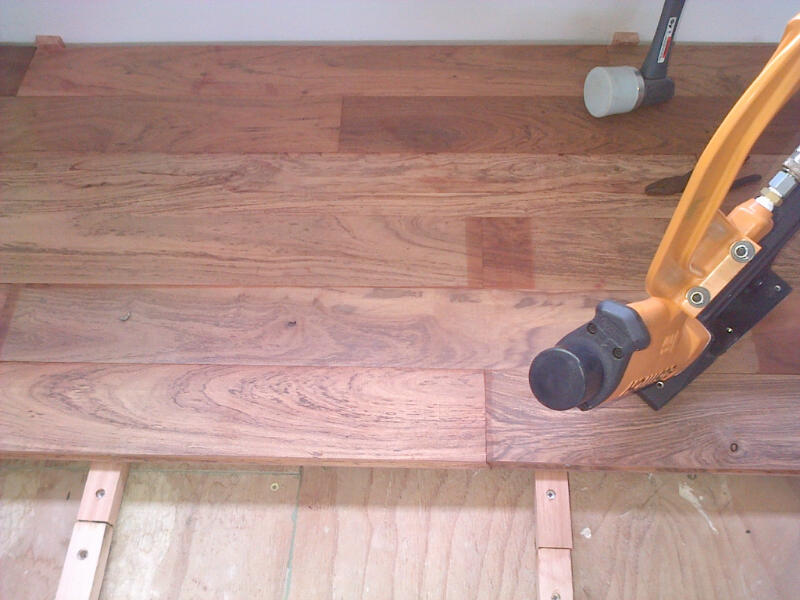
Nailing solid wood floor boards down can be a time-consuming job if done manually. When nailing tongue and groove floor boards down, one needs to nail the nail through the tongue at 45° and counter sink it slightly so that the next floor board can be slotted in over the nail making it invisible.

If this task is done by hand then one needs to nail it and then use a punch to counter sink it so that you don’t damage the tongue. As the hammer gets used it picks up small traces of oil from the nail and eventually it starts slipping off the head of the nail which will damage the board or the tongue. To avoid this one needs to occasionally sand the head of the hammer to remove that oil and to rough the head up a bit. Just a quick light sand will do the trick.

The nail that would most commonly be used for nailing solid wood tongue and groove floor boards down is a 40mm oval nail. The nail is fairly thick in diameter and if a very hard wood like teak is being used you may need to pilot a hole first so that the oval nail doesn’t split the tongue. With softer woods it is not necessary. You will also need to hammer the board tight up against the preceding board so that there are no gaps and then drive you nail in.

This is all very time-consuming so one would tend to try to use a pneumatic tool to drive these nails in. A normal brad nailer won’t work as you won’t be able to get the head of the nail to be counter sunk so that the next board can be installed without a gap. Also the brad nails are not ribbed so tend to pull out over time. They also have a very small head so can pull through the tongue over time.

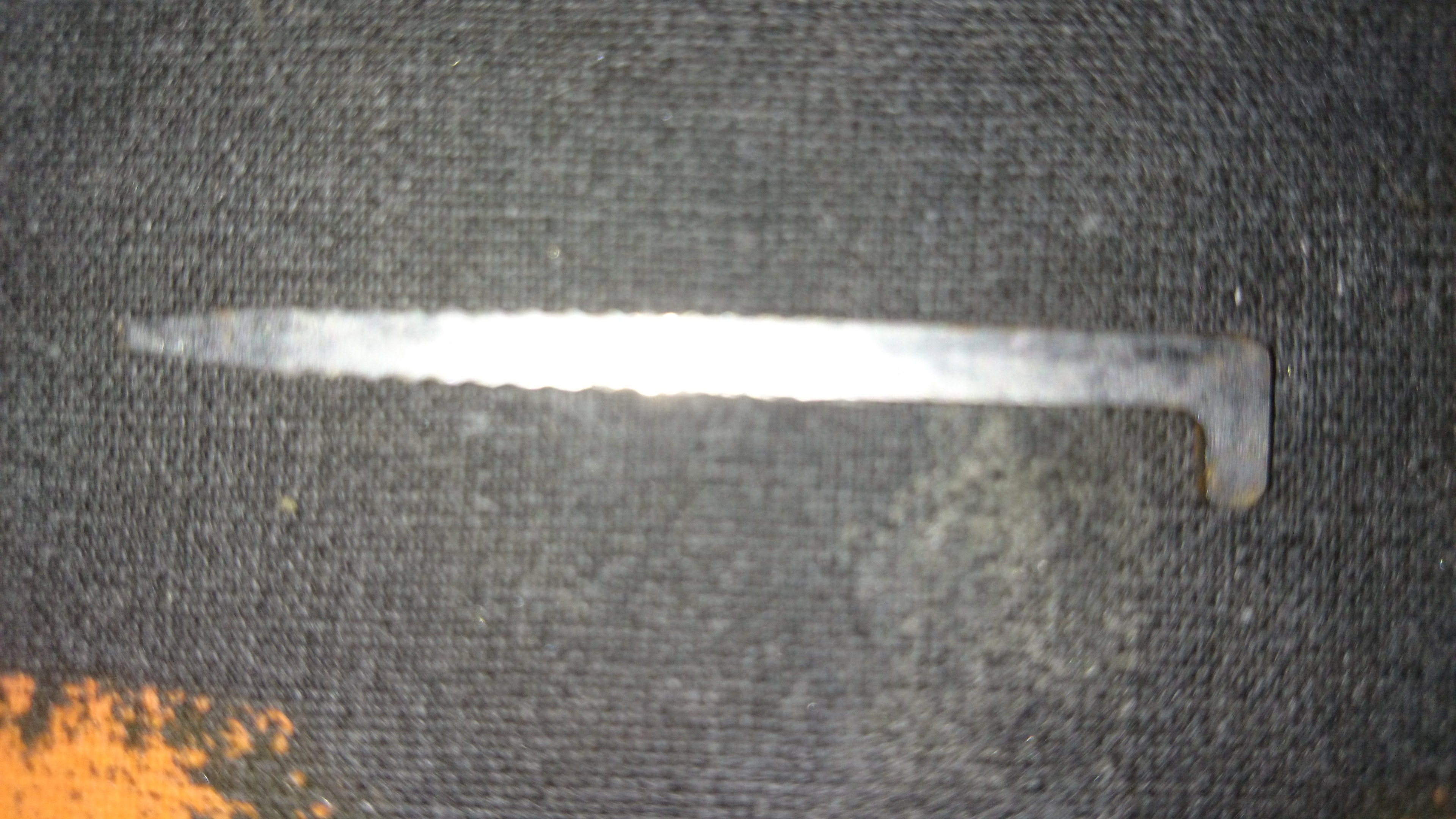
There is a specialised tool for this job. It is a dedicated hardwood floor nailer. The video above is pretty self-explanatory in how the tool works. The nail is a hook shaped nail which is driven in at 45° and counter sunk. The nail is also wide but not thick. It is designed to enter the tongue with the width in the direction of the grain and the thickness, which is not very thick at all, against the grain. So splitting of the tongue is reduced to a minimum and the hook prevents the nail from pulling through the board. These nails are also ribbed so they do not pull out over time.

Solid wood floors

Nail for pneumatic nailer

The machine is also designed so that the shaft that pushes the nail in, is used to counter sink the nail. The same applies to a normal brad nailer, but because this tool is designed at 45° it is able to reach all the way into the corner of the tongue.

Because the tool is struck with a hammer, the tool also pushes the board tight up against the preceding board as it nails it down. So any gaps between boards are closed, slightly before the nail is driven through the tongue.

A very useful tool if you are laying many floor boards but cost prohibitive if you are not.

Please contact us for your solid wood flooring needs, laminates, wooden decks and wooden fences by calling us on 082 496 5444 or using the contact us form below.

Go back

Your message has been sent

Warning
Warning
Warning
Warning
Warning

Warning.

Wooden Sun Decks Durban – Westville

Wooden Sun Decks Durban

Click to enlarge

Wooden Sun Decks Durban

Click to enlarge

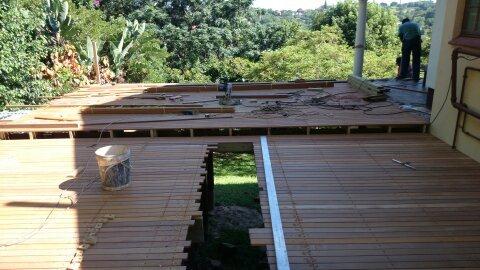
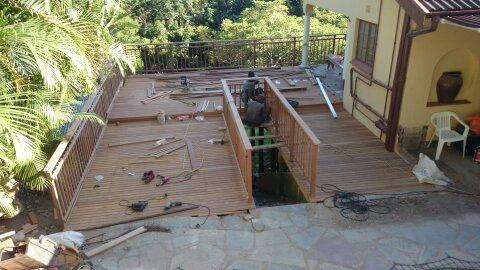
This wooden sun deck we built in Westville Durban was designed to try to maximise outdoor space. The house we built it at had very little outdoor space as it was situated on a steep plot. You can see from the pics that before we built the wooden sun deck, the garden had only a small area of about 1m around the pool on the front side of the garden. There was then a steep concrete staircase down the side of the house going to the back garden. The back garden was however not very usable as it was far from any entrance to the house. So the idea here was to build a wooden sun deck that extended from the slasto of the pool area to meet the far side of the house. It was about 48m² in total floor area and was surrounded by a wooden balustrade in a picket design. We left the existing concrete stair case in place and built the wooden sun deck so that one could use this existing stair case. Hence the U Shaped deck.

Wooden Sun Decks Durban

Click to enlarge

We also had to split the wooden sun deck into two levels as the area by the pool was a little lower than the area where it met the existing concrete deck. So we had a split level deck with a small step up of about 180mm. 180mm is always a good step height or riser height.

Wooden Sun Decks Durban

Click to enlarge

The posts beneath had also been lined up so as to avoid being placed in the middle of the stair case. Even though the outer posts were some distance from the bottom of the stairs, if we had placed them where they would normally have gone (i.e. equal distances from either end) then it would have spoilt the line of sight as one was walking down the stairs. So they were shifted slightly left and right to miss the line of the stairs.

We also had a garden shed beneath the front edge of the deck so we had to build around that which had had a new roof built on it and waterproofed. When building over waterproofed structures one cannot drill through the torch on as it will results in leaks beneath. You need to then build on either side of it or use thicker beams and joists to be able to span them further apart.

Wooden Sun Decks Durban

Click to enlarge

Wooden Sun Decks Durban

Click to enlarge

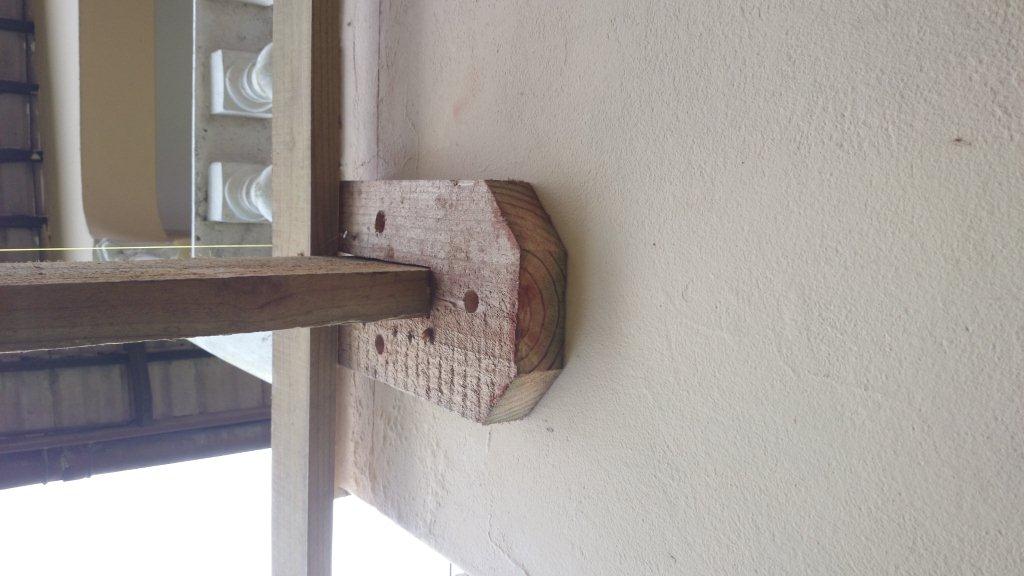
In the pics on this article you can also see the horse shoes we used to support the beams on the walls. Instead of dropping posts to ground you can simply attach the beam to the wall by cutting a horse shoe using the same timber as the beams. The bottoms are always cut to 45° for both neatness and to avoid having sharp corners jutting out. This also applies to the ends of main beams.

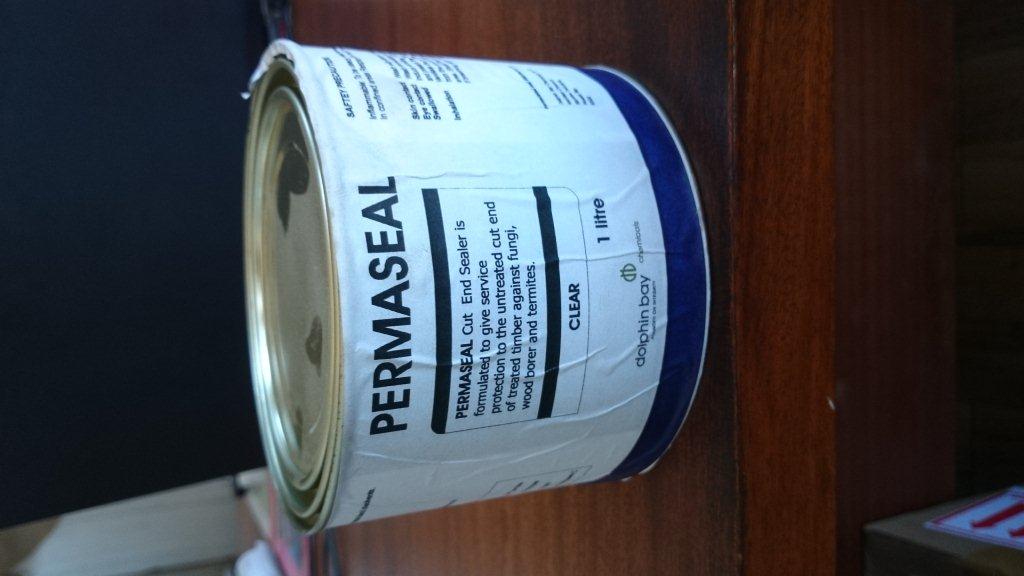
We treated our cut ends with Permaseal, an approved end sealer used to stop rot or insect damage to cut ends of CCA treated timber. This was necessary in order for us to activate the 50 year guarantee that the supplier provides on the CCA Treated pine substructure. There are a few articles on this blog that go into detail about this and what is required in order to activate your 50 year guarantee.

For a free no obligation quote on wooden sun decks, wooden floors or wooden fences, please contact us on 082 496 5444 or use the contact us form below.

Go back

Your message has been sent

Warning
Warning
Warning
Warning
Warning

Warning.


Wooden Post and Rail Fencing Durban

Wooden Post and Rail Fence Durban

Click to enlarge

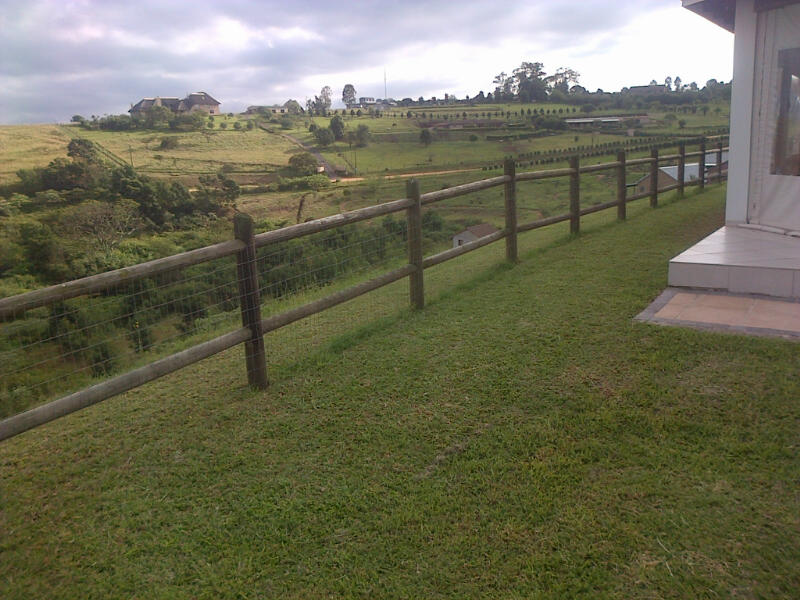
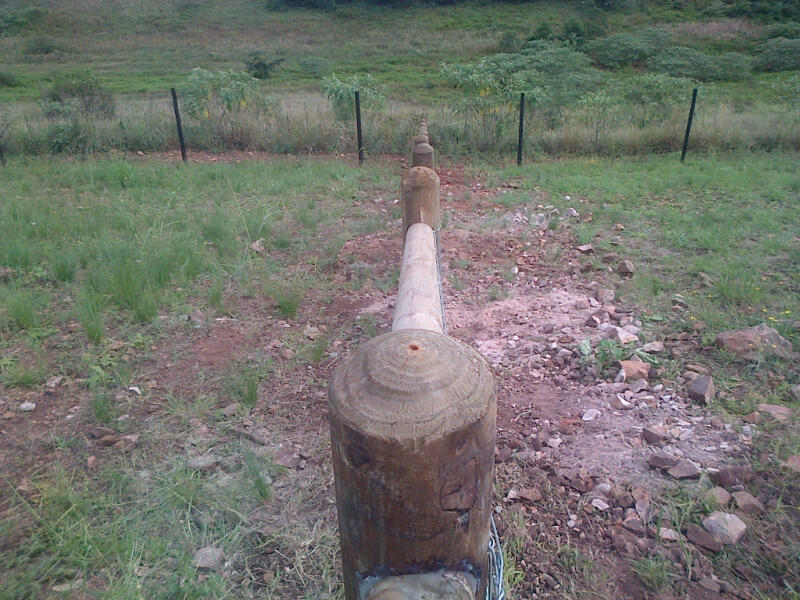
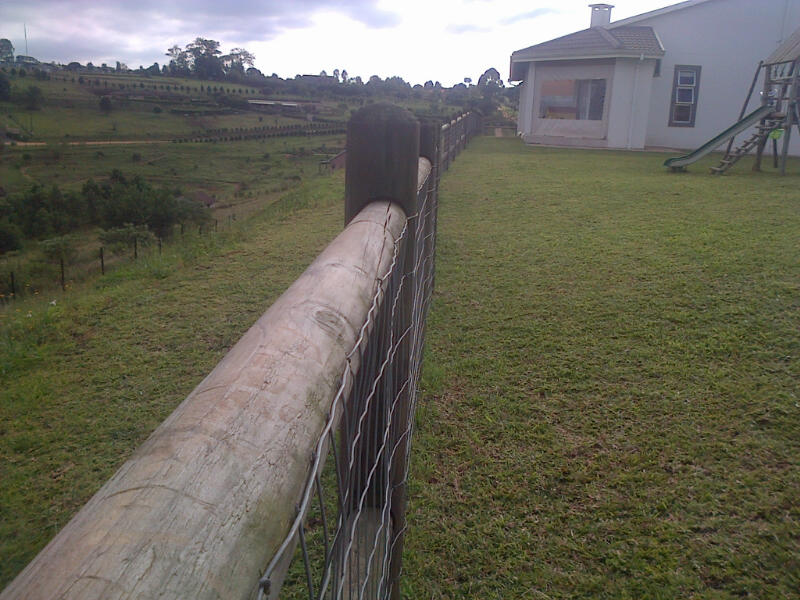
A wooden post and rail fence is an attractive boundary to your property. Although they have large gaps between the rails and posts they can be made secure by adding weldmesh as we did in this one in Summerveld. Wooden Post and Rail fences are traditionally associated with horse farms as in their normal state they successfully keep horses in without having to build a completely closed off boundary fence.

With a few fencing techniques they are relatively easy to install in that one simply needs to dig a hole, place a post, add a rail and then place the next post.  Of course you need to be careful that the top of each post is in a flat and straight line until you get to a point where the ground starts falling faster, at which point you would start a new line. So one would start with the first post and then dig a hole for the last post. Both posts can be set permanently. We use decomposed granite and cement mix so that the post is stable, without the need for concrete. This will prevent the posts from falling, or being knocked skew, over time. The decomposed granite is cheap in comparison to Umgeni sand and works just as well. The mix is a relatively weak mix (1 bag to 4 barrows), just enough to stabilise the decomposed granite without wasting cement.

From your first post dig all your other holes in a straight line. It is not absolutely important to get the holes the right distance apart. Rather set them 50mm or so shorter than they have to be to accept the rail as you can always cut 50mm off the rail to make it fit, but you can’t add a piece on to the rail. If you’re unsure dig shorter lines of posts so as not to find that half your holes need to be re-dug. Marking all the holes at the same time and digging them will save you time, and if you are using a breaker to get through rock, as we did on this job, then

Wooden Post and Rail Fence Durban

Click to enalrge

you can get finished with the breaker on day one rather than incur a hire charge for second day or more.

Then you simply place the rail in the pre cored hole in the first post and set your second post. It is better to use a nail, at 45° to secure this rail to the post so that it doesn’t move.

You will see from the pics in this article that every so often the top of the fence changes line to remain parallel to the ground. Don’t change it too often as this will give the top of the fence an uneven appearance, but change it where necessary to remain more or less parallel to the ground.
If the ground is fairly steep you can battle to get your rail in the post as the pre-cored holes are cored at 90° to the post. So you may need to trim the end of the post to get it to fit properly.

There are various types of posts that you can buy. Ends are the posts that have only one hole cored in them. Intermediaries are those that have two holes cored at opposite ends. There are also 90° bends and 135° bends that can be used for either a 45° corner or a 135° corner.

The posts come in various lengths so you can install a 900mm high fence, a 1.2m, 1.5m and so on. You can opt for a single rail, double rail or triple rail. Obviously you won’ get a 900mm high fence with three rails but they are available for the higher fences.

There are two different types of post and rail fence. Some of the poles are grown

Wooden Post and Rail Fence Durban

Click to enlarge

and manufactured in KZN. Others are grown and manufactured in The Cape. The Cape Timber is better as it is less prone to splitting, but, at the time of writing, there were not many companies bringing them up from The Cape due to volumes and cost. Be careful not to mix them though as the cored holes are often drilled in different places and the diameter sometimes varies.

Once you posts and rails are up you can install weldmesh on it to keep the dogs, or the kids, in or the neighbours’ dogs out.

Gates can be built from the post and rails and hinged using heavy-duty galvanised gate hinges. On this job we had some hoops fabricated from steel to latch the gate which added a nice finishing touch to the job.

For a free no obligation quote on your post and rail fence, other wooden fences, sun decks or flooring needs, please contact us on 082 496 5444 or use the contact us form below.
Go back

Your message has been sent

Warning
Warning
Warning
Warning
Warning

Warning.

Wooden Sun Deck Repairs – Durban

Wooden sun deck repairs Durban

Besides our main activity of sundeck building in Durban, we also maintain and repair sundecks.

Wooden sun deck repairs need to be performed from time to time and the sooner they are attended to the better. If a wooden deck is constructed correctly these repairs can be kept to a minimum, but from time to, factors beyond anyone’s control can result in repairs having to be made to your wooden sun deck.

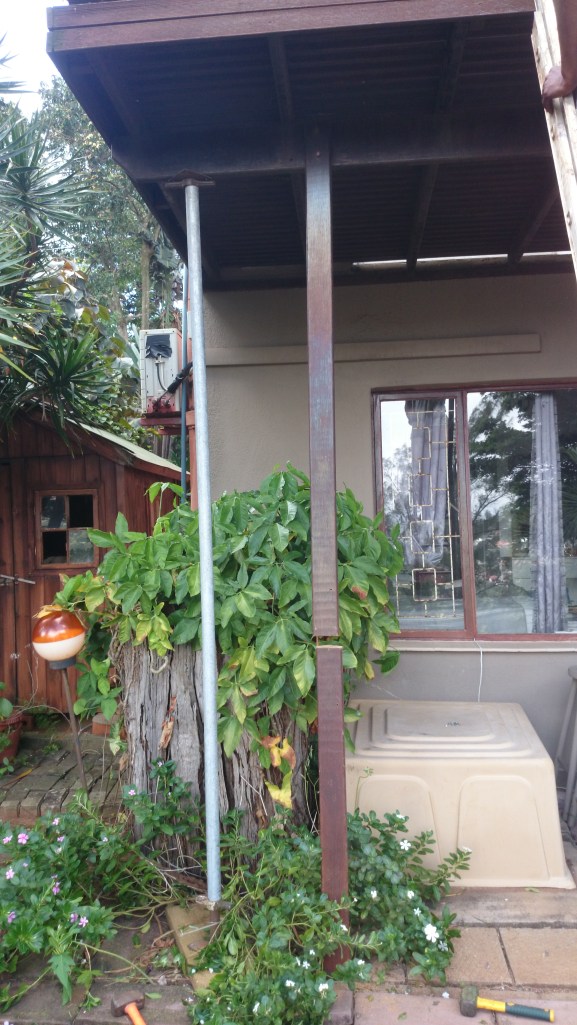
The pics alongside show how we repaired this wooden sun deck in The Bluff Durban. It had been built on two posts of balau that were about 2.6m high. One of the posts had, for some reason, sunk slightly, soon after building the deck, but had since stopped sinking. The deck was about 7 years old and the subsiding had apparently occurred in the first year after building it. We were happy that it had stopped subsiding so we were able to use the existing posts to correct it. The client didn’t want us to install a new post because there was a lot of concrete and paving around the base which would have resulted in digging that up in order to set a new post and remove the sinking one.

Wooden sun deck repairs Durban

Wooden sun deck repairs Durban

Wooden sun deck repairs Durban

Wooden sun deck repairs Durban

The reason for it subsiding could have been that there were no horizontal nails inserted into the bottom of the post before it was concreted in. Nailing 6” nails into the wood at the bottom of the post and then setting concrete around the post will stop this sinking as the nails will act as anchors in the concrete. Without them the post can very easily move through the concrete and sink. Another reason could have been that the ground was not completely compacted and the whole level of the ground at that point sunk. Being The Bluff, the latter is quite probable as The Bluff is essentially one large sand dune and is continually moving.

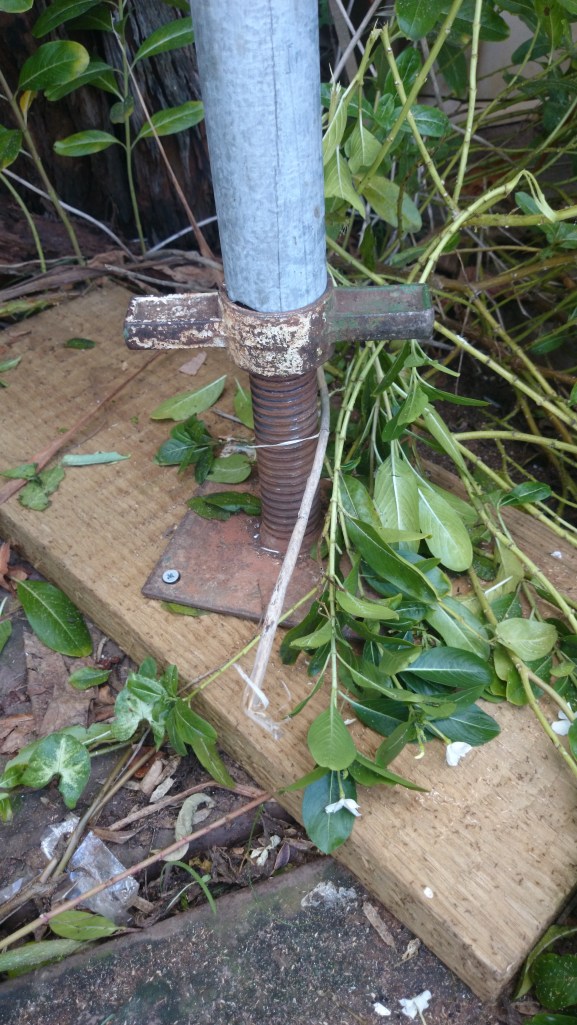
Because the post had sunk about 50mm the top of the deck was no longer level. We jacked the deck up using two scaffolding jacks, one on top and one below, and a 50mm pipe cut to size. We placed a nice flat piece of 50 x 228 timber below to give us a level base and a larger foot print that the scaffolding jack provided.

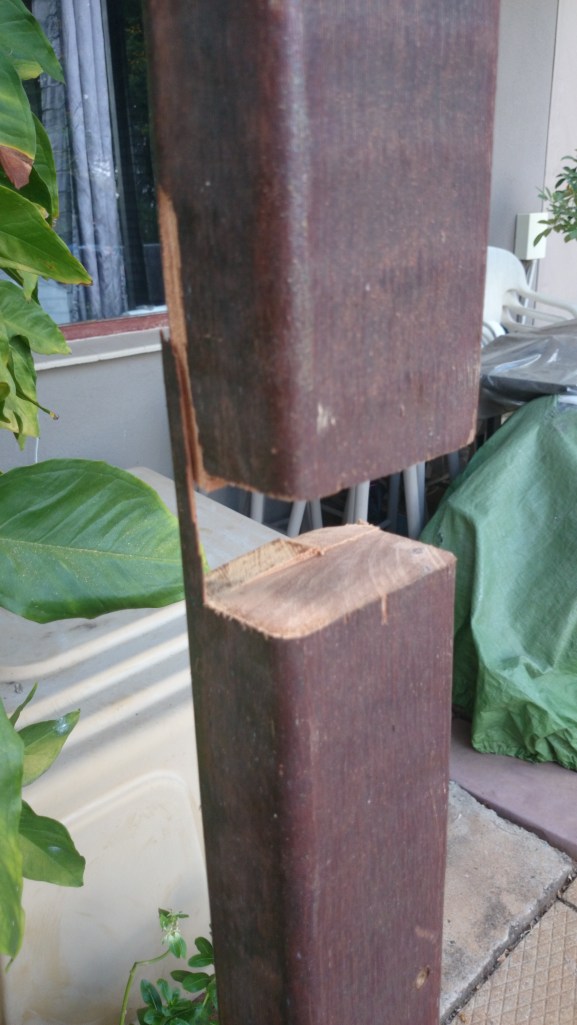
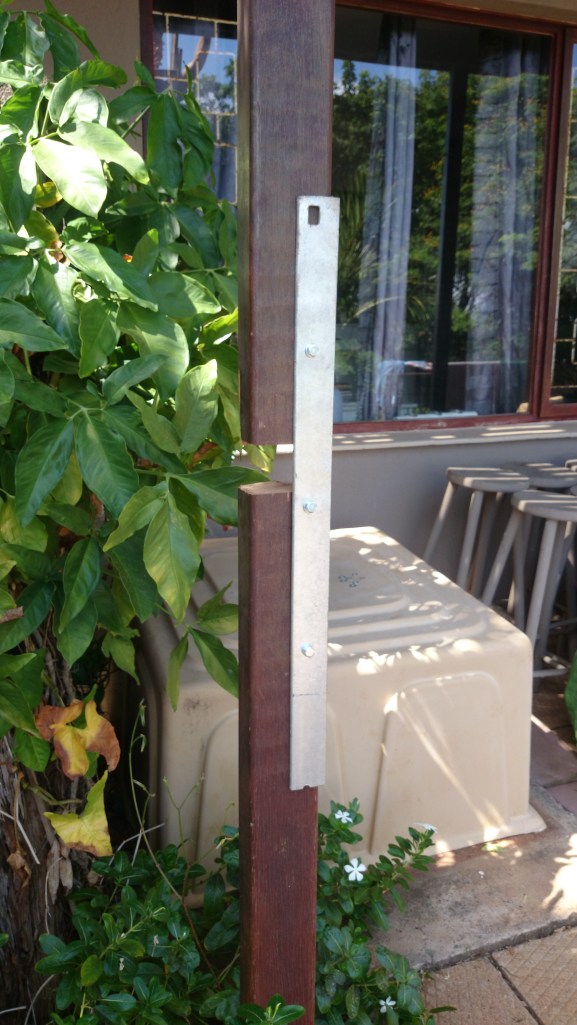
We took the pressure off the post by jacking it up until both scaffolding jacks became tight up against the ground and the beam respectively. We secured the scaffolding jacks to the beam and the base plate using screws so that it could not slip off once we started lifting the deck. Once the pressure was off the post we cut the post in half and then continued to jack the deck up to our required height checking periodically until the top of the deck surface was again level. Once it was level we installed two pieces of galvanised angle iron on opposite corners of the post using coach screws.

We then filled the cavity we had created in the post, of about 50mm, with a block off wood as a fail-safe in case the angle iron or coach screws ever failed. This way the post could not drop down, in the event of the angle iron failing, as the block would prevent that.

Although it doesn’t look as nice as it would have had we replaced the entire post, it was much easier to do, less expensive and eliminated the problem of digging up the concrete and paving.

For a free no obligation quote on your deck repairs, deck building or maintenance in KZN please contact us on 082 496 5444 or use the contact us form below.
 

Go back

Your message has been sent

Warning
Warning
Warning
Warning
Warning

Warning.

CCA Treated Substructures in Wooden Sundecks – Durban

Wooden sundecks Durban North

Click to enlarge

As I’ve mentioned in previous articles we use a H3 CCA treated pine substructure which the suppliers offer a 50 year guarantee on. In order to activate that guarantee we need to adhere to best practices and there are a few things that we need to do, and document by way of pics. 

Although all decks we build are built according to best practices, when applying for a guarantee we need to document it. So if you require a guarantee please let us know beforehand so we can collect all the documents we need to process it. These include charge sheets and retention records from the treatment plant to ensure that the chemicals used in the treatment process penetrated the timber properly. The charge sheets also document all sorts of things such as how much solution was added to the chamber, how much wood was in the chamber and how much solution much was left over. From this one can work out what the penetration was and can be verified through the retention records.

When the wood is treated it is placed in a chamber and all the air is sucked out to create a vacuum. Solution is then added to the chamber which now takes up the void or vacuum and the solution is sucked into the timber. They call this pressure treatment.

Wooden decks Durban

Click to enlarge

CCA is an abbreviation for Chromated Copper Arsenate. The copper stops fungus growing on the wood, which in turn causes the fibres of the wood to break down and rot. The arsenate stops insects from eating it and the chrome binds the two so that they don’t leach out of the wood. There are different hazard classes of CCA treated timber. For a full explanation you can visit http://www.sawpa.co.za (South African Wood Preservers Association).

Once this pine has been treated it can now get wet without the fear of it rotting because the fungus cannot grow. It is not water that causes rot, but rather fungus. The water allows the fungus to grow which breaks down the fibres of the wood which causes rot. So now your wood can get wet without rotting.

When the wood is treated, this CCA solution they use penetrates the timber based on the pressure they use and the time it remains in the chamber. The longer the time, the greater the pressure and the stronger the solution, the higher the hazard class and more resistant it is to rot and insect infestation. So timber being used outdoors subject to weathering (rain and sun) needs to be of a higher Hazard Class than timber being used in your roof where it is protected from rain to a large degree.

The depth of the penetration is subject to the density of the timber (pine vs. saligna or gum), and the time in the chamber. These retention records mentioned above are obtained from coring a section of the timber on each batch to ensure that the solution penetrated the timber properly. The charge sheets will outline how long the timber was in the chamber, the strength of the solution etc.

Wooden deck guarantee

Click to enlarge

So once all these documents have been collated, one can apply for a guarantee from the suppliers of the solution used in the treatment process.

One last criterion is that where we cut a piece of timber we need to treat the end grain with an end sealer approved by the supplier. This is because the solution used in the treatment process does not penetrate all the way through the timber. Depending on the density of the wood it will penetrate about 16mm into the timber. With pine, as opposed to saligna, it will obviously penetrate further as the timber is softer. Timber such as balau cannot be successfully treated as it is too dense. However it rarely needs to be treated as it is naturally resistant to insect infestation and rot due to the resins and oils naturally found in the wood.

By following the manufacturers and SAWPA’s guidelines one can successfully use treated pine as suitable outdoor timber for decking.

The pictures alongside show where we have used an approved end sealer to treat the timber on all cut ends.

For a free no obligation quote on your decking and other outdoor requirements please contact us on 082 496 5444 or use the contact form below.

Go back

Your message has been sent

Warning
Warning
Warning
Warning

Warning.

Timber Decks Durban – Umhlanga

Timber decks Durban

Click to enlarge

This existing timber deck in Umhlanga Durban had reached a point of no return and our recommendation to the client was that we remove it and replace it. It’s never a good thing to hear that you must throw it away and buy a new one because it can’t be fixed, but often wooden decks are not built as they should be built and they therefore do not last as long as they should.

From the picture alongside you can see the damage done to the posts at ground level as a result of insects. Given another year or so and those posts would have failed and although the deck might not have come falling down, it would have become unsafe and a danger to those trying to enjoy it.  See far below for pics of the finished product.

The existing deck had been built out of pine and I can only think that the wrong H class was used. As I’ve mentioned in other articles, pine used for decking purposes needs to be CCA treated to at least an H3 level and any pieces in direct contact with the ground should be treated to H4 level. You can read up more on the H levels here http://www.sawpa.co.za. In a nutshell though, off the shelf H2 treated timber will not last. And don’t be fooled by the timber yard telling you they will “double dip” it. The pressure between H2 and H3 treated timber is different, so doubling dipping H2 will not make H3, it will make H2 + H2 and it WILL rot. On the other hand if the correct H level is used the suppliers will offer up to a 50 years guarantee on this timber against rot and insect infestation. Who’s building a deck that will still be around in 50 years?

We first removed the existing deck boards so that the joists were exposed. We removed all joists but left the main beam on the front edge so that we could use it as our guide to installing the new beam. We used the existing posts as temporary posts to build our substructure, then installed our new beam and dropped posts to ground from there. We then removed the old beam and old posts and were left with a new timber deck substructure in pretty much the same place as the old one. It made our life easier and took a lot less time.

There was a gate we built and installed along the one side. We used stainless steel hinges on it. I’ve found that stainless steel hinges with bearings in the spine are not that costly. In fact a lot less expensive than brass and, in my opinion, a lot more durable. The solid brass can sometimes be a bit soft whereas stainless steel is a lot harder. This is especially the case when talking about screws. Brass screws tend to sheer of quite easily under pressure.

Timber decks Durban

Click to enlarge

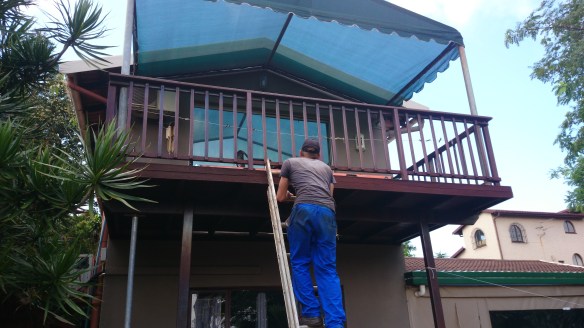
It was a nice job to kick the year off with as it was relatively simple. The only hurdle was trying to build 3m in the air on a very steep slope. We used extension ladders but still it makes it difficult and a bit slower because someone has to hold the ladder and keep moving it when screwing down pickets on the balustrade which is time consuming.

For a free, no obligation quote on your timber decking and other outdoor timber construction needs in Durban please call us on 082 496 5444 or use the contact form below.

Go back

Your message has been sent

Warning
Warning
Warning
Warning
Warning

Warning.

Timber decks Durban

Click to enalrge

Timber decks Durban

Click to enlarge

Timber decks Durban

Click to enlarge

Wooden Sundecks – Durban North

Wooden sundecks Durban North

Click to enlarge

Wooden sundecks Durban North

Click to enlarge

We completed these wooden sundeck jobs in Durban North last year during our busy decking season. There were two decks we built. They were both quite simple in that they were low-level wooden sundecks coming off the granny flat, which had just been refurbished measuring 5m x 2.2m.

The first one was a relatively small deck. It had two steps off the front edge with closed risers. That was probably the most difficult part of the job but we have worked out a way to build these quite effortlessly. We build the deck with a fascia beam on the front and then we build a box complete with supporting joists frame etc. We then attach this to the fascia beam of the deck we have just built and we are left with a frame which we can clad to create our riser and tread of our stairs. It is much easier to do it this way. Trying to build it piece by piece in situ is a lot more difficult and time-consuming. In fact building decks in sections and then hoisting them up into place is the easiest way to build as it allows you to work on a section of the deck on the floor, get everything square and then simply level it in place and attach it.  We had two concrete columns on the front edge of the deck so it was relatively easy to secure the deck and made for fewer posts and concrete.

Wooden sundecks Durban North

Click to enlarge

The second deck was closer to ground level off the patio of the main house. Again we built this in sections and lifted them up to secure them to the wall and then secured the front edge with posts to ground using concrete. Because of the length of the deck (11m odd) we had to build it in two sections and lift each section up independently of each other. It becomes a bit cumbersome trying to lift an 11m deck into place. So it is better to build it in two sections and lift each one separately. You need to be careful though that the entire structure remains flat from one end to the other. By doing them in two sections it is easy to get a kink in the middle. So run fish line from one end of the one section to the far end of the other section and adjust the join to get the entire frame flat and level.

In another article I will describe the different methods used to screw the deck boards down. Again there is an easy and quick way or there is the slow process of marking and cutting each board individually. What one wants to do is to lay all boards out and snap chalk line where the cuts should be, then cut them all, put them back and secure them. There is another method too where you screw the boards down and then lift the ends that need to be cut and cut with a skill saw.

Wooden sundecks Durban North

Click to enlarge

These two decks were sealed using Timberlife Satin Wood 28 Base, a sealer suitable for woods of low porosity. Being and oil based sealer it goes on very easily, cannot run or streak and when it comes to maintenance, you simply wipe clean and re-apply. You will need to do it a bit more often than other deck “sealers”, but there will be no more sanding as the oil cannot peel or flake like a coating does. It soaks into the wood, nourishes it, leaving the full natural look of the wood and simply disappears instead of flaking and peeling.

For a free no obligation quote on your wooden deck, balustrades, stairs etc. please call us on 082 496 5444 or use the contact us form below.
Go back

Your message has been sent

Warning
Warning
Warning
Warning

Warning.

Wooden Parquet Floor Sanding and Sealing

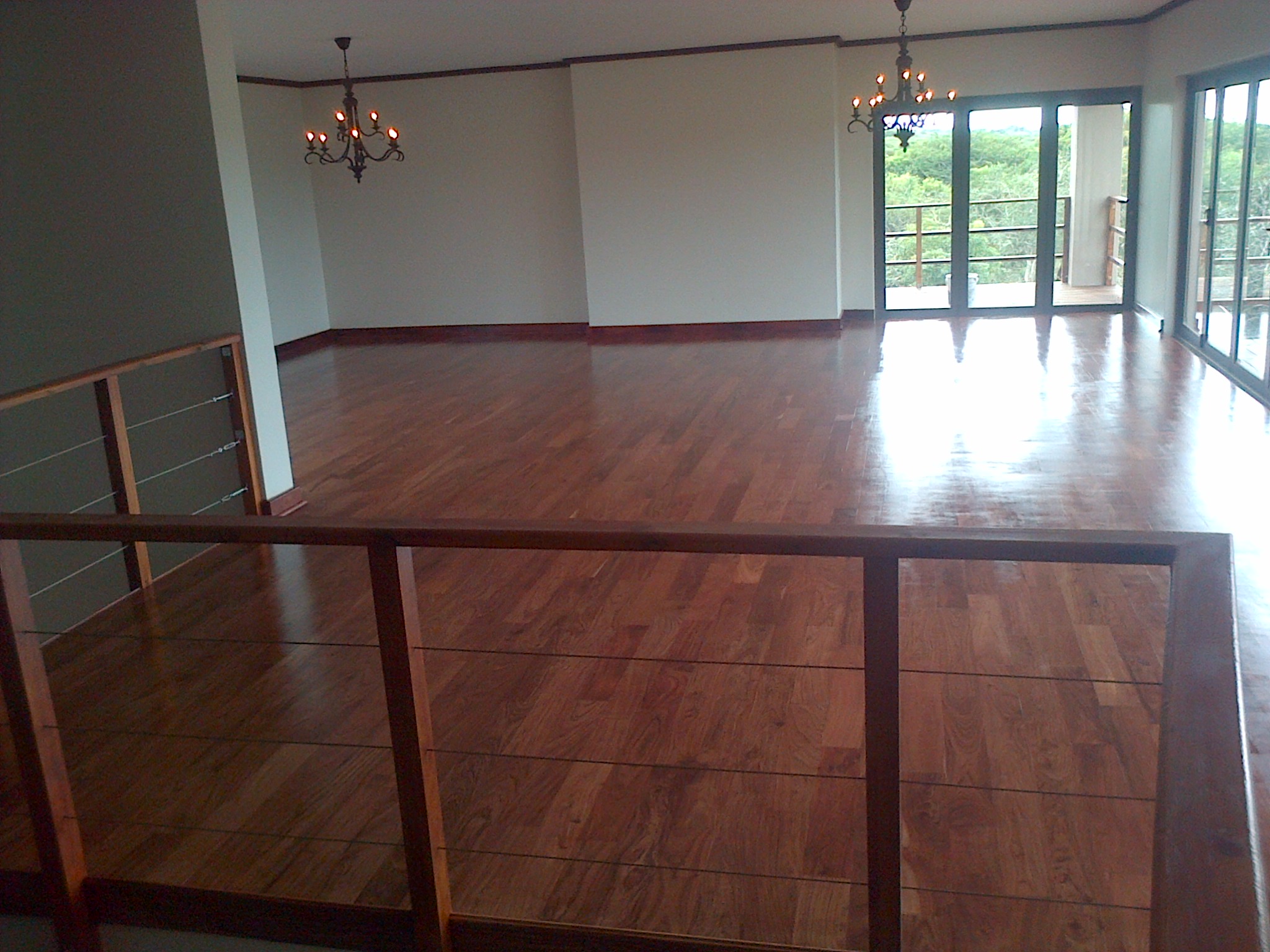
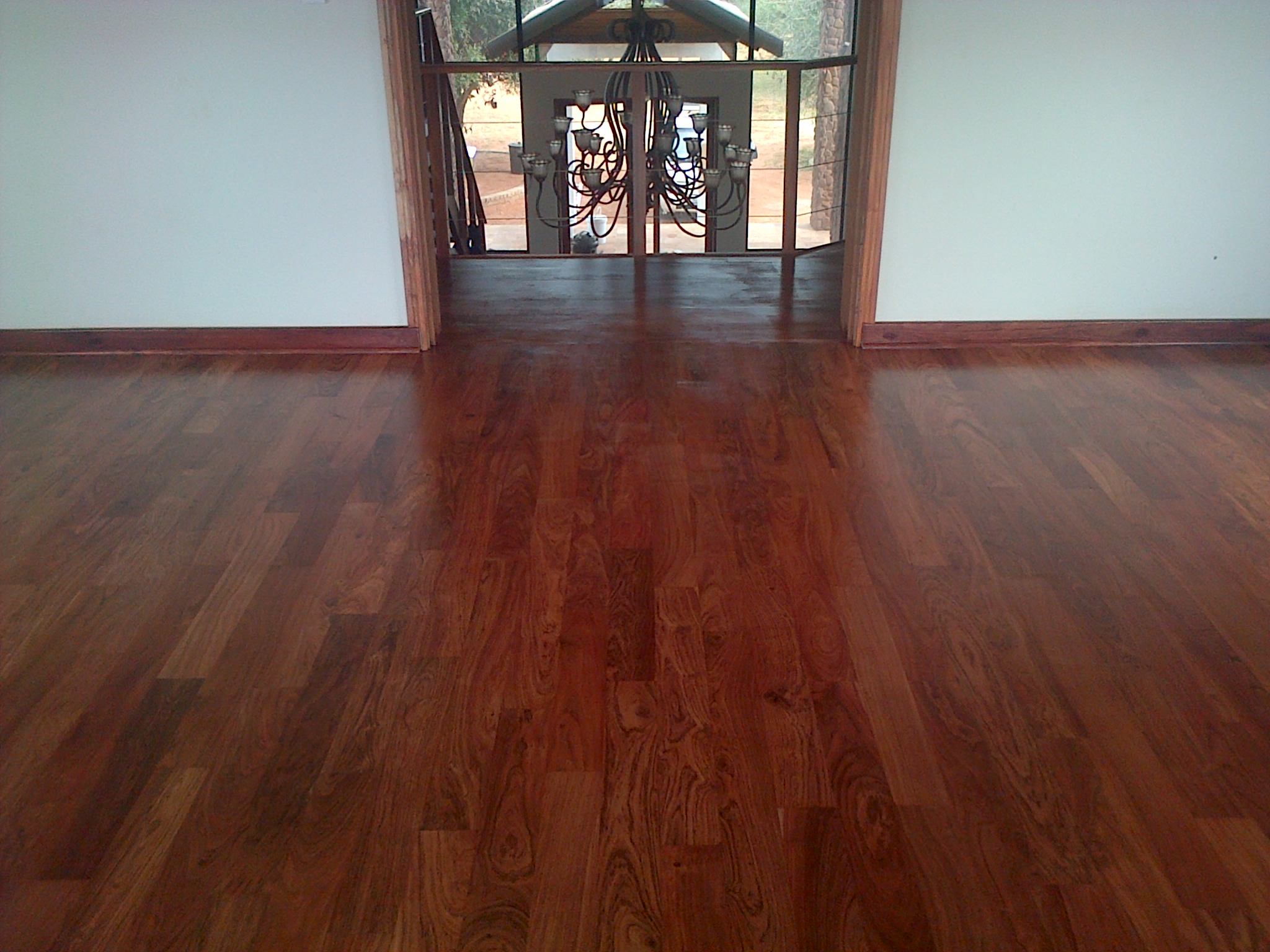
We were called to quote on sanding and sealing the wooden Swiss parquet floors in an old house in Hillcrest. From the pics alongside you can see that these rooms are the typical large ones found in older houses.

Swiss parquet floor sanding Durban

Click to enlarge

The Swiss parquet floors have probably been there well on 40 years or probably even since the house was built. Since then carpets have been put down on top of them, probably in the seventies when those big thick pile carpets where the fashion. The carpets had been lifted some time ago but the sealer on the wooden floor was scuffed in many areas and although it was not peeling off or flaking, it had worn back to wood in high traffic areas and there were various marks on them from pot plants and other items that had been placed on them and left for long periods of time.

The total area we had to sand was 170m², so quite a nice sized area. It consisted of 3 bedrooms, passage, lounge, dining room and study. We were relatively lucky in that the existing coating had deteriorated to a point where it came off quite easily. One always needs to be careful of floors that have been coated fairly recently and still hold a lot of coating or sealer because it tends to clog the sand paper. In these cases one needs to use a very coarse grit paper of about 30 grit and at times you need to sand at 45 degrees to the grain to remove it and then sand again with the grain with a less coarse paper. Also, although the floor is flat, it is never perfectly flat and the large floor sander sometimes

Swiss parquet floor sanding Durban

Click to enlarge

leaves patches. So just turn the machine at a slight angle to get it to flatten the floor in that area and then go back with the grain to get your scratch marks all running in the same direction.

Once the bulk of the sealer or coating is off, one needs to come back with a smaller hand-held sander to remove those stubborn areas. Once it’s all off you need to remove the scratch marks with a finer sand paper. If you’ve started with a 30 grit paper, you may need to then go to a 60 and then to a 100 grit. But always finish on a 100 grit paper.

We used a polyurethane epoxy floor sealer with hardener or accelerator (mineral based) on these floors in order to speed up the drying time. The client was living in the house so we had to limit dust and had to paint rooms in a special order so that they could still live there while we sealed the floors.

I’m still not completely sold on water based products. The water based floor sealers I have used require many more coats to get the same thickness of coating. Although they dry a lot quicker and many more coats can be applied in the same day, they tend to use a lot more and, in my opinion, don’t provide as hard a finish as mineral based

Swiss parquet floor sealing Durban

Click to enlarge

products, especially those with catalysts for hardening.

In between coats we rubbed the floors with steel wool to remove the fibres in the wood that stand up when first coated. A thorough vacuum after that and a second coat was applied.

A quick tip on using the epoxy / polyurethane floor sealer.  Because this product has an accelerator, or hardener associated with it, it goes off, or dries, a lot quicker than a single pack polyurethane.  When you mix your sealer with the accelerator, you should use a flat-bottomed tin such as a coffee tin or jam tin and a flat paddle to mix.  The flat-bottomed tin allows one to mix it thoroughly because there are no ridges for the flat paddle to get stuck on (as opposed to a coke bottle).  A good choice for a flat paddle is a steel ruler.  If you were to pour it directly into your paint tray you will be need to clean that paint tray with every new mix otherwise the sealer will be getting hard already and will interfere with the smooth rolling on the floor.  So place a black dustbin bag (well it can be any colour really) over the paint tray and simply through the black bag away after each mix.  Don’t mix too much as the product has a pot life, (the time it can remain liquid enough to use in the pot).  A hot day will result it in going off quicker than a cold day, or a humid day, and using more accelerator will also result in a quicker drying time.  So be careful with your quantities, you don’t want to waste sealer.

Swiss parquet floor sealing DurbanZ

Click to enlarge

This product should be applied very thinly in order for it to dry quickly.  If it is applied too thickly the top will dry but the middle will still be tacky and it will take much longer to be able to walk on it to flat it and apply subsequent coats.  So mix just enough each time.  If it starts going off in the tray, rather through it away than try to apply it while it is already getting hard.  What happens then is that the front edge of the roller spreads it on the floor and the back-end of the roller starts to pull it off the floor because it is already tacky.  This results in a streaky floor which will mean getting the sander out again.  So rather waste a little sealer and star with fresh sealer than waste time by re-sanding it.  And then of course mix a little less so it doesn’t go off in the pot or tin.

For a free no obligation quote on installing wooden floors or floor sanding and sealing please call us on 082 496 5444 or use the contact us form below.
Go back

Your message has been sent

Warning
Warning
Warning
Warning

Warning.