Wooden Decking Durban

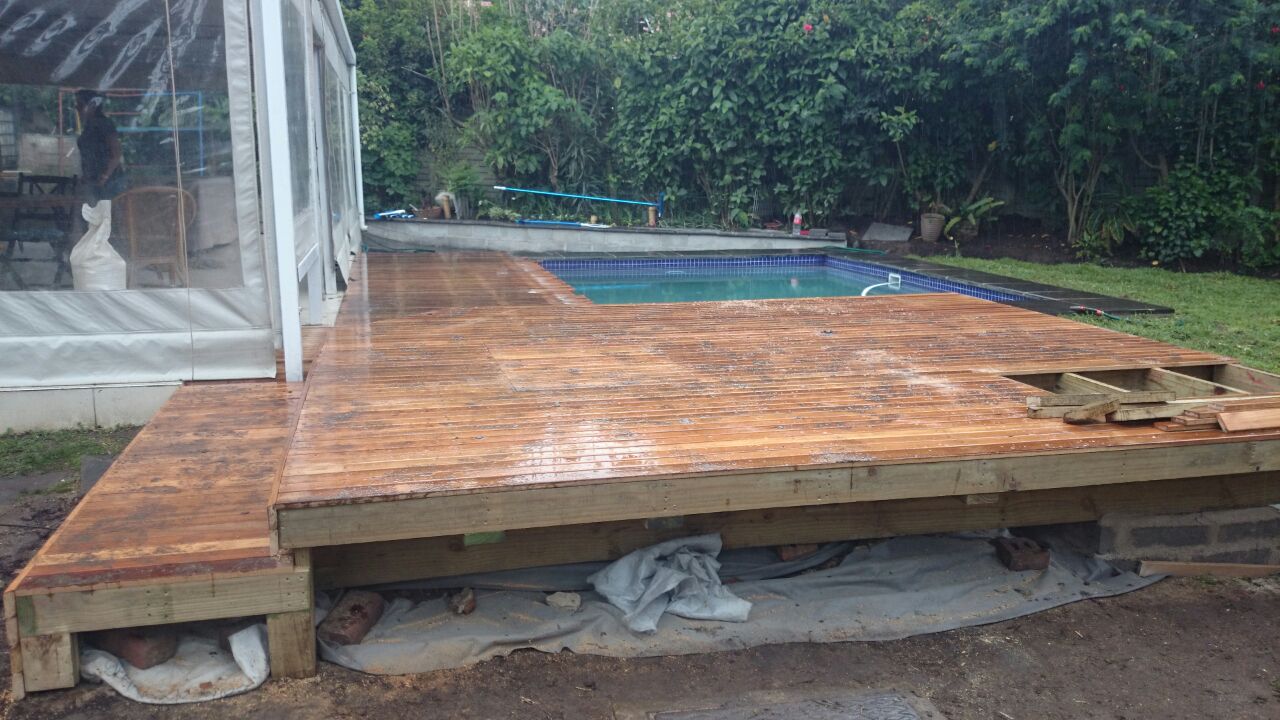
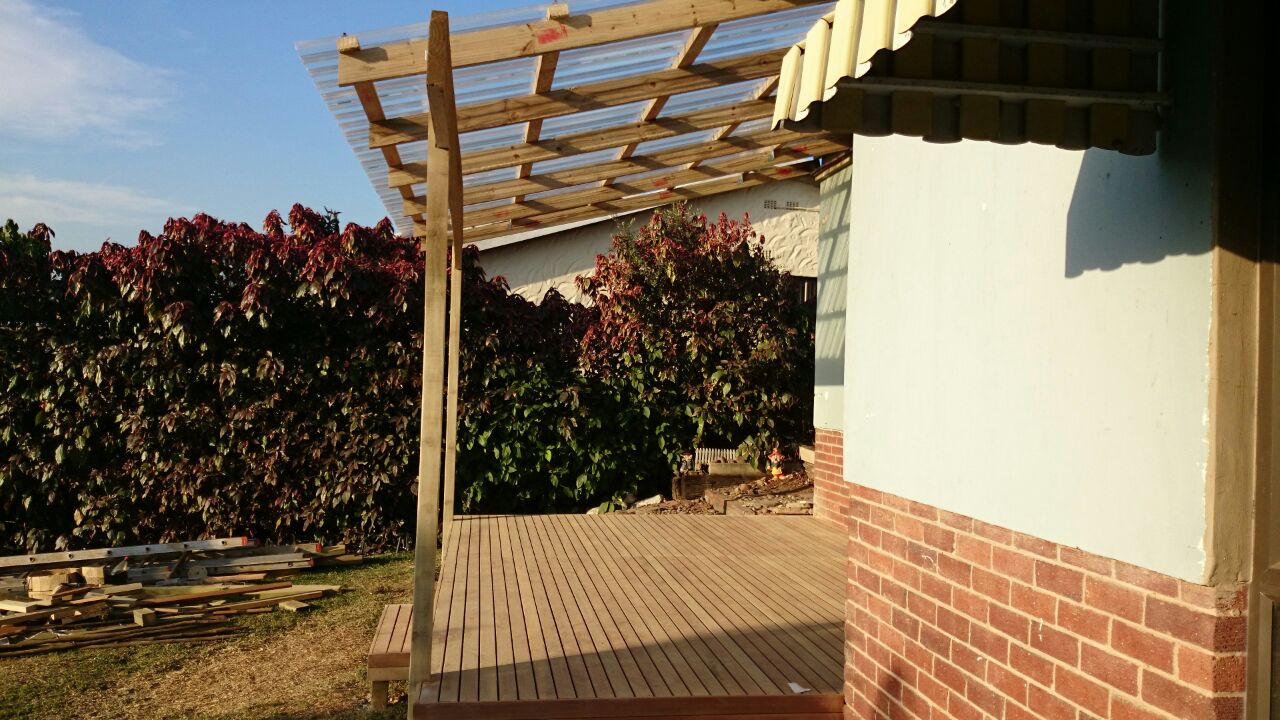
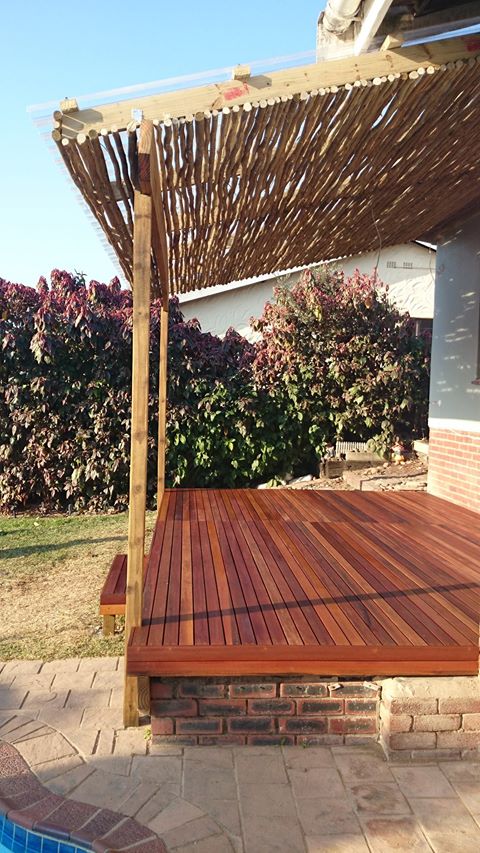
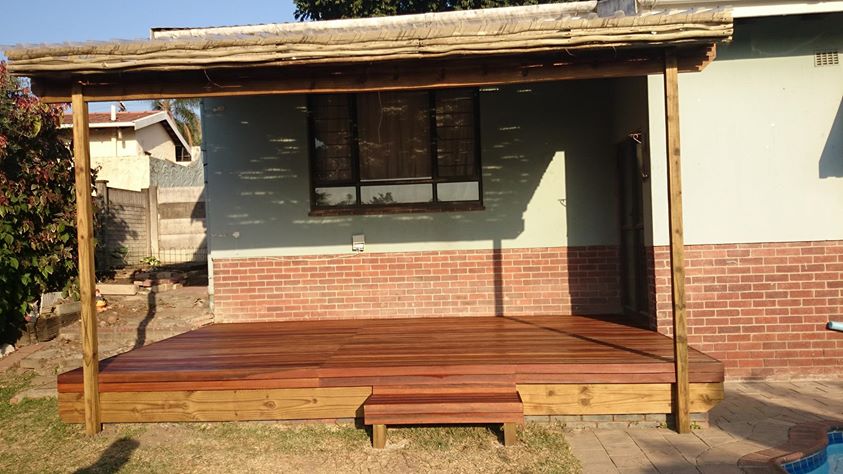
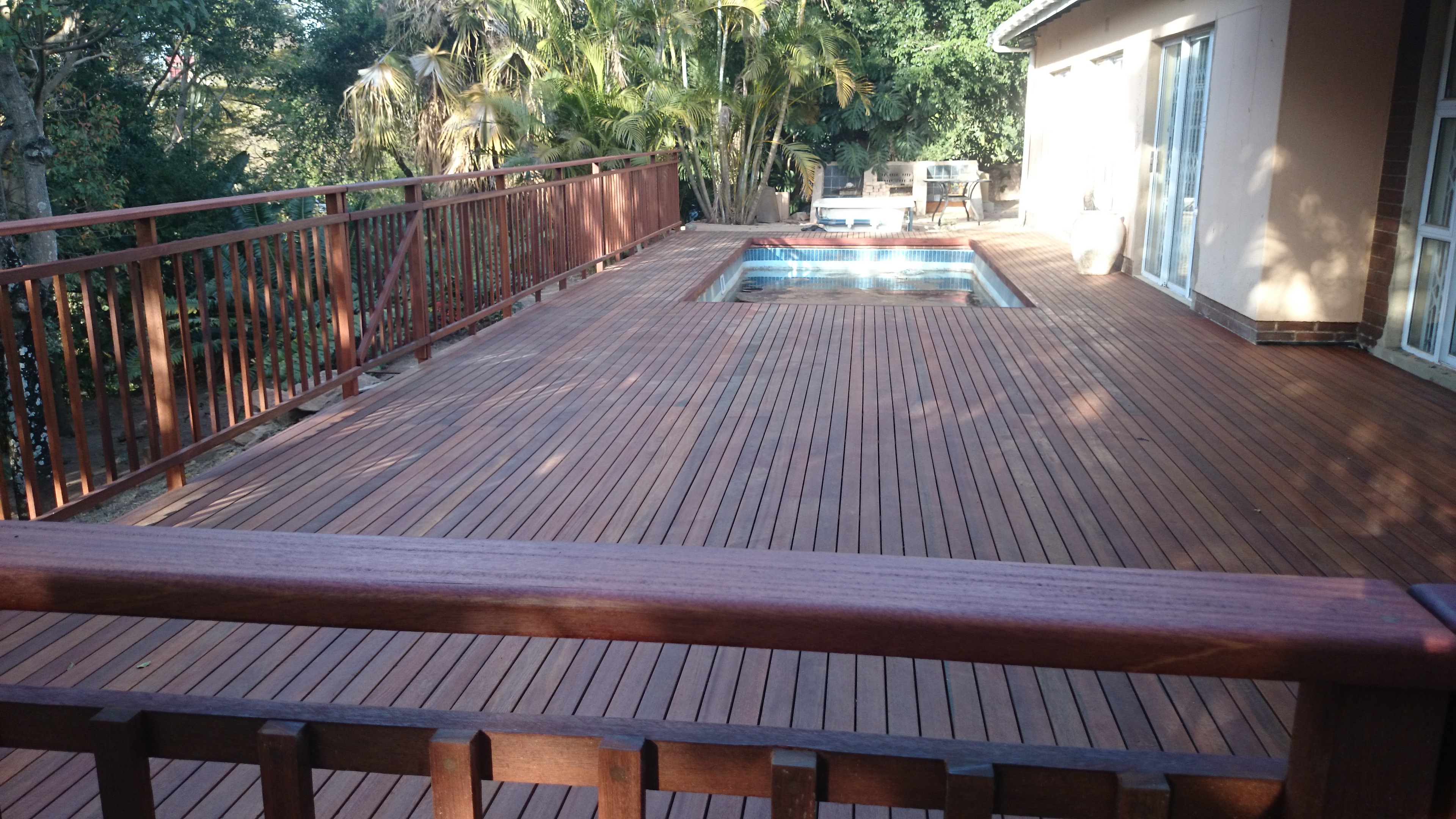
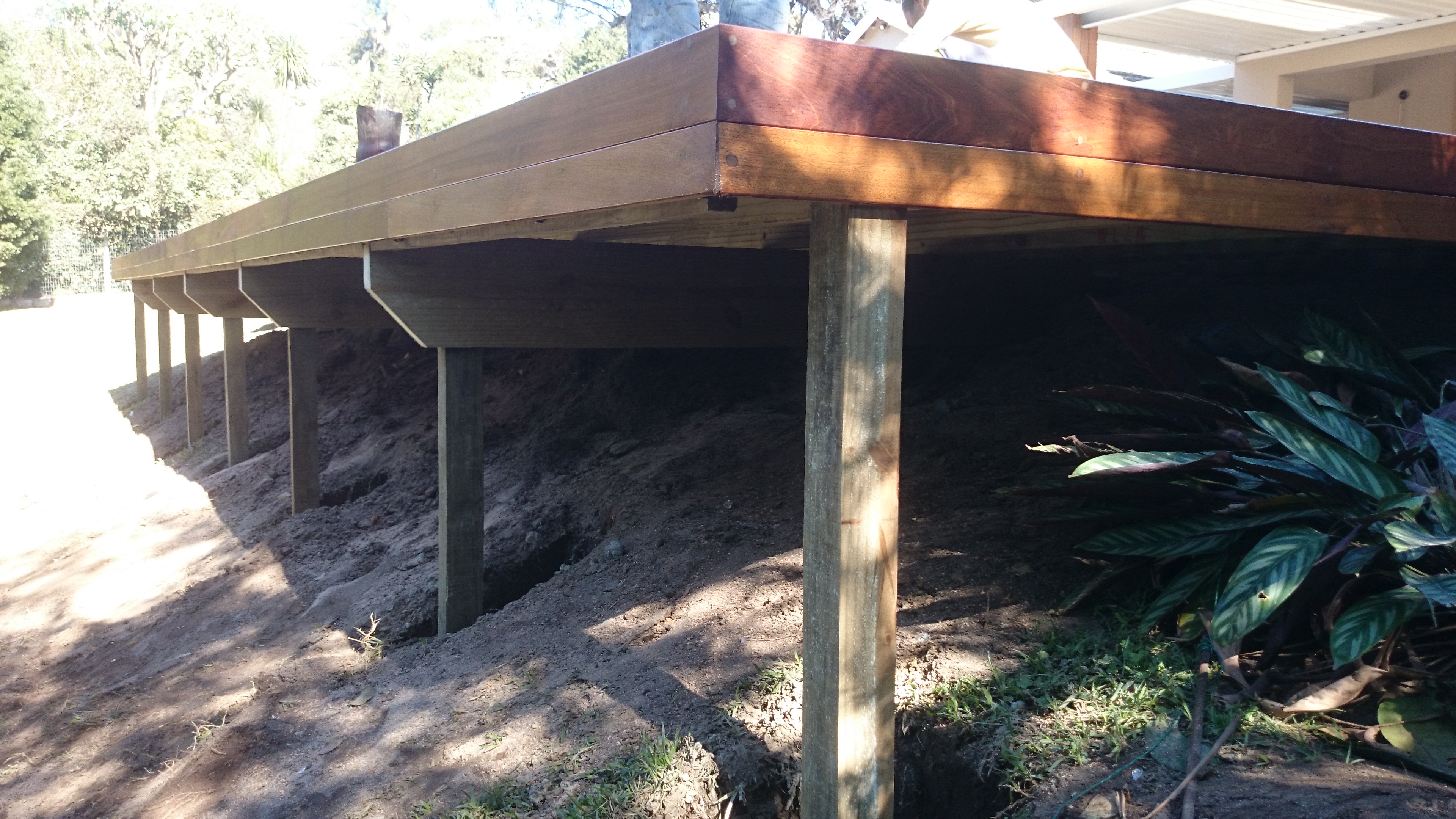
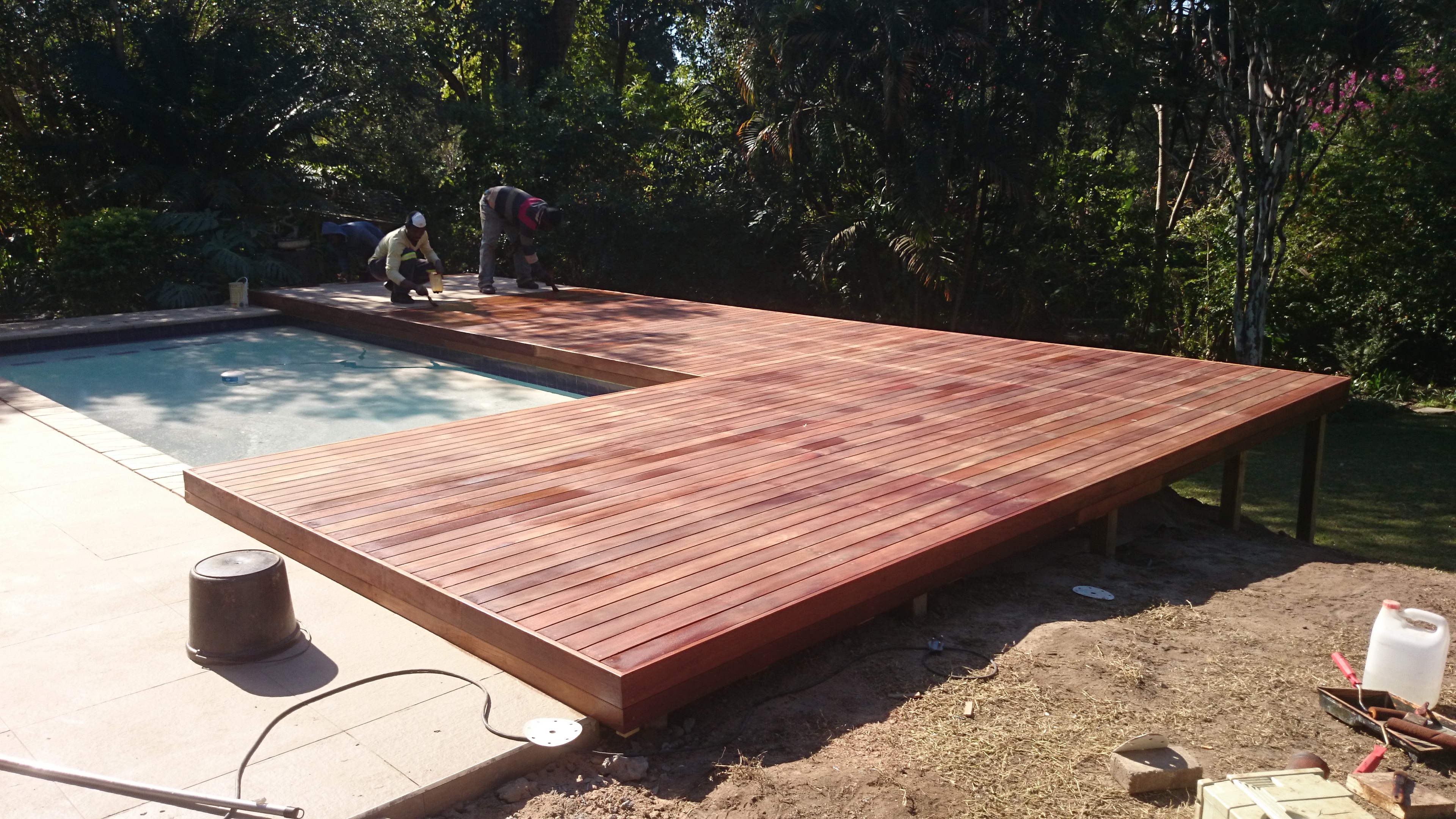
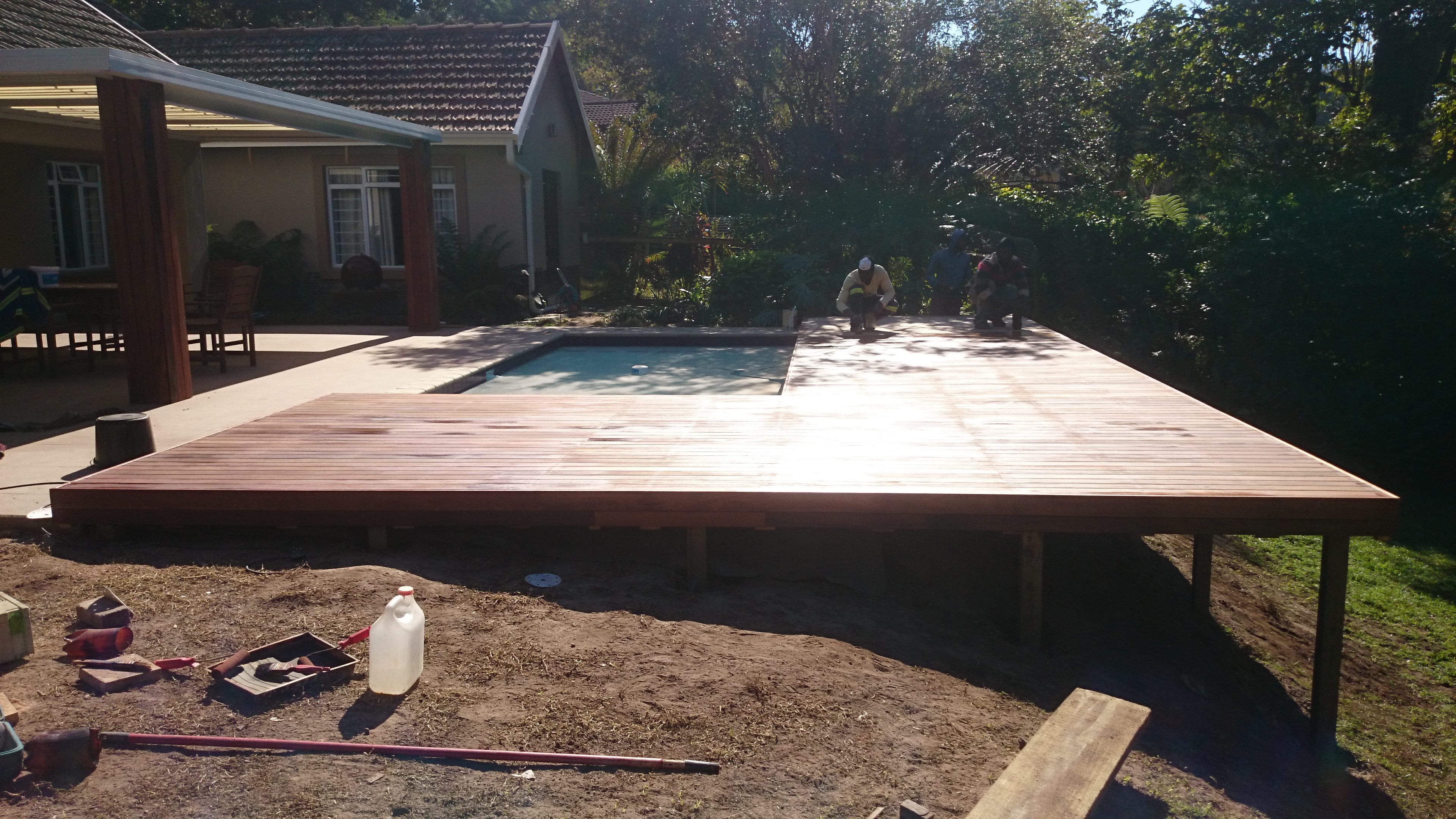
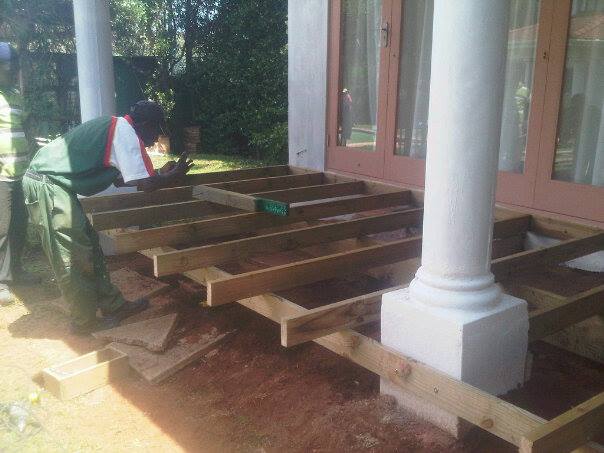
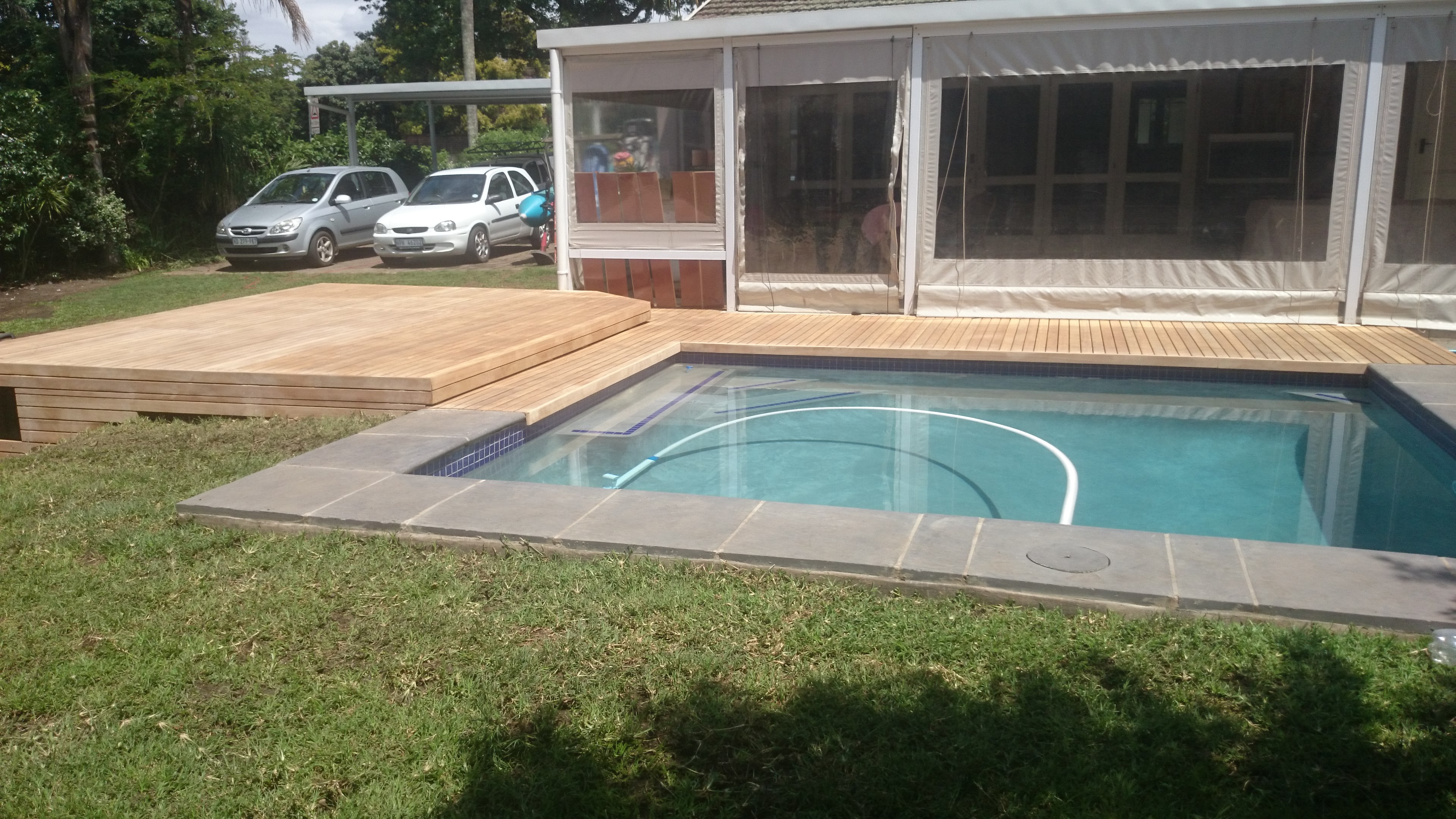
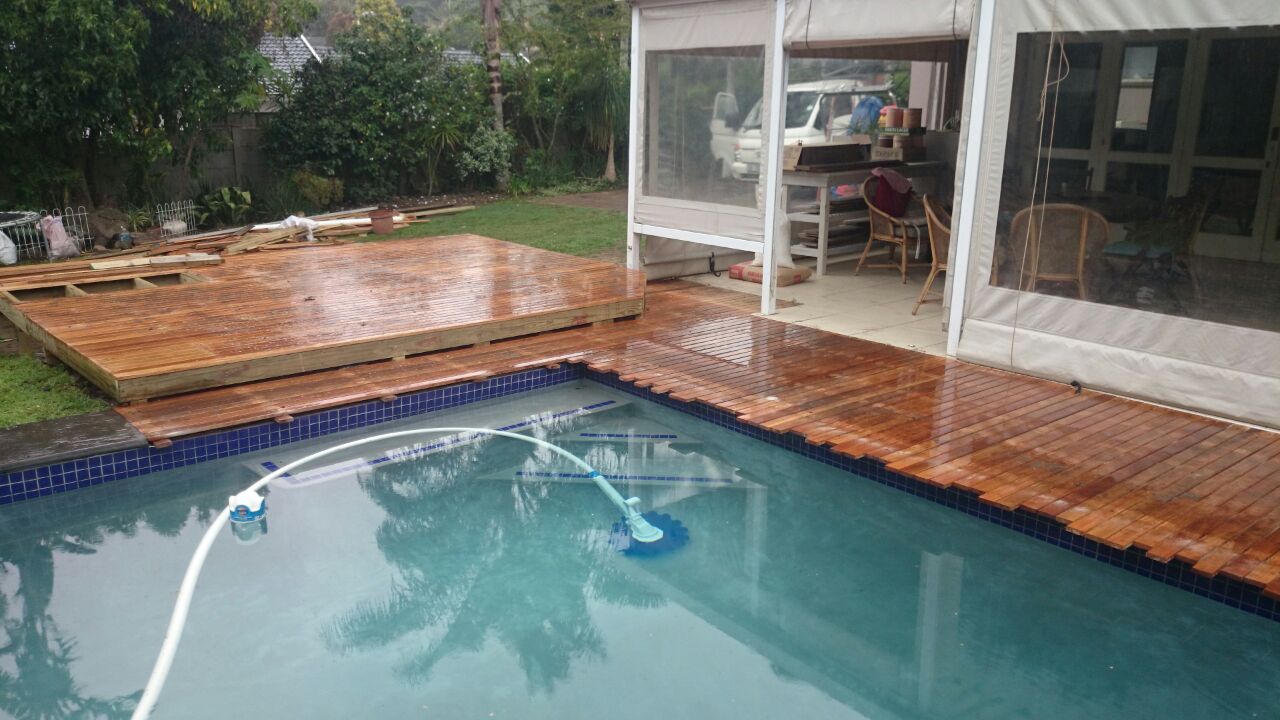
Wooden decking DurbanWe built this wooden deck in Pinetown, Durban over a well so could not rest any joists on the well lid itself. Normally we would have raised the height of the deck enough to use 50 x 228 as joists. A 50 x 228 piece of wood can be spanned about 3m without any support below which would have solved our problem. However we could not come up that far as that would have resulted in two steps from the raised deck level to the tiled area on the patio.

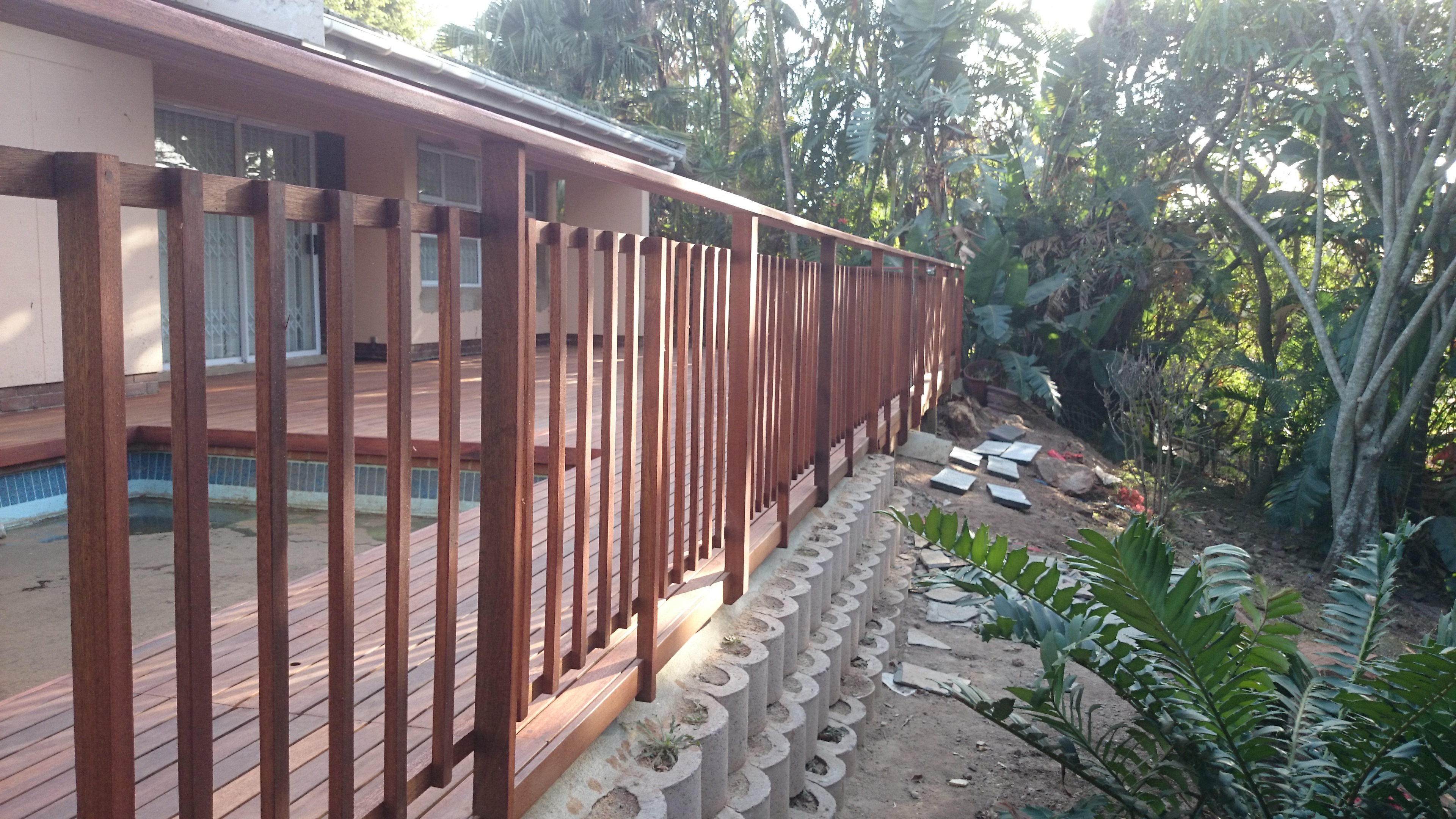
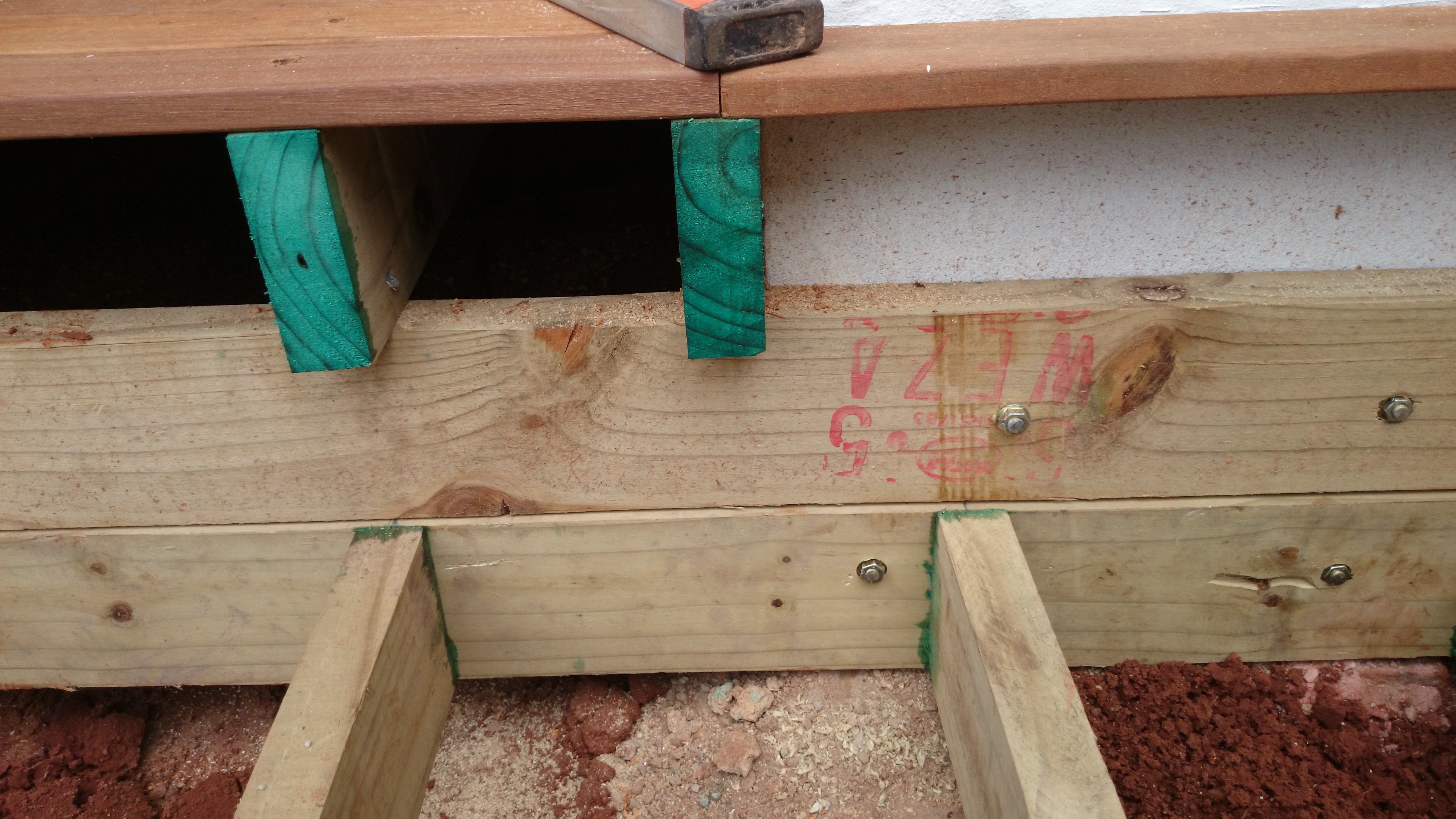
We used 38 x 152 stock as our joist material, compared to the normal 38 x 114 stock which we normally use. This allowed us to span up to about 2.2m which still wasn’t quite far enough to get over the well. We brought the feet of the deck in as close as we could and placed them on top of the side wall of the well. We also braced the deck in other places so as to stop any bouncing which would have occurred otherwise. There was also a corner that we had to cut off so that it created a clear pathway from the lower deck around the awning upright and on to the tiled patio. Half of the Wooden decking Durbanpool was built with pavers or coping stones on the edge of the pool and the other half had wooden decking. So we had to get all our levels right to create a seamless integration between materials. It is quite popular now to mix materials and have a combination of pavers and wood and grass.
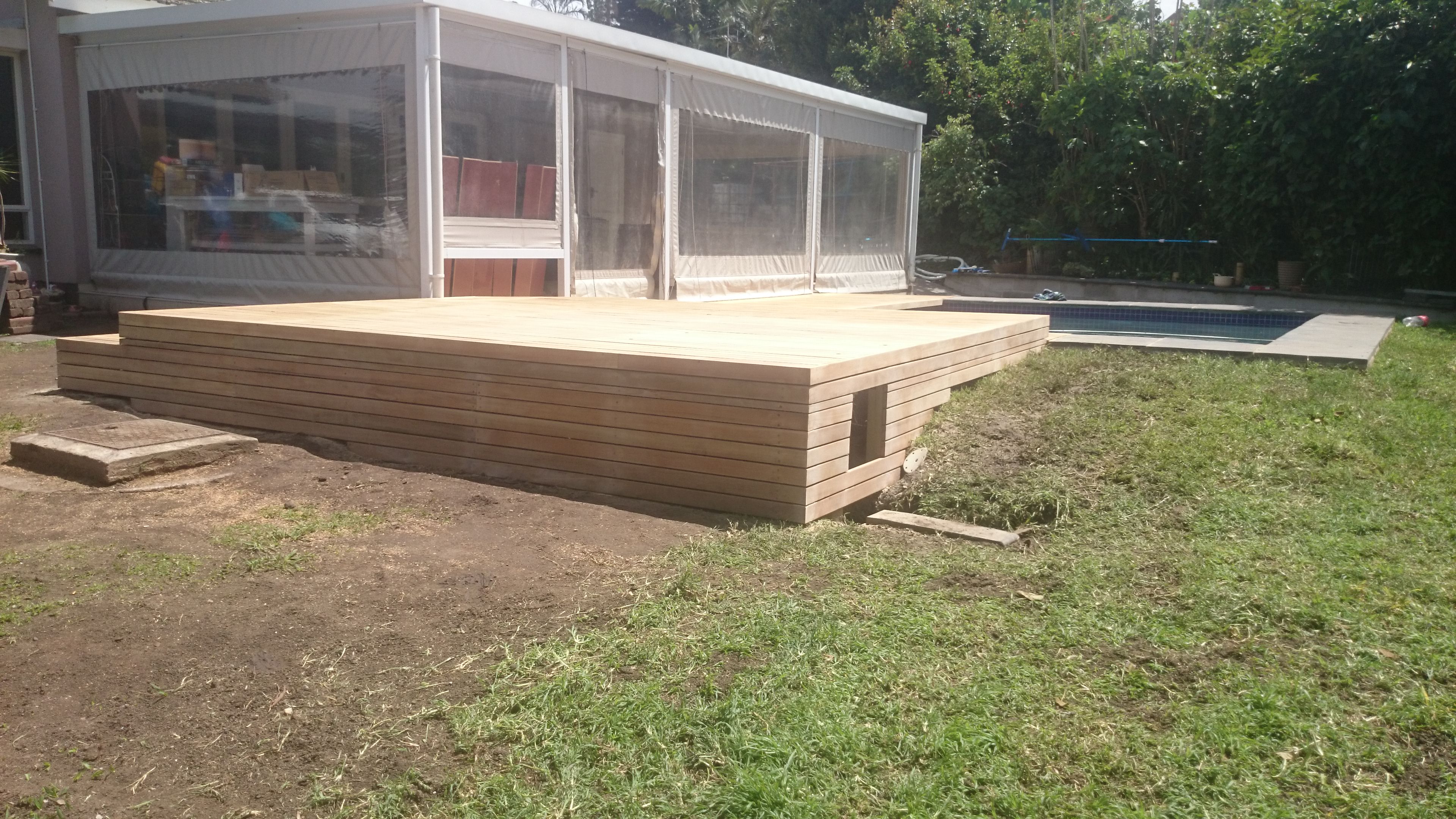
The pool pump was installed below the deck on the highest end and some trap doors were built on top of the deck to access the filters etc. We had to build a big enough trap door to allow a person to climb in there to change the sand or do other maintenance if needed.

The sides were clad to block visibility underneath the deck and a full length step was built along the one side for access to the grassed area.
A small opening was created on one side to house the pump DB board and this can later be hinged with a small door if the client wishes.
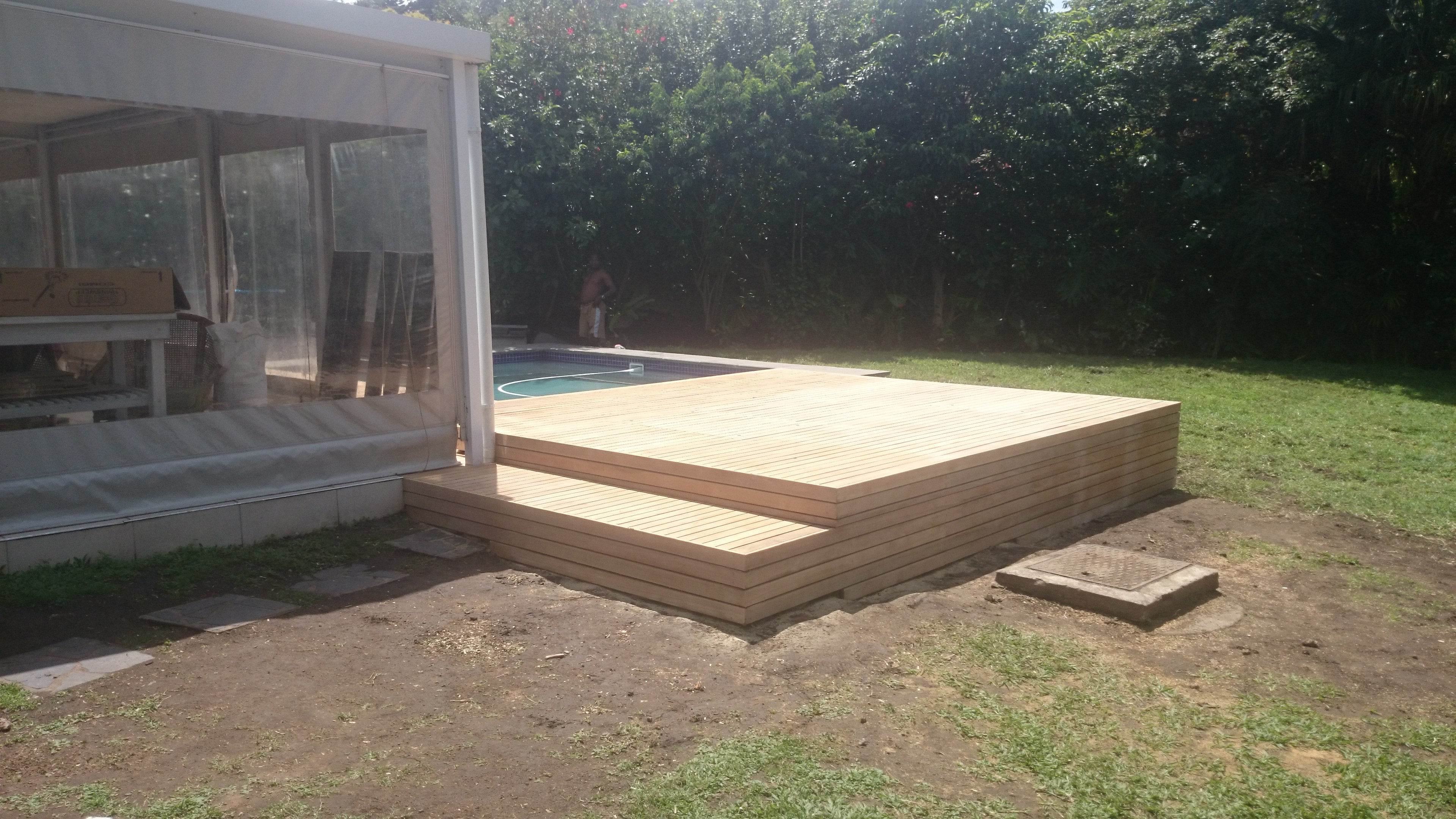
Wooden decking DurbanThe challenges on building pool decks between a tiled area and the side of a pool is to get the deck boards to fit into the space you have been given to work with. If the side of the pool isn’t 100% parallel to the side of the house, up to which you will deck, then you need to adjust the spaces between deck boards on one or both sides of the deck to either gain or lose space as you lay deck boards. If for instance one side is 20mm wider than the other side, you will need to gain 1mm per row of deck boards in order to bring your deck boards parallel to the house so that you don’t end on a wedge-shaped deck board. At times this can be quite tricky. We are working on one in Hillcrest where the house and the pool paving is 77mm out of parallel. The total distance is only 2.4m. So the space will take approximately 32 deck boards to fill. Which means we need to gain or lose more than 2mm per row of deck boards to bring the last deck board parallel to the side of the house (or pool depending on which side we start decking). What we’re doing there is to increase the gap between deck boards to 6mm one side and reduce it to 4mm on the other side.
Then the last trick is to adjust your deck board spaces so that you don’t end on a half deck board. So once you are parallel you need to either reduce Wooden decking Durbanthe gap tot 4mm or increase to 6mm to gain or lose space so you end on a full deck board.
For a free no obligation quote on your wooden sun deck, balustrades, walkways, pergolas, screens and other timber construction, please call us on 082 496 5444, or use the contact us form below.

Go back

Your message has been sent

Warning
Warning
Warning
Warning

Warning.

Wooden decks Durban


Wooden decking Durban


Wooden Balau Walkway Umhlanga, Durban

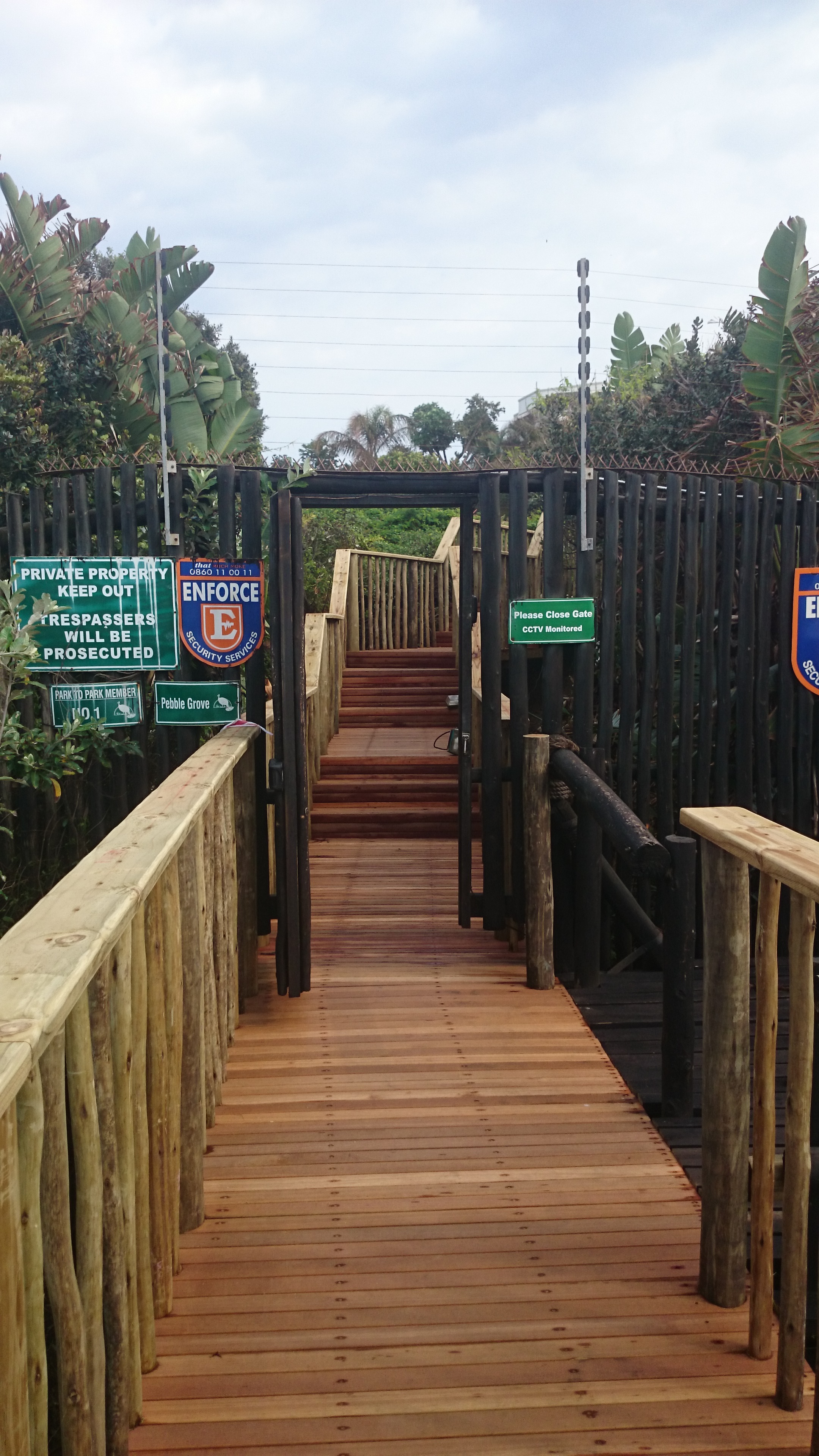
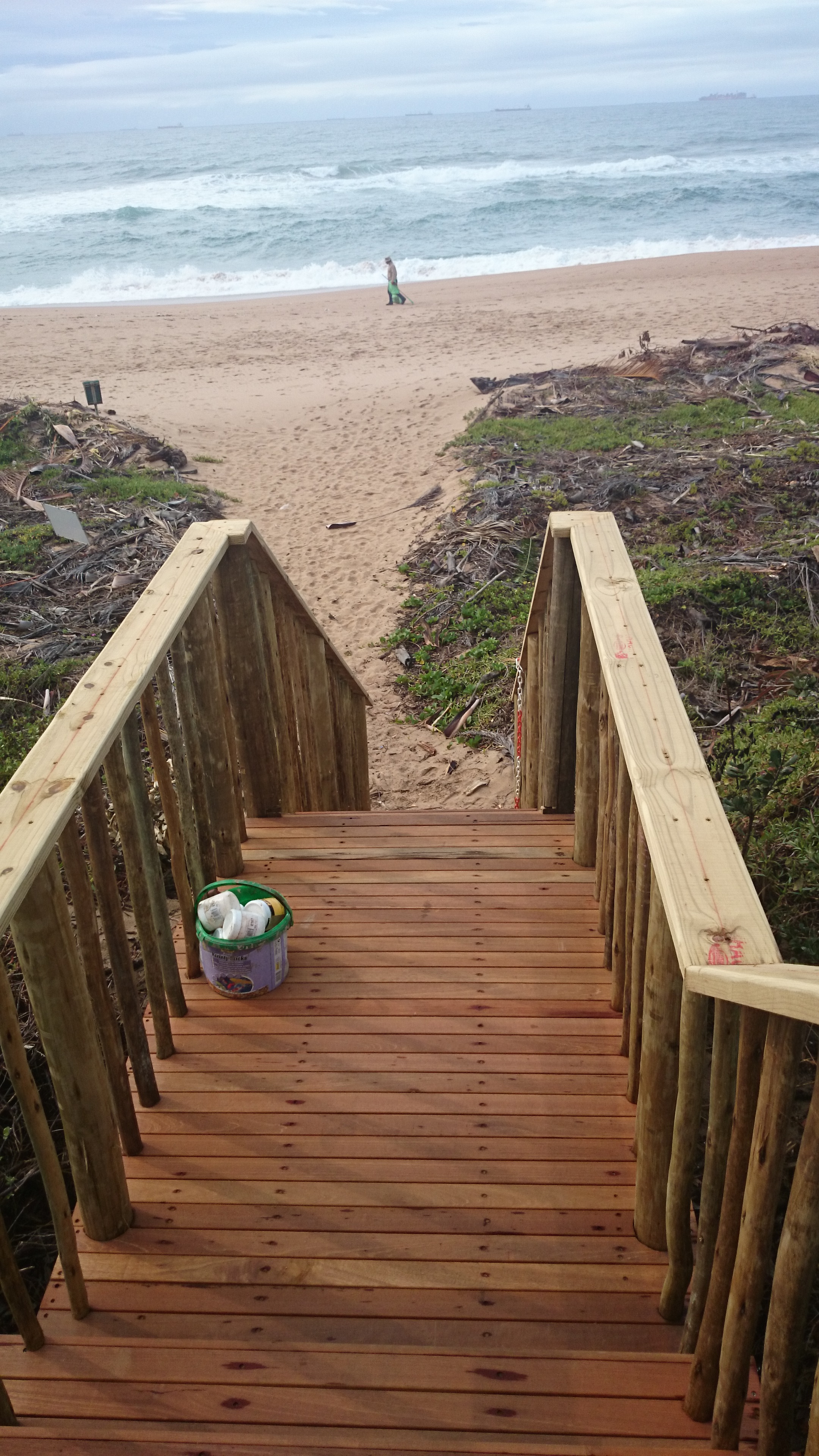
Wooden Balau WalkwayThis wooden balau walkway, or bridge, leading to the beach, needed to be replaced as the old one, although it was nearly 20 years old, had started sinking on one side. It had been built on beach sand so the concrete that had been used to set the upright posts had sunk over time into the soft sand. This problem also occurs on decks that are built on the bluff as the Bluff is essentially one big sand dune, so many parts of it are soft enough to allow a post to sink over time.Wooden Balau Walkway

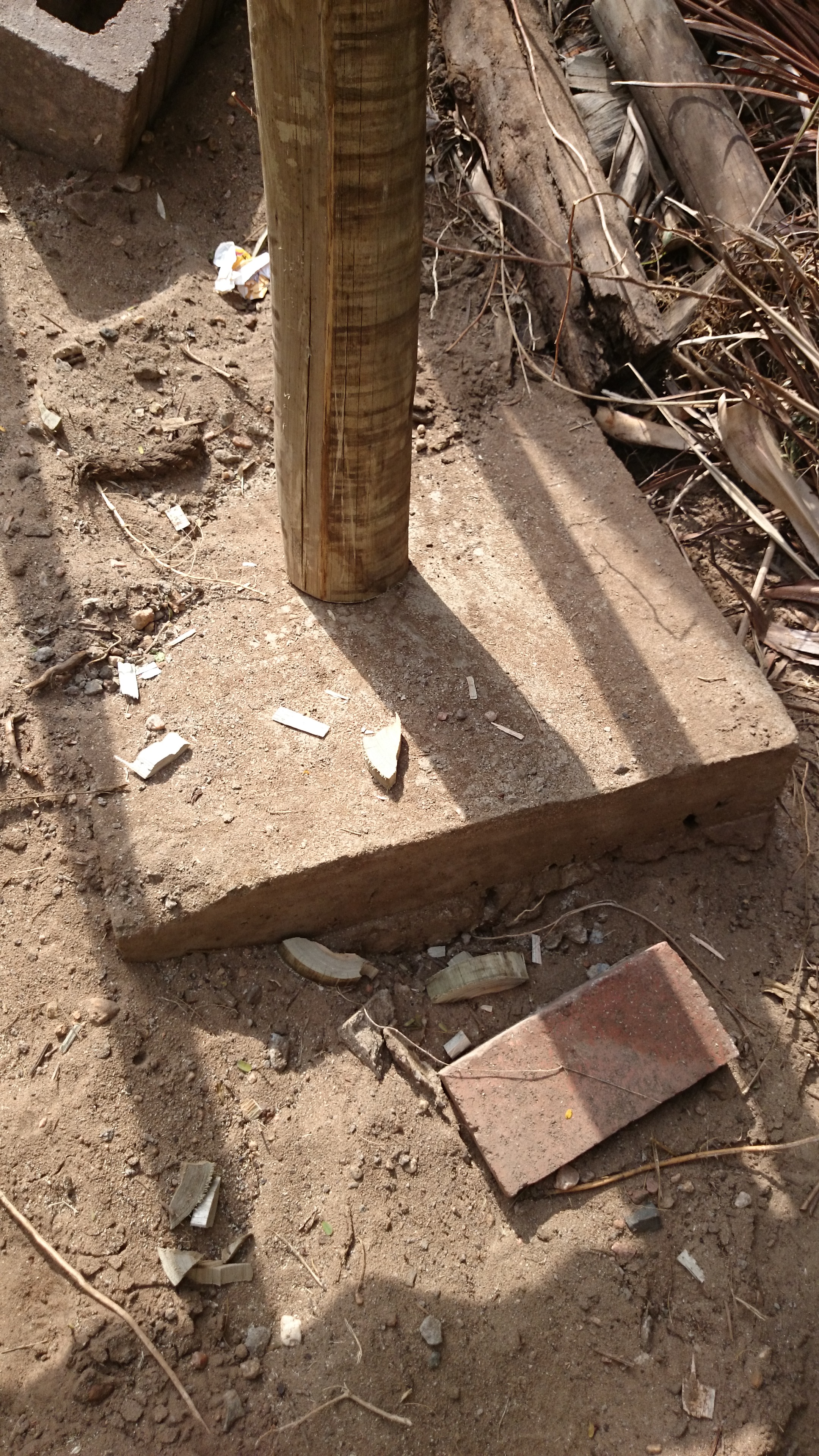
We overcame this problem by making use of a floating foundation. It is often used in building houses where the soil is very soft. Instead of throwing a concrete foundation beneath the walls and bringing the bricks up and then throwing a slab, the entire foundation is a concrete slab on top of which the bricks are laid. The result being that it creates a much larger foot print in the sand and is of course more difficult to sink than if it was a column of concrete.

This method solved the problem of the posts sinking, but created another problem in that there was no lateral support for our posts which would have resulted in them falling over. This was overcome by throwing a “pad” on every second post and every other post was set 600mm in the ground in concrete. So one post stopped it from sinking and the other gave it lateral support and stopped it from falling over.

The floating “pads” were 600mm x 600mm and 150mm thick with mesh in between to stop the concrete from cracking with the weight of the deck.Wooden Balau Walkway

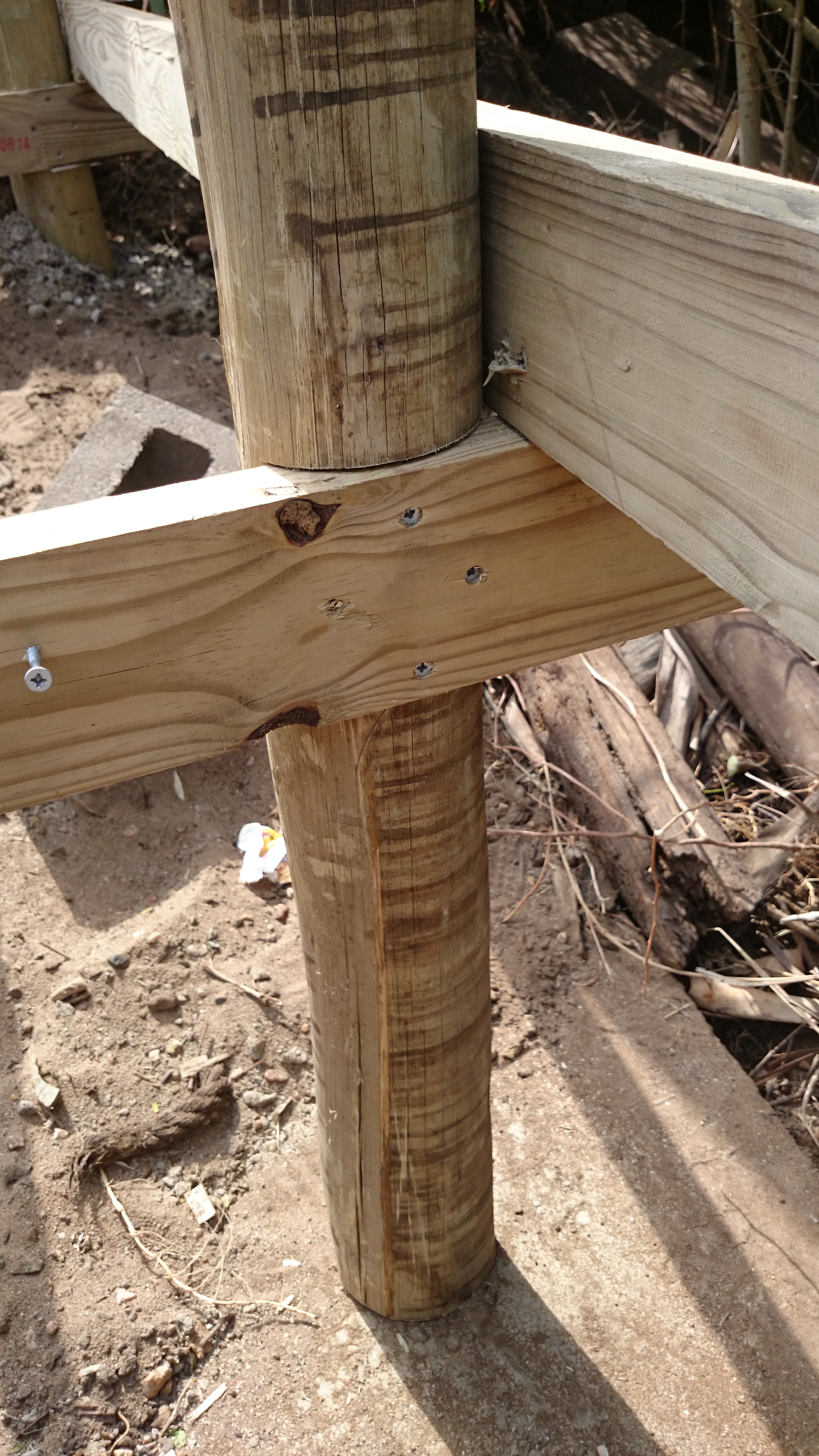
The pics alongside show the “pad” that the upright posts sits on top of and a post that has been buried in the ground 600mm.

Once our structure was up we installed our joists and decked it using balau deck boards. The width was 1.5m so we installed 4 joists to give us joist centres of 500mm. This is about the maximum one can span a 19mm deck board without it bowing from the weight of a person. Anything bigger than 500mm will result in the deck surface being springy. One should aim for between 450mm and 500mm. This of course applies to a 19mm balau deck board. If another timber is being used, or the board is anything but 19mm thick, then this will vary.Wooden Balau Walkway

We used the uprights, which were 100 / 125, H4 CCA treated gum poles, as our uprights for our balustrade too so as to ensure that they were sturdy. Because our gum poles were between 100mm and 125mm in diameter, we had to use a 38 x 152 H3 CCA Treated pine capping; otherwise the capping would have been narrower than the upright which would have looked odd. We then installed droppers as our pickets and secured these through the top of the capping and from underneath the deck boards.

Our stairs leading from the last section of walkway to the beach were made using H3 CCA treated pine stringers and treads and we then clad the treads with balau to match the walkway surface.

For a free, no obligation quote, on your wooden decks, walkways, bridges, screens, pergolas and other outdoor timber construction, please call us on 082 496 5444 or use the contact us form below.

Go back

Your message has been sent

Warning
Warning
Warning
Warning
Warning

Warning.

Wooden Sun Decks and Wire Rope Balustrades

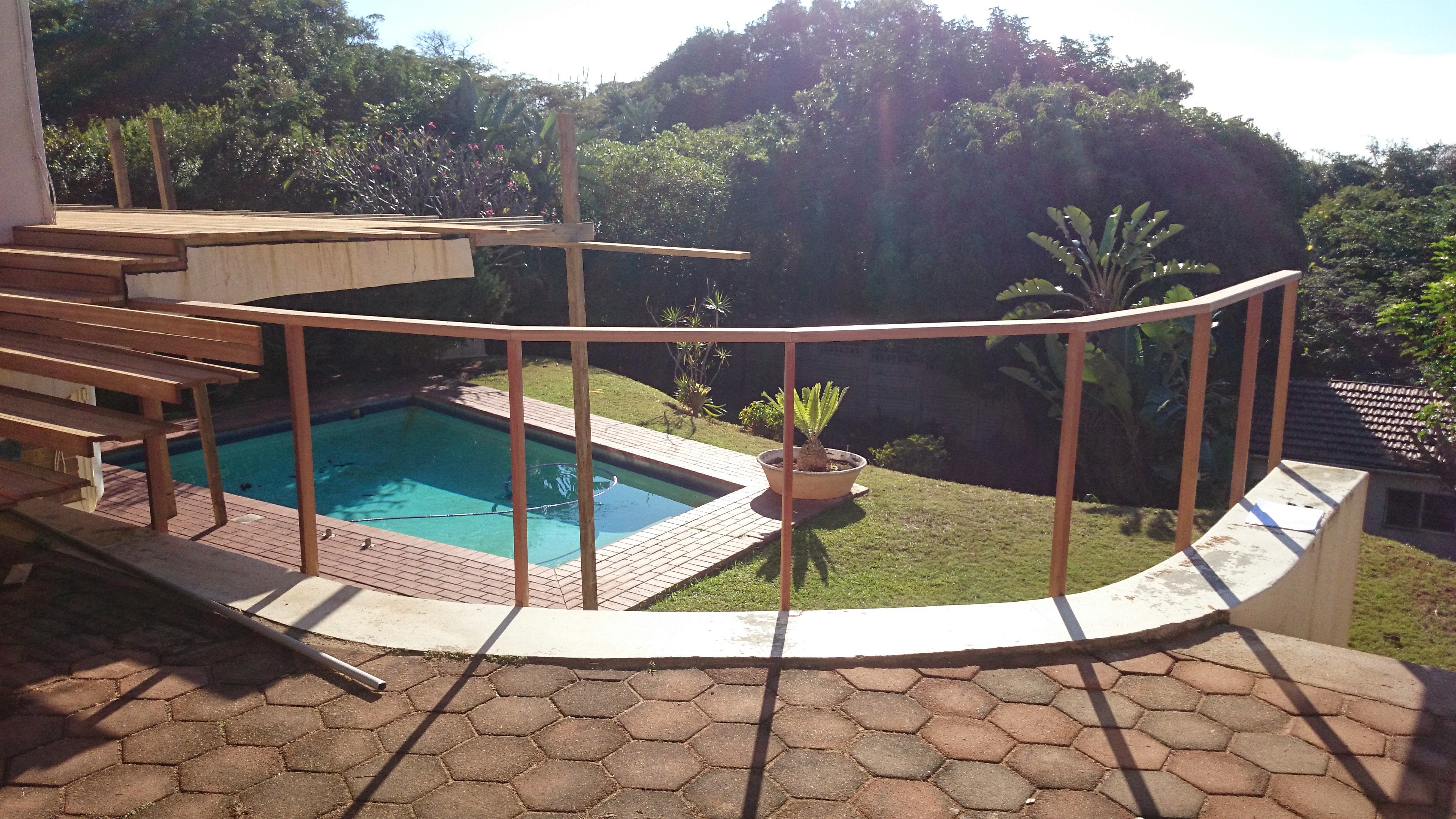
Wooden Balau Deck with Wire Rope BalustradeWooden deck with wire rope balustradeWooden deck with wire rope balustradeA wire rope balustrade on a wooden sun deck, as pictured in this article, has a few pros and cons to it which I will discuss below. I will also describe the method used to install wire rope balustrades and what to be careful of to ensure that the job runs smoothly. If you don’t feel like doing it yourself, or don’t have the right tools or time, then scroll to the bottom and complete the contact us form below. I will contact you and we can take the task off your hands. Alternatively call us on 082 496 5444. We are Durban based.

Firstly one should choose the correct wire rope to use. We use the 4mm marine grade stainless steel wire rope with button heads. One can also get the 5mm wire rope but I have found that that often contains one rogue strand which will tarnish over time and spoil the look of your balustrade. The 4mm wire rope does not bend as easily as the others so where you get to a 90° bend you will need to terminate your wire rope with a button head and start again on the next run. The 4mm wire rope can bend around gentler curves quite easily. It is just the 90° bends that require a new run.

We start by installing our wooden, normally balau, uprights and these can be anything from a 30 x 60, 40 x 60 or 60 x 60. Obviously the 60 x 60 is better as it is more solid and stable, but it unavoidably carries a higher price tag. A 40 x 60 works very well, but the 30 x 60 can do the job just as well if installed properly. Now install your capping on the top to hold the whole lot together while you install your wire rope.

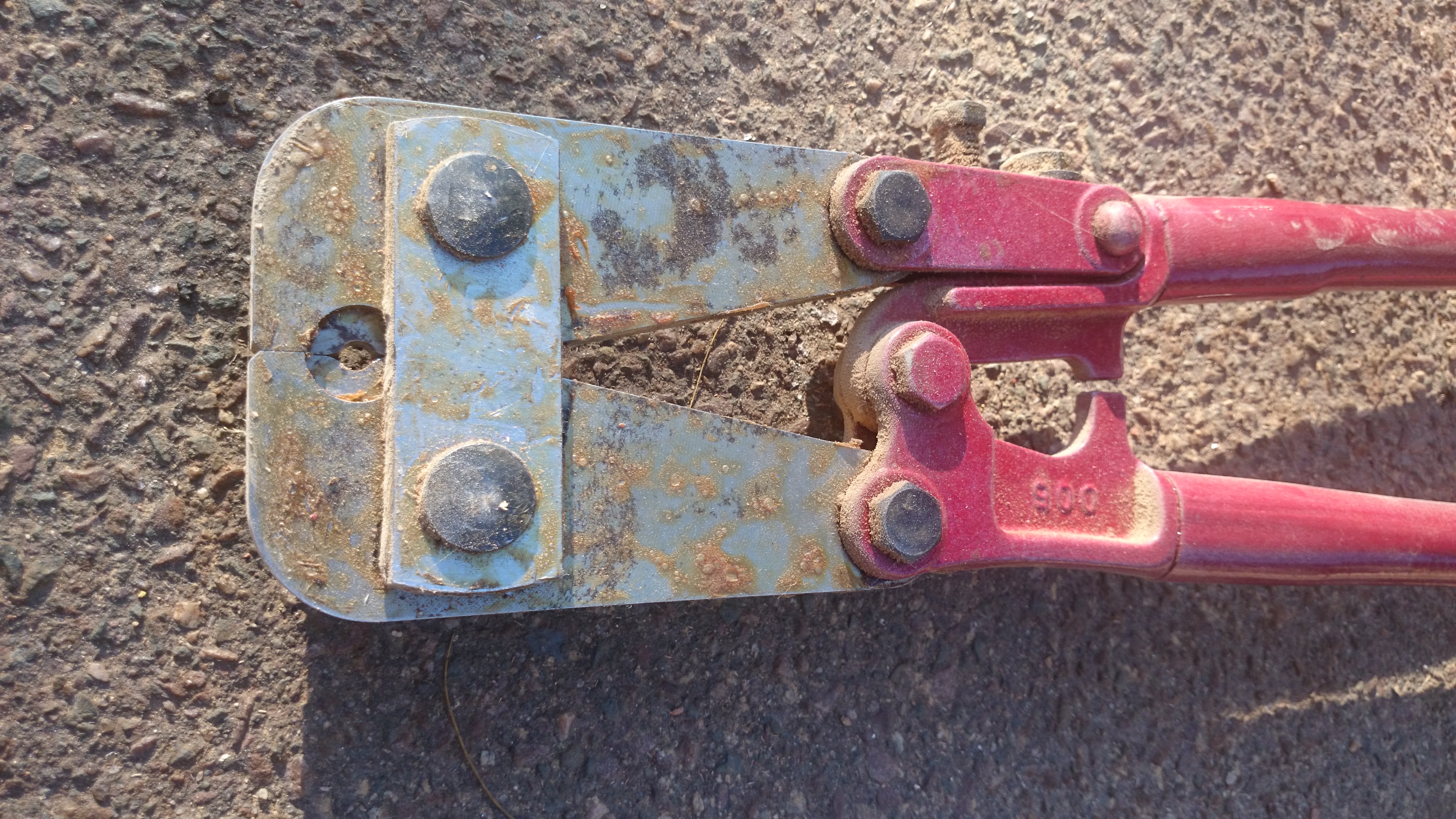
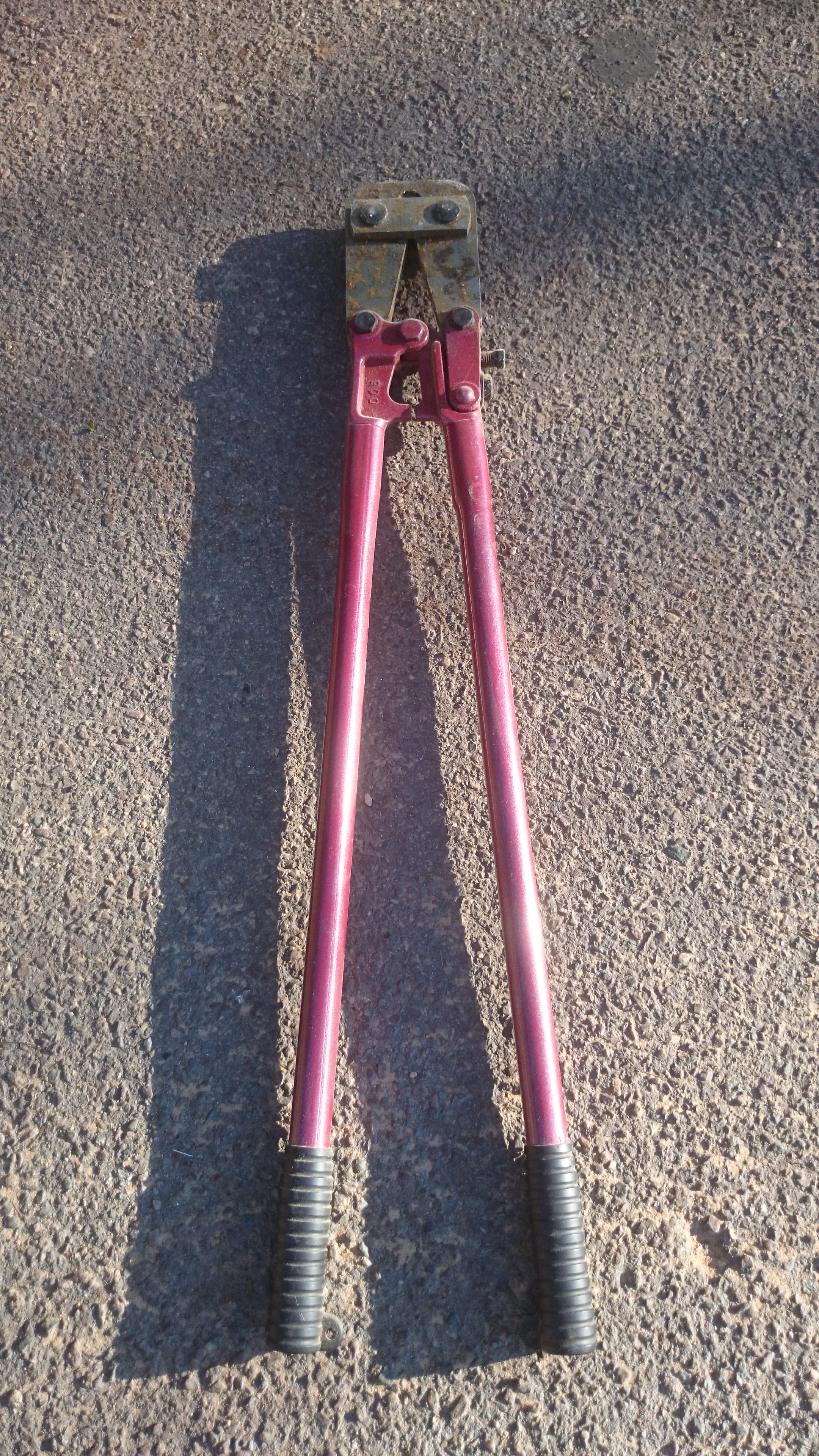
There are various methods of securing your wire rope. We use the button heads as opposed to turnbuckles. A hole is drilled, to a diameter slightly bigger than the button head, in the wooden upright and the wire rope is threaded through it so that the tag end is protruding to the outside of the balustrade. One side of the button head is then inserted over the wire rope and crimped using a special crimping tool. The crimping tool looks very similar to a large bolt cutter with a head that has been adapted to accept the button head and crimp it to the right size to hold the wire rope without damaging it.

Now cut a length of wire rope to slightly more than is required. Remember think twice, cut once as it is always easier to cut more off then to add more on once it has been cut too short. Now all your holes need to be drilled in all the other upright posts. Measure you spaces out accurately so that your wire rope will run parallel to the capping on the top and the wooden deck on the bottom. When drilling through a piece of wood it is easy to hold the drill slightly skew resulting in the drill bit exiting the wood at an angle which will result in the exit hole not being in the place it should be. So drill half way from one side and then drill from the other side to get your entry and exit holes perfectly lined up. It doesn’t matter if the middle of your hole is slightly skew because you can’t see it and it is not enough to impede the path of the wire rope. Thread the other un crimped end of the wire rope through all your holes in your uprights until you get to the end.

Wooden deck with wire rope balustradeNow take the other button head with the thread on it and measure, very carefully, where you need to cut your wire rope. You will need to cut it with a thin cutting disk on a baby grinder so as to get a nice clean-cut. If you cut it too long you won’t be able to tension it and too short, well start again from the beginning. So cut and check before crimping the other end. The second button head will be inserted through the hole from the back and the wire rope inserted into it from the front and crimped. Make sure you have your thread to its longest position so that you still have thread to use to tension it. Now tension it, but do not over tighten it. It is not a guitar string and only needs to be tight enough to be visibly straight. Over tightening it will result in the end wooden uprights bowing, or even failing.

Pros of Wire Rope Balustrades

• Does not interfere in your vision when seated and looking through the balustrade
• Adds a second material, other than timber, for a clean minimalist look and feel
• Marine grade stainless will last a life time

Cons of Wire Rope Balustrades

• Does not offer as much protection from objects or people falling through the strands as timber does
• If installed incorrectly can look terrible
• Can detract from the timber look and feel

Good luck in installing your wire rope balustrade. I hope this article has helped. If you’re not up to it, please complete the form below, or contact us on 082 496 5444 and we will gladly quote you to do the task for you. We are Durban based and work throughout KZN.

Go back

Your message has been sent

Warning
Warning
Warning
Warning
Warning

Warning.

Laying Balau Deck Boards Down

This video shows how we have laid these deck boards without ending on a half deck board or a wedge-shaped deck board.

Most often two opposite walls will not be exactly the same length and they certainly won’t be designed to accommodate an exact amount of deck boards with a uniform gap. What can happen is that you start on one end and end up with a half deck board that has to be ripped length ways on the other end. This is both unsightly and can result in premature failure because the deck board may become too narrow to be secured properly.

If the two opposite walls are not the same length then the problem is compounded because not only will you end up with half a deck board, but you will end up with half a wedge-shaped deck board.

So we need to try to mitigate this problem by adjusting our gaps between deck boards either up or down, very slightly so as to be unnoticeable.
Normally the gap between deck boards is 5mm and we commonly use a 6 inch nail as a spacer. By increasing one end of the line of deck boards to 4mm and the other end to 6mm you can effectively gain, or lose 2mm per line of deck boards. In this video these boards were 90mm wide, so if on every line we gain 2mm, we will gain about 20mm for every 1m of deck boards installed. So after 4.5m you can gain a full deck boards width. On most decks this is sufficient to allow you to finish on full deck boards and to avoid having to cut a wedge-shaped deck board.

Watch the video and you will see how I panned around the little alcove that we had to deck into. We employed both methods here to end on a full deck board and to avoid a wedge-shaped deck board.

It is far easier when decking to the end of the deck as here you can continue with full deck boards until you reach the end, and then cut your joists off at the right length.
It makes for a much neater deck and less chance of failure.
Other videos are also available on the Videos Tab on the menu bar on the left. These show other techniques we employ in building wooden decks which can make the job a lot easier.

For a free no obligation quote on your wooden deck, please contact us on 082 496 5444, or use the contact us form below.
Go back

Your message has been sent

Warning
Warning
Warning
Warning
Warning

Warning.

Wooden Balau Deck Built in Malvern, Durban

Wooden balau deck built in Malvern, DurbanWe incorporated a pergola style roof covering into this wooden balau deck we built in Malvern, Durban.

We started with our deck in a normal joist and beam system, but installed our main beam of 50 x 228 on the front in line with the joists rather than slotting it in underneath. This was simply because we didn’t have much space below the deck to slot it in. On the front edge it was fine to use a 50 x 228 beam, but midway across the deck we couldn’t use a 50 x 228 and had to secure each joist to the ground with a small post. It wasn’t a problem though because we were placing it directly on top of the slasto substrate. So there were no holes to be dug and filled with concrete.

We then attached two 76 x 76 pine posts, which can also be replaced with balau 90 x 90, to give us some posts to work from for our pergola. Our pergola was built using a 50 x 228 beam on the front, but this could have also have been replaced with a 38 x 152 as there is no real weight on top of the pergola. You do get some wind loading from beneath in pergolas with fixed roof sheeting, but not much weight from the top. We only used two posts as our main beam on the front was long enough to span across the 5.2m of the front of the deck. Adding extra posts in between clutters up the front of the deck.

Wooden balau deck built in Malvern, DurbanWe added 50 x 76 purlins and covered that with clear polycarbonate roof sheeting. This allowed the light to still get in but it will be protected from rain. This roof sheeting is however not that attractive from beneath so we clad the underside with thatching laths with no gap between them. I’ve tried building one of these before with a laths gap between laths, but it doesn’t work as you can then see the roof sheeting clearly. Because the laths are not a regular uniform thickness all the way along, you still do get some gaps, even if placing them side by side, which allows light through but takes away the view from beneath of the roof sheeting.

We added a step on the front, as the top of the deck was more than 200mm off the ground on the front so this made for easy access to the garden from the deck.

In the pics alongside you can see the roof sheeting on before we placed our thatching laths on. We’ve also previously used a translucent bronze roof sheeting which works very well to cut the glare from the sun. The polycarbonate roof sheeting is far better than fibre glass roof sheeting, albeit more expensive, as it doesn’t contain strands as the fibre glass sheeting does.

For a free no obligation quote on your wooden deck, pergola or any other outdoor wooden construction, please call us on 082 496 5444 or use the contact us form below.
Go back

Your message has been sent

Warning
Warning
Warning
Warning
Warning

Warning.

Wooden balau deck built in Malvern, Durban

Substructure on Low Level Wooden Pool Deck


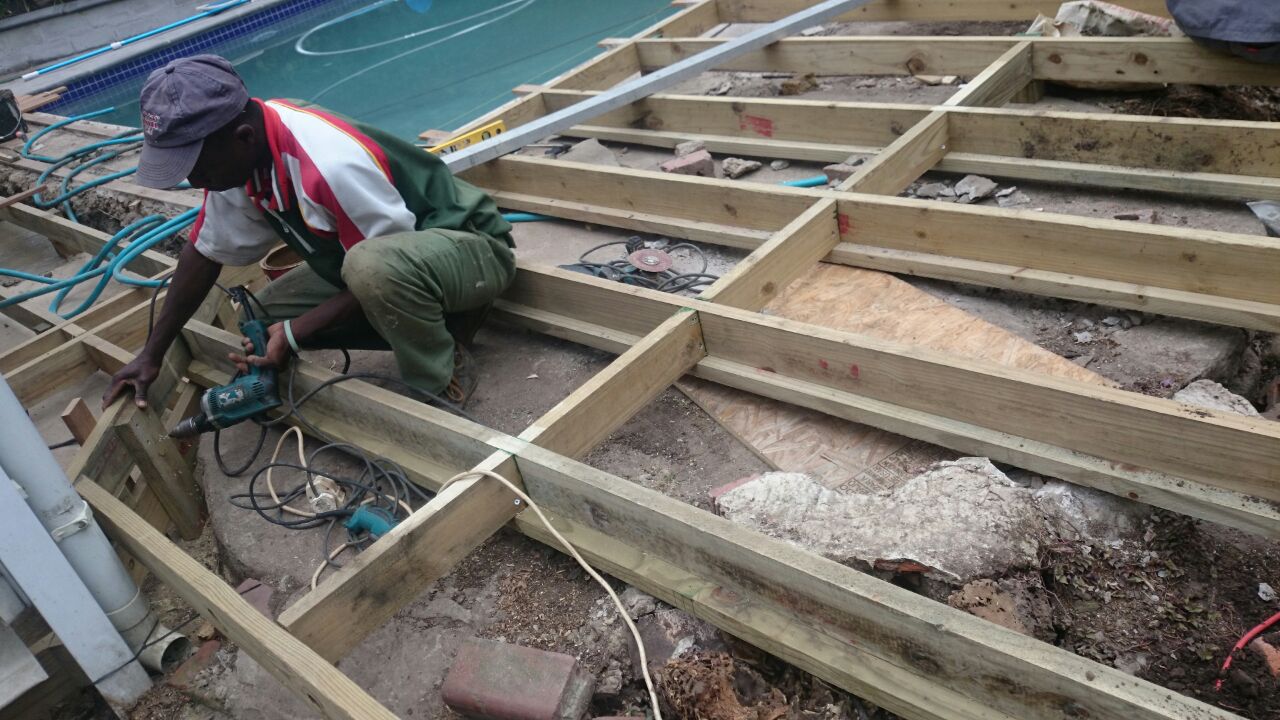
We are busy with a new wooden pool deck build in Hillcrest, Durban and I have taken a video to show how the substructure is built before the deck boards go down.
This is a low-level wooden pool deck that we are building which is only about 200mm off the ground. Because it is 200mm off the ground we can’t simply use 38 x 38 cleats as we have done in the past which are secured to the ground. We still need to use a joist of at least 114mm wide which is supported every 1.6m with a foot or post as there will be a void beneath the joist and the paved substrate. We have aimed to get our deck flush with the floor inside the house which is about 200mm above the paved area around the pool.

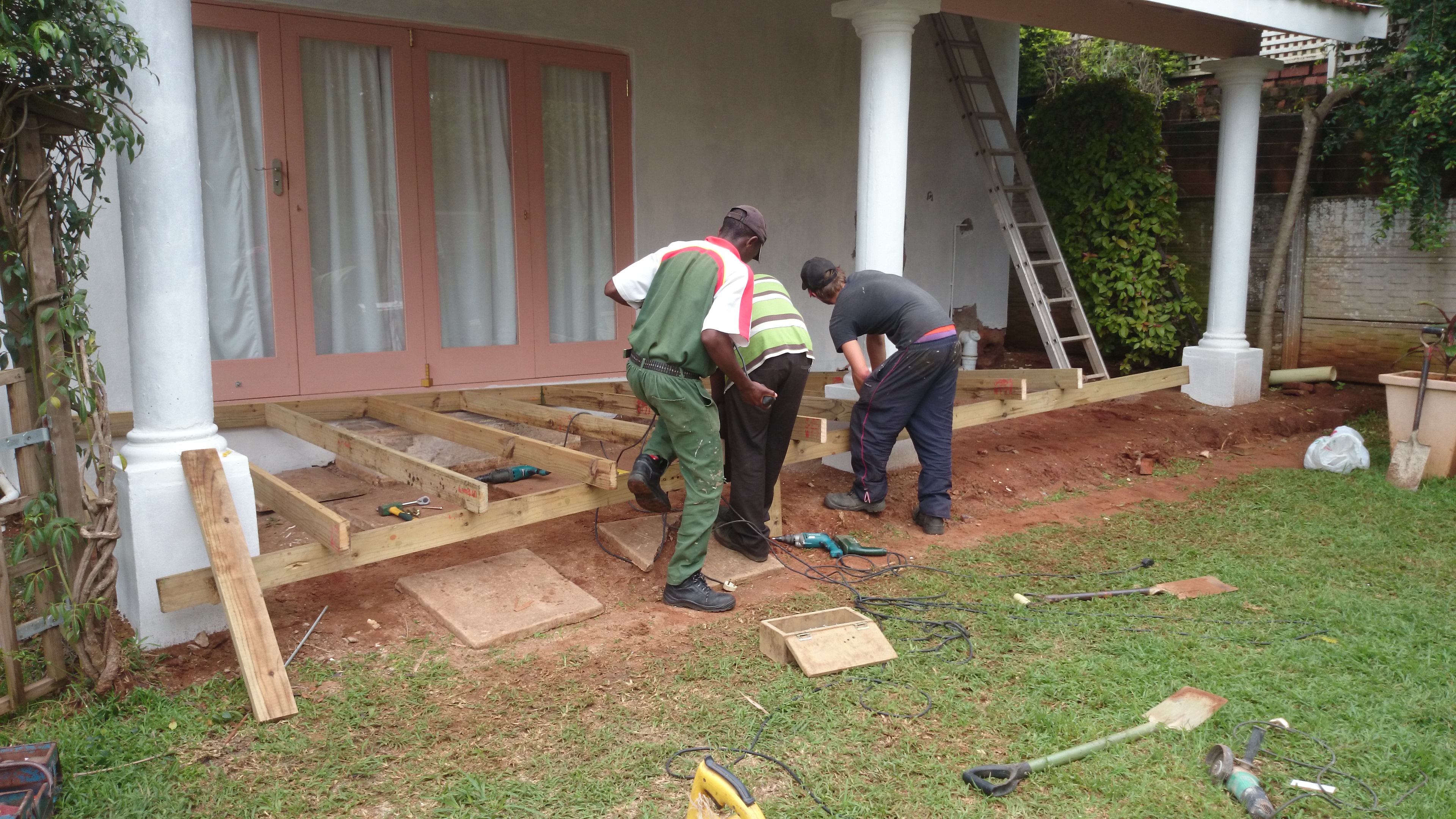
We built our substructure in a number of separate frames which are then lifted up into place on the wall side and secured using sleeve anchors. The opposite ends of each frame are then also lifted up to get the top of the joists level and flat and supported using a 76 x 76mm square post which rests on top of the paving. We will also remove some paving on every other post and sink that into the ground to ensure that the deck doesn’t sink over time if the paving sinks. The separate frames are then all attached to each other.

We have left our joists long to extend over the pool and now that the side of the frame is attached to the house we can work out exactly where we want our joists to end so as to get our fascia board on the inside of the pool completely flush with the vertical of the coping of the pool. This way we can slide our fascia down to cover the coping neatly. We can now trim our joists to the correct length and install another 38 x 114 joist running at right angles to the main joists. We could not make use of a beam and joist system here because we don’t have space beneath our joists to install a beam. We would need an extra 228mm to do this. So our frame is assembled in one single plane rather than having joists sitting on top of beams.

We’ll install some truss hangers where the joists meet the side beam which is attached to the wall. All that is holding those joists to this side frame now are two 60mm screws from behind so they need to be supported with a truss hanger to stop them ever dropping if the screws fail. Those screws are screwed into ends grain which is never that strong in terms of fixing.

The trick to this type of deck is to get the fascia frame around the pool to sit completely flush with the coping of the pool so that a fascia board (two deck boards) can be installed in the vertical plane to cover the fascia. Once that is all fixed in place and can’t move then we can deck.

Balau deck boards will be secured on top of our joists and we will start our deck boards on each side of the pool and deck towards the house and towards the grassed area. When decking towards the house we need to hope that the pool is parallel to the house and if not then we need to adjust our spaces between boards to accommodate any difference. So for instance if one side, between pool and house is 20mm shorter than the other, then we will need to increase the gaps between deck boards by 1mm for 20 boards to get the deck parallel to the house. If not we will end up with a wedged shape board as the last board which will be unsightly and will fail more easily. Also we need to try to end on a full board rather than a ripped half board as that too will be unsightly and may fail prematurely. Again we will adjust the gaps as we go to ensure we end on a full board. The gaps are normally 5mm, but we can adjust them to 4mm or 6mm without being noticed. Then we will “fill” the section between each long side of the pool and again we need to ensure that we don’t end on a half board, by adjusting our gap to 4mm or 6mm. The final result will be a deck with full deck boards and no wedges.
The grassed side is easy enough in that we can protrude over the end of the paving to end on a full board and terminate our deck there. On this end we will install a screen of 1.8m high the length of the deck. So we will tie our upright posts for the screen into the posts for our deck to secure the deck into the ground with concrete to prevent any slippage, and at the same time providing an upright of 1.8m for our screen.

For a free no obligation quote on your wooden sundeck, pool deck, balustrades, screens, cladding, walkways etc. please contact us on 082 496 5444 or use the contact us form below.
Go back

Your message has been sent

Warning
Warning
Warning
Warning
Warning

Warning.

Wooden Pool Deck Built in Westville, Durban

Pool deck built Westville Durban

Click to enlarge

Balau Deck board

Click to enlarge

50 degrees

Here was a nice size wooden sun deck, or pool deck, we built of approximately 60m². I say a nice size because at that size one can reduce the costs slightly, pass a saving on to the client, and make a little bit more money on the job.

Wooden deck with jacuzzi cladding Durban

Click to enlarge

This wooden sun deck was built around the pool as you can see from the pics alongside. It also extended to the far end of the house and was enclosed by a balustrade on two sides with two gates leading to the garden. Access to the deck was from two bedrooms on one end in front of the pool and from the lounge on the other end. The level of the floors, in the rooms, near the pool, were not the same level as the level of the lounge floor so we were left with a choice to either step the deck or have a small step up to the lounge. We chose to create a small step up to the lounge because having a step in the middle of your wooden pool deck is only going to lead to someone tripping and hurting themselves.

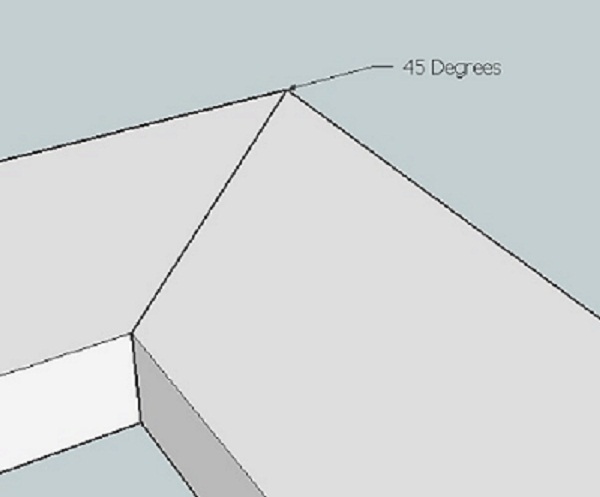
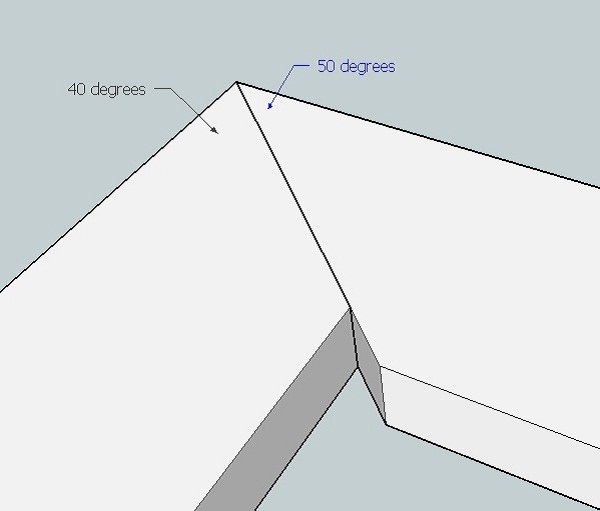
In this article I want to write about the different ways of laying the boards when it comes to pool decks or any other deck where the boards can possibly run in both directions. If a deck needs to be built with deck boards all running the same way it is relatively easy to install them in that the ends do not need to match up. The problem one can have in trying to match up ends of deck boards is that if they are not cut at precisely 45° then the length of the cut ends will differ. I’ve drawn a sketch alongside to illustrate this.

It is highly unlikely that any pool will be perfectly square. When installing the wooden pool deck it may be necessary to cut one end at say 44° and the matching board that runs at right angles to it, at 46°. The two ends will not be of equal length and will therefore not match up flush with each other. The problem is compounded with each deck board that is added. Let’s assume that the one cut end is 2mm longer than the other. After installing 15 deck boards (or one metre) the boards will have shifted by 30mm (15 x 2mm). This will be unsightly. The problem is also compounded by the variance from 45° which results in the difference in lengths of cut ends being greater.
There is a way to overcome this problem and that is to install a joiner between the cut ends as the sketch alongside illustrates. The other way is to run the deck boards all in the same direction (i.e. not all parallel to the edge of all sides of the pool, but rather all parallel to each other).

Pool deck built Westville Durban

Click to enalrge

Another advantage though of running the deck board’s parallel to all edges of the pool, with corner joins, is that you will have face grain facing the pool and not end grain. Water is absorbed largely through the end grain of wood and if this end grain is facing the pool, then it stands to reason that the deck boards on this side of the pool will be exposed to more water and will tend to rot more quickly than those with face grain facing the water. Even though we use balau for our deck boards, which is rot resistant, all wood will rot and by employing methods that will inhibit rot, makes good sense. Having said all that, it is easy and cheap to replace deck boards and if a deck board with end grain facing the pool gives you 15 years life, the cost vs. preference is not that great.

For a free no obligation quote on your pool or sun deck, or any other outdoor timber construction, please call us on 082 496 5444 or use the contact us form below.
Go back

Your message has been sent

Warning
Warning
Warning
Warning
Warning

Warning.

Balau Wooden Sundeck Built in Kloof, Durban

Wooden Sun decks Durban

Click to enlarge

Here’s a balau wooden sundeck we’ve just built on Kloof, just inland of Durban.

We used a 19 x 90 balau deck board on this wooden sun deck at the client’s request. We normally use a 19 x 68 balau deck board as they are considerably less expensive per square metre than the 19 x 90 balau deck boards and we can pass that saving on to our clients. Granted it is quicker to install a deck board that is wider as you need less boards per square meter (in this instance 15 boards per square metre using a 68mm wide board and 11 using a 90mm board), but not by that much that it warrants paying 35% more for it. 90mm boards are about 35% more expensive per square metre than 68 mm boards.

Wooden Sun decks Durban

Click to enlarge

When screwing down a 19 x 90 deck board I put two screws, per board, in each joist line, one in each shoulder. I have seen other deck builders putting one in

Wooden Sun decks Durban

Click to enlarge

every alternate shoulder. It does work, but if you do get a board that is particularly prone to warping it will warp where the one screw has been left out. It is not a huge cost or effort to put a second screw on the opposite shoulder of each board at each joist line. Obviously the wider the board the more prone it will be to warping. Why they are more expensive I haven’t yet worked out because good balau is good balau is good balau. If the wider boards we taken from a different part of the tree, the heartwood vs. the sapwood, then I would understand the price difference, but they aren’t. It is a preference, at a price, that’s all.

Wooden Sun decks Durban

Click to enlarge

We ran the deck boards all in the same direction on this wooden deck. With this deck we ran the deck boards parallel to the edge of the pool meeting each other at a 45° angle on the corners. It is far easier to run them all in the same direction as you will never get a problem of matching the cut ends. If one board is cut at 46° and one therefore at 44°, they will be of different lengths and will not match up. In this instance you need to install a barrier between then (one deck board’s width) to hide any difference in length between cut ends. But I’ll write another article about that later. Running them all the same way on both sides of the deck eliminates this problem.

You need to be careful though to start installing your deck boards in the middle of the deck and not on one end. If you start on one end, you may very well reach the 90° corner and find that you have to rip a deck board in half to cover your space. This is unsightly and will result in that deck board failing more quickly than the rest. So start in the middle and move outwards to both ends and end with a full deck board.

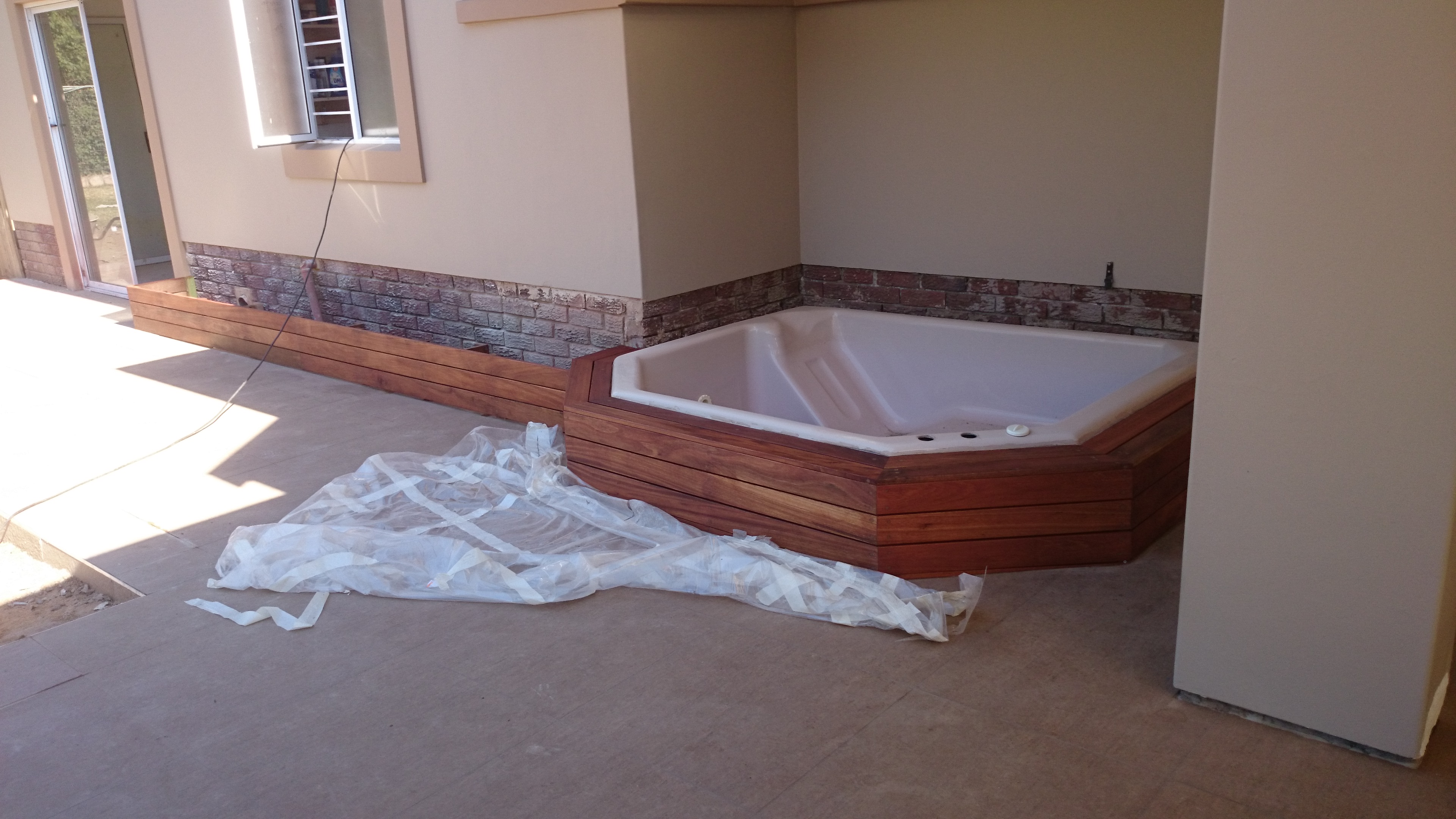
There was also some other work on this wooden deck build in that the client wanted a planter stand built so he could place potted plants in it and he wanted his Jacuzzi walls clad. We battled a bit with the Jacuzzi cladding as the original brick structure that was there was skew and we had to try to mitigate this by building up

Wooden Sun decks Durban

Click to enlarge

our substructure to bring it back to square.

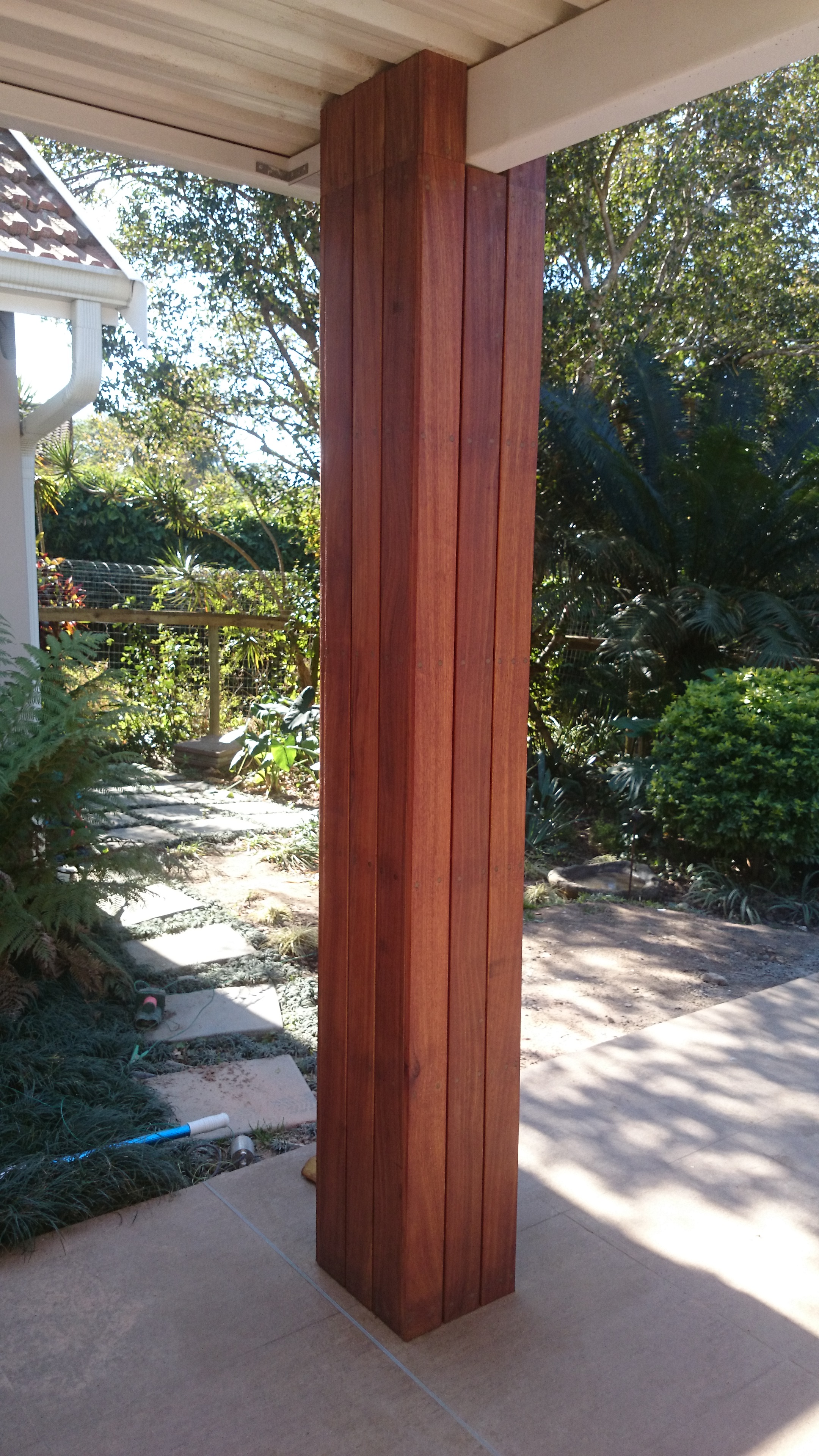
The cladded vertical posts you see in the pics alongside are 19 x 90 boards (x 3 of) around a 76mm steel awning post. We needed to build the steel awning post up to get to our 290mm and then attach it to the post. Although it looks very nice to have such bulky wooden posts, it does block the view slightly when sitting at the pool. Why 290mm when each board is 90mm (90mm x 3 = 270mm)? Because we set each corner chasing the other surface. And let’s just forget about the 5mm gap we had in between each board.

For a free no obligation quote for your wooden sundeck, pergola, walkway, screens or other timber construction please use the contact us form below or call us on 082 496 5444.

Go back

Your message has been sent

Warning
Warning
Warning
Warning
Warning

Warning.

Wooden Sundecks – Durban North

Wooden sundecks Durban North

Click to enlarge

Wooden sundecks Durban North

Click to enlarge

We completed these wooden sundeck jobs in Durban North last year during our busy decking season. There were two decks we built. They were both quite simple in that they were low-level wooden sundecks coming off the granny flat, which had just been refurbished measuring 5m x 2.2m.

The first one was a relatively small deck. It had two steps off the front edge with closed risers. That was probably the most difficult part of the job but we have worked out a way to build these quite effortlessly. We build the deck with a fascia beam on the front and then we build a box complete with supporting joists frame etc. We then attach this to the fascia beam of the deck we have just built and we are left with a frame which we can clad to create our riser and tread of our stairs. It is much easier to do it this way. Trying to build it piece by piece in situ is a lot more difficult and time-consuming. In fact building decks in sections and then hoisting them up into place is the easiest way to build as it allows you to work on a section of the deck on the floor, get everything square and then simply level it in place and attach it.  We had two concrete columns on the front edge of the deck so it was relatively easy to secure the deck and made for fewer posts and concrete.

Wooden sundecks Durban North

Click to enlarge

The second deck was closer to ground level off the patio of the main house. Again we built this in sections and lifted them up to secure them to the wall and then secured the front edge with posts to ground using concrete. Because of the length of the deck (11m odd) we had to build it in two sections and lift each section up independently of each other. It becomes a bit cumbersome trying to lift an 11m deck into place. So it is better to build it in two sections and lift each one separately. You need to be careful though that the entire structure remains flat from one end to the other. By doing them in two sections it is easy to get a kink in the middle. So run fish line from one end of the one section to the far end of the other section and adjust the join to get the entire frame flat and level.

In another article I will describe the different methods used to screw the deck boards down. Again there is an easy and quick way or there is the slow process of marking and cutting each board individually. What one wants to do is to lay all boards out and snap chalk line where the cuts should be, then cut them all, put them back and secure them. There is another method too where you screw the boards down and then lift the ends that need to be cut and cut with a skill saw.

Wooden sundecks Durban North

Click to enlarge

These two decks were sealed using Timberlife Satin Wood 28 Base, a sealer suitable for woods of low porosity. Being and oil based sealer it goes on very easily, cannot run or streak and when it comes to maintenance, you simply wipe clean and re-apply. You will need to do it a bit more often than other deck “sealers”, but there will be no more sanding as the oil cannot peel or flake like a coating does. It soaks into the wood, nourishes it, leaving the full natural look of the wood and simply disappears instead of flaking and peeling.

For a free no obligation quote on your wooden deck, balustrades, stairs etc. please call us on 082 496 5444 or use the contact us form below.
Go back

Your message has been sent

Warning
Warning
Warning
Warning

Warning.

Wooden Screens, Pergolas, Decks and Gates Durban

Driveway gate clad in balau

Click to enlarge

Wooden gates Durban

Click to enlarge

Wooden Screens Durban

Click to enlarge

Wooden balustrades and pergolas Durban

Click to enlarge

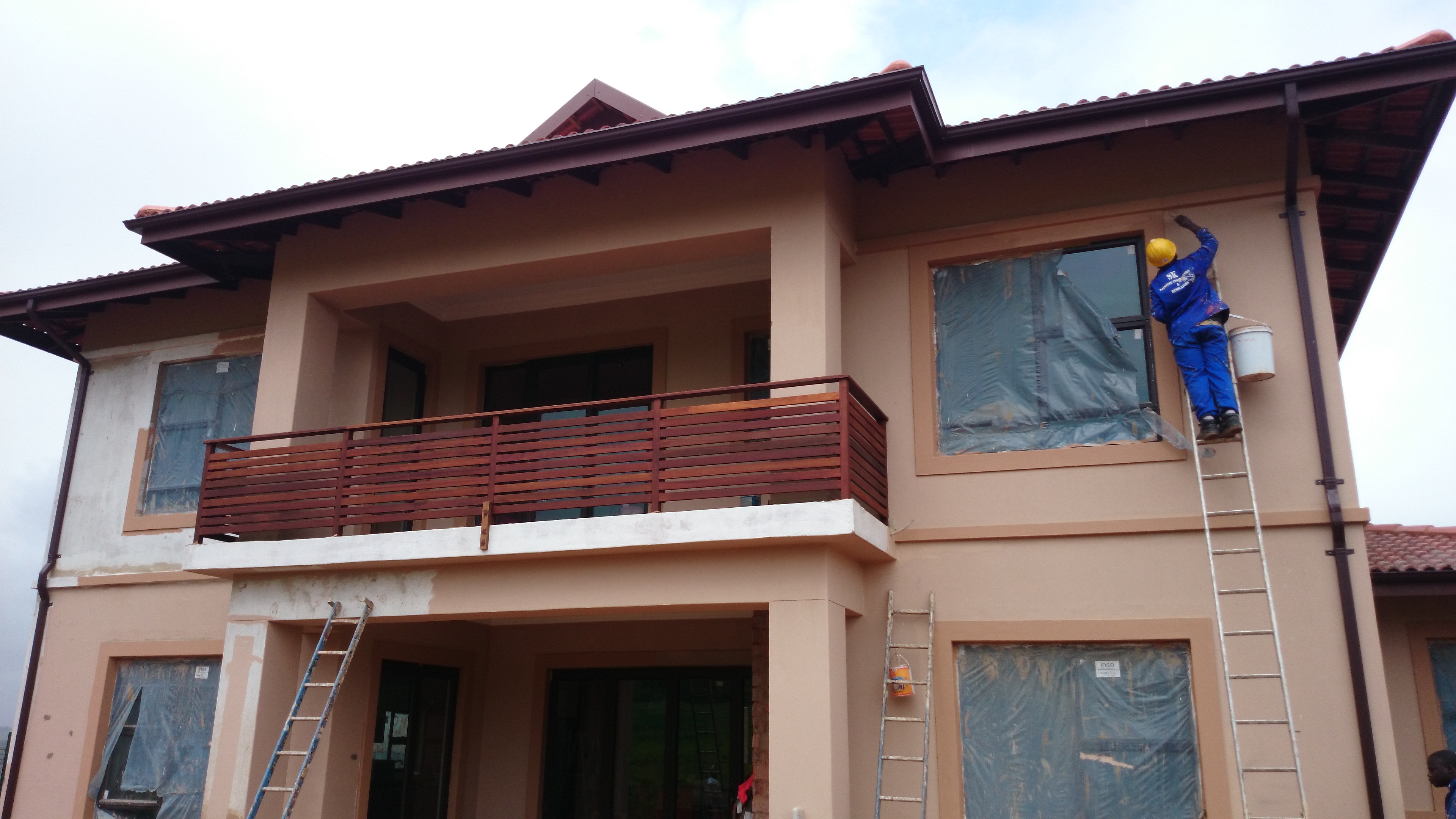
We were asked to quote on wooden screens, wooden pergolas, wooden decks and wooden gates on a new build in Prestondale, an area north of Umhlanga, at a development called Izinga Ridge. We originally quoted in about June 2013 and the work was awarded to us for s start date of about 1 November 2013. The job consisted of various screens between brick columns on the boundary wall, a pergola on an open balcony on the first floor, external and internal balustrades, garden gates, a driveway gate and a pool deck.

All the timber we used was balau hardwood with the exception of the substructure of the pool deck which was H3 and H4 CCA treated pine. In other articles you can read about how we have managed to keep our prices down by using this as a substructure whilst still being able to offer up to a 50 year guarantee on this treated timber.

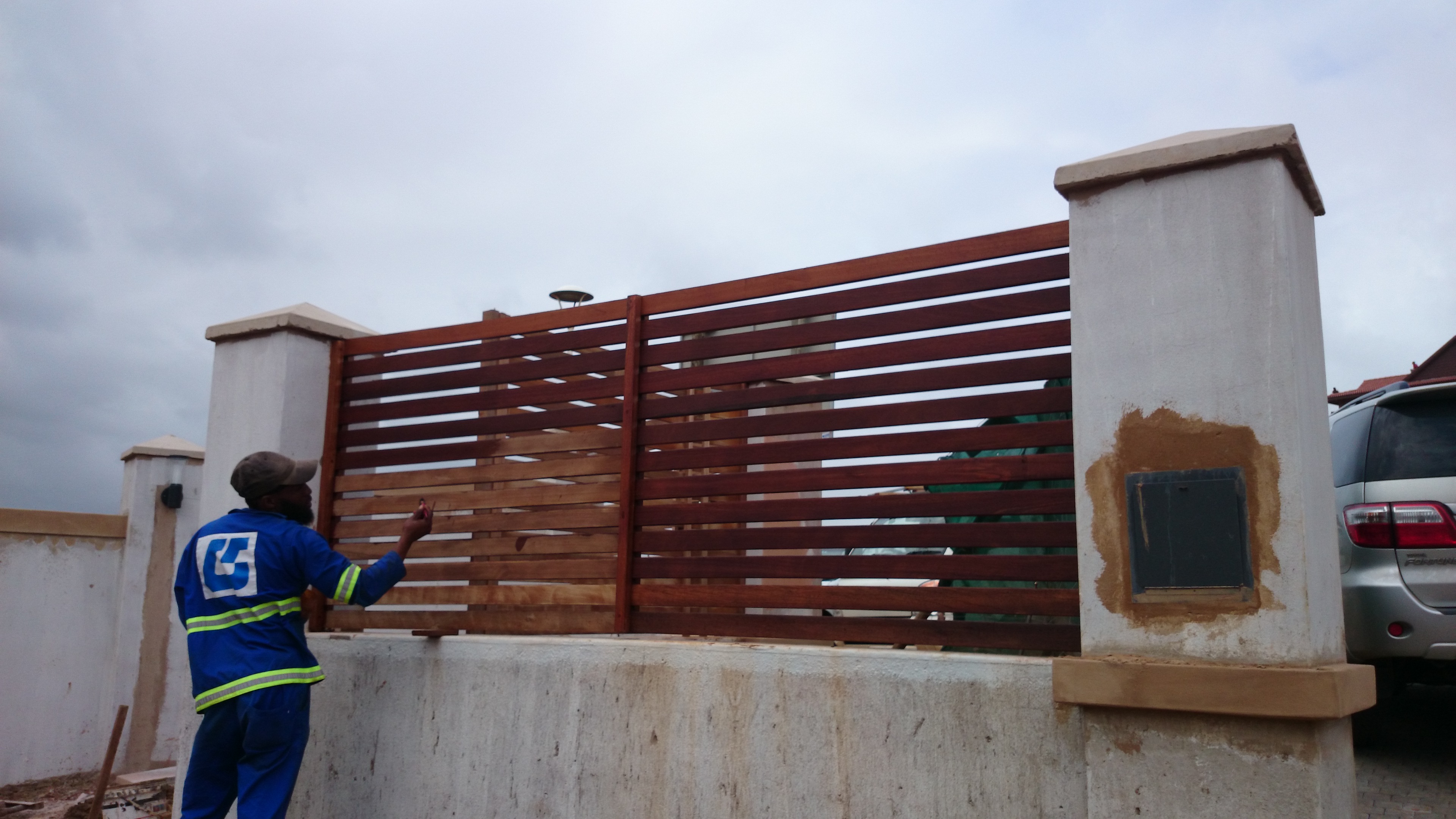
Most of the screens were pretty straight forward with balau cleats on the wall and then clad using a non reeded 19 x 68 deck board. We used non reeded so that both sides would look the same, but we did battle to find non reeded boards as most of the deck boards available are already reeded, or grooved on one side. There were two screens that proved a little more difficult as the wall we were attaching them to was angled. So the boards had to be cut at that angle and secured to each other whilst still remaining level and the join remaining plumb.

The external balustrades were different to our normal vertical picket style balustrades as the client requested horizontal slats instead. Again we used non reeded deck boards for this with a normal post system. On each post we attached vertical cleats to accept the horizontal deck boards or slats. They were installed in line, or on top of the concrete slab, rather than being attached to the front of the concrete slab. The tiles had already gone down so we had to drill through the tiles without cracking them. We installed an “ankle” on the middle post to provide support which is attached to the vertical post and is then shaped to fit around the slab to attach again to the vertical of the concrete slab. This, in effect, allows the post to be attached to the outside but still allows the balustrade to sit on top of the slab. It is much neater but does require a bit more thought and re-enforcing.

Wooden decks durban

Click to enlarge

The pool deck was relatively simple as it was a low-level deck around the pool with a simple frame system using 38 x 114 joists and beams. Extra posts had to be concreted in as it wasn’t high enough to slot an under beam, or main beam, of 50 x 228 in.

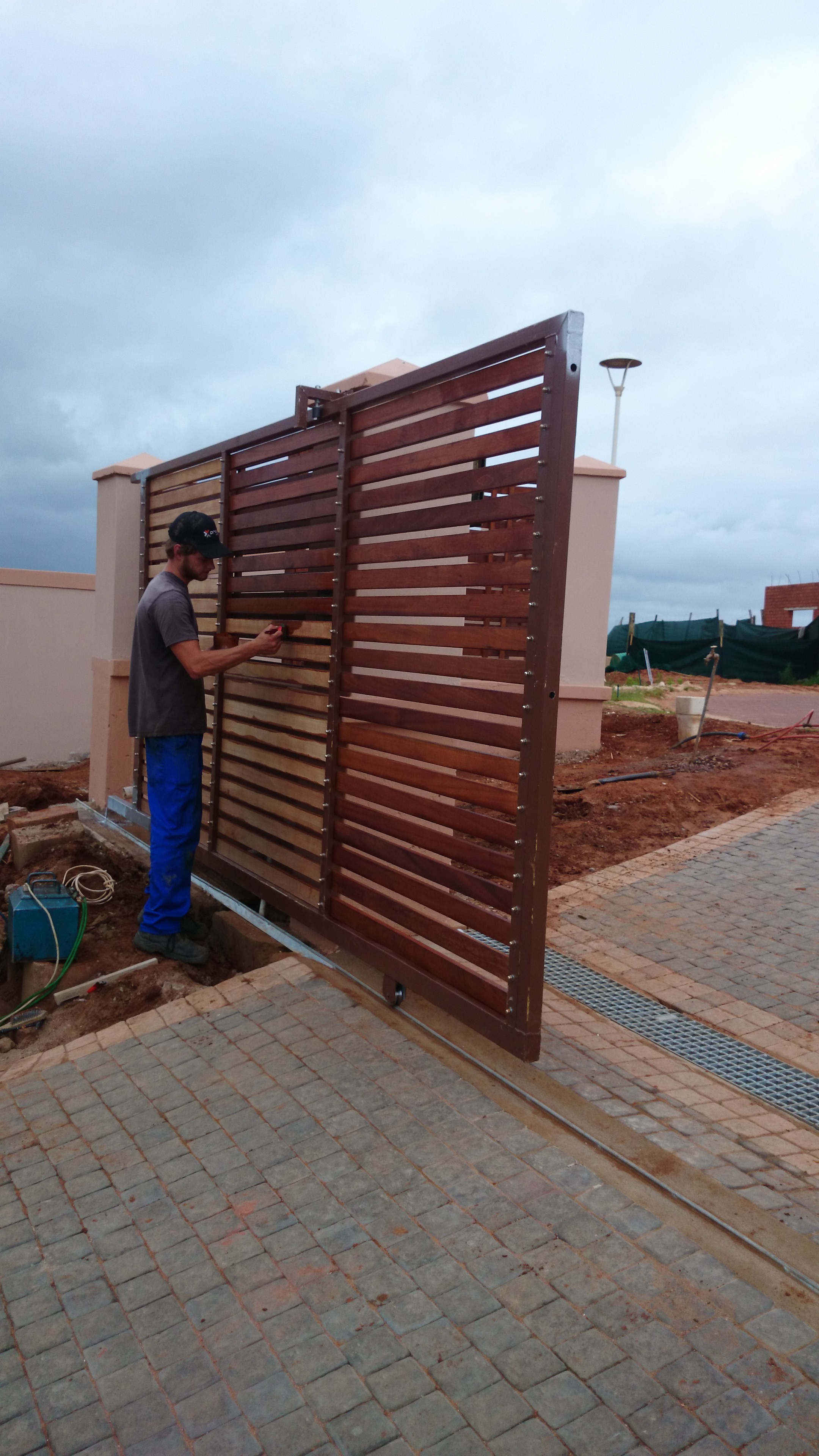
The driveway gate was fun. We had the steel made up in a design that would work well by cladding it with wood. We had to source long enough non reeded boards to run the full width of 4m. One cannot join boards in this type of gate unless there is a centre steel vertical support which would spoil the look of the gate a bit. We had run out of standard non reeded boards and so had all suppliers so we sourced a 20 x 140 board and ripped it in half, length ways, to arrive at two boards of 20 x 68.

Wooden balustrades Durban

Click to enlarge

The pictures alongside show some work in progress and some completed work. It was an interesting but challenging job as there were many contractors on site all trying to work, and finish, before the handover of the house. The worst part of the job was fighting traffic from north Umhlanga to the freeway in both the morning and afternoon.

For a free, no obligation, quote on wooden decks, pergolas, garden gates, balustrades and all other outdoor timber work, please call us on 082 496 5444 or complete the form below.
Go back

Your message has been sent

Warning
Warning
Warning
Warning
Warning

Warning.