Wooden Balustrades

Wooden Balustrades Durban and Cape Town

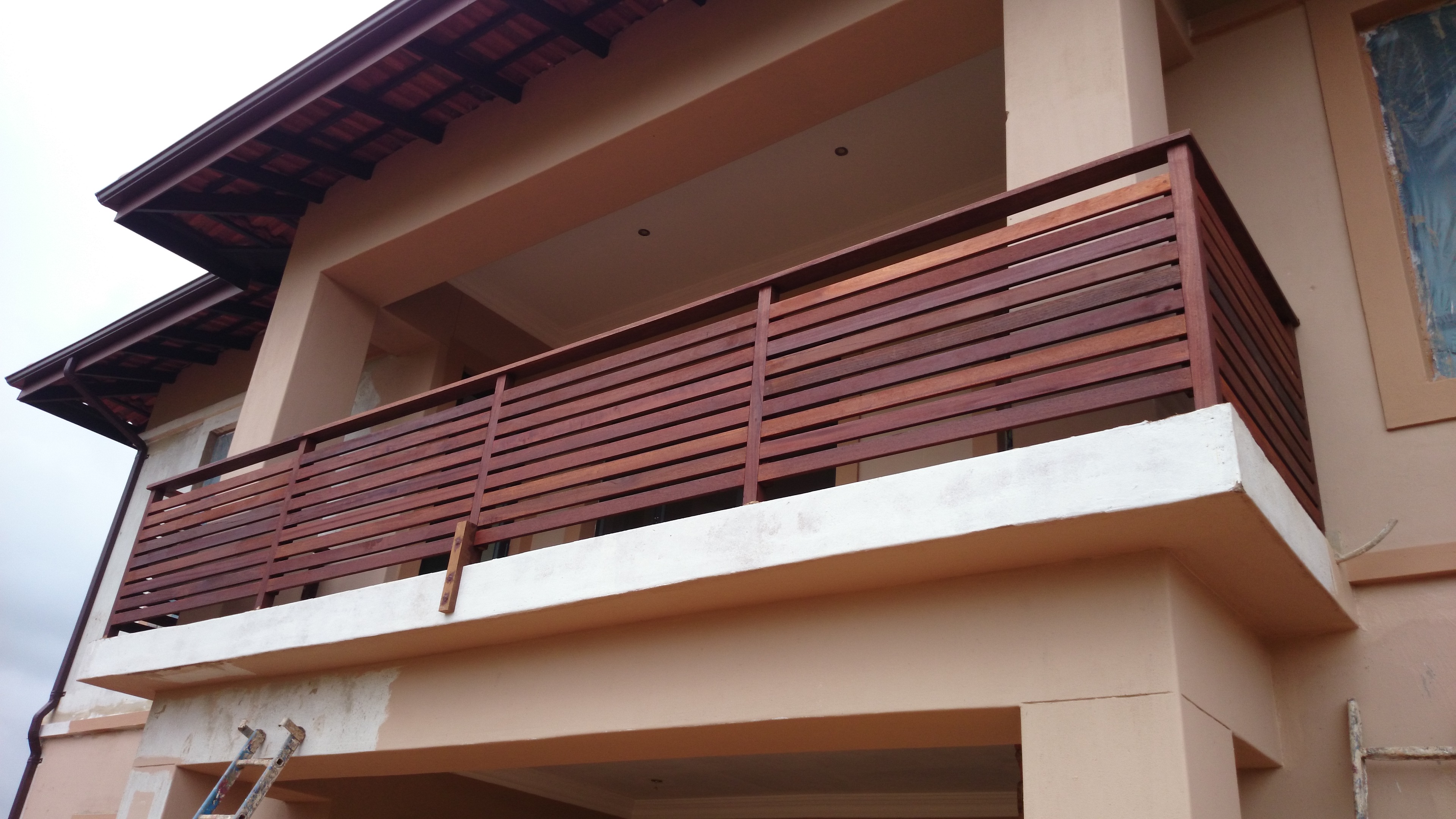
Balau Horizontal Balustrade

Wooden balustrades are necessary on all decks that are above 1m off the ground for safety reasons. Some people opt for them even if the deck is lower than 1m. They normally sit 1m above the deck surface but on decks which are higher than about 4m off the ground, it is recommended that one install a 1.2m high balustrade for safety reasons.

There are various designs from a standard vertical picket style balustrade to a criss cross pattern to diagonal slats and even deck boards installed horizontally. One should consider the reason for installing a wooden balustrade and then decide which one to opt for. For instance a vertical picket style is safe for high decks as they can’t be easily climbed and all gaps between pickets are less than 100mm so small children can’t fall through.

A criss cross balustrade has large openings and is not as safe.

Most balustrades have a capping on top of about 30mm x 100m allowing for a comfortable arm rest and a spot to place a drink.

Wooden Decks Durban and Cape Town

Click to enlarge

Contact us if you’re planning on doing any wooden balustrade work on 082 496 5444 or use the form provided below.

Go back

Your message has been sent

Warning
Warning
Warning
Warning
Warning
Warning

Warning.

Wooden Bridges and Walkways

Wooden Decks Durban and Cape Town

Click to enlarge

Wooden bridges and walkways are popular in gardens that have small streams or where the garden necessitates a walkway in order to get from one place to another.

Instead of allowing a path to form from wear on the grass you can install a 1m or so wide walkway which is level and flat allowing you to move from one side to the other in comfort. They are often complimented by stairs or the occasional step up or down where the ground falls. They are often used to join one deck to another or a doorway to a deck.

Bridges can be spanned quite far without using supporting posts if balau is used. If posts are needed to support the bridge midway then H5 CCA treated posts can be used which can live in water for up to 30 years.

Please complete the form below if you require a quote and I will contact you or you can call on 082 496 5444.

Go back

Your message has been sent

Warning
Warning
Warning
Warning
Warning
Warning

Warning.

Wooden Pergolas

Wooden Decks Durban and Cape Town

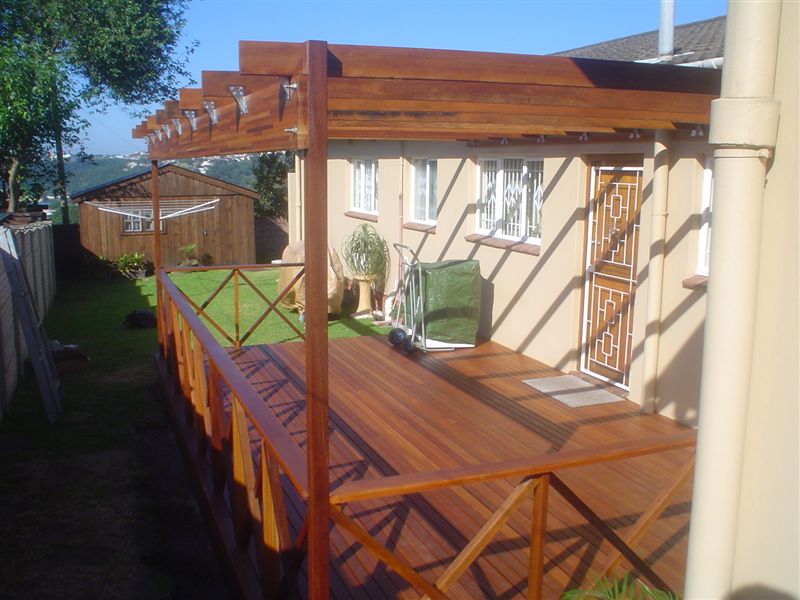
Deck and pergola

A wooden pergola is a structure above that is designed using timber beams, purlins and slats. It is largely decorative as it does not prevent rain and provides limited shade depending on how many slats are installed.

They are sometimes referred to as Sun Screens and can be built in such a way as to offer shade at certain times of the day by adding more or less slats to the top. There are a multitude of designs and they are only limited by ones imagination, and of course budget.

They can be attached to the main building and then supported by posts on the front edge or they can be free-standing with posts to ground. One can install roof sheeting above to keep the rain out, but often it is better to consider an aluminium awning for this application due to cost. A balau pergola is not the cheapest method, but does add a nice appealing underside to your covering.

Wooden pergolas can also be installed using thatching laths to give them a more rustic look and feel.

Should you require a quote on a pergola or any other timber construction for your home, please call us on 082 496 5444 or use the form below.

Go back

Your message has been sent

Warning
Warning
Warning
Warning
Warning
Warning

Warning.

Wooden Screens and In Fills

Wooden screens Durban and Cape Town

Click to enlarge

Screens can be used for a multitude of purposes from screening out the view of the neighbours to enclosing an air conditioner so that it is not visible. They are sometimes concreted into the ground and can vary in height. Sometimes they are attached to boundary walls or the main building and some contain gates and hinged or removable lids for access to air conditioners, pool pumps, koi pond pumps and so on.

In fills are similar to screens but are normally installed between two brick columns on a boundary wall to create the effect of brick work and timber.

Most often the slats are installed horizontally with a 20mm gap between boards. This allows you to still be able to see through but screens out the view of others on the outside. This gap can however be changed for different applications. Double sided screens are also available so that both the inside and outside look the same.

To request a quote or for some advice please contact us on 082 496 5444 or use the form below to contact us.

Go back

Your message has been sent

Warning
Warning
Warning
Warning
Warning
Warning

Warning.

Wooden Sun Decks Durban and Cape Town

Wooden decks Durban and Cape Town

Click to enlarge

A wooden sundeck is a valuable extension to your house in that it is relatively cost-effective whilst still increasing the living area and total coverage of your property. If properly installed and maintained it will give you many years of warmth and enjoyment and you will retain the value of it when ultimately selling your property. It is more cost-effective than brick, concrete or steel and with the trend moving towards sustainable and green building, a sun deck, sourced from sustainable forestry will retain its value for many years to come.

We generally use CCA treated pine in our substructures as it is a lot more cost-effective than using balau and we are still able to offer a 50 year supplier guarantee on the timber used in the substructure. This is provided we document the build with photos, retention records from the treatment plant, the date and invoices of when we bought the timber etc. As a rule we build in accordance with their criteria for the guarantee, but if a guarantee is required, we must be notified beforehand so that we can obtain these documents during our build. We use balau deck boards on the surface of the deck because they are infinitely more stable and do not warp or twist as much as balau. This is not as important in the substructure because it is largely covered from the sun and the pieces we use are a lot thicker so don’t warp or twist as much. Deck boards on the other hand take the full brunt of the sun and tend to warp more quickly. Also we source our balau at very competitive prices and can therefore build a deck at very competitive prices, even compared to using pine deck boards. Pine deck boards are much softer so one has to use twice as much wood negating the cost saving by using a cheaper timber. The structural pieces in balau are more expensive per cubic metre than pine so using a CCA treated substructure reduces the cost which we pass on to the client.

We use kalgard screws which are guaranteed by the supplier against rust for 25 years, we counter sink them and close the holes using an epoxy and saw dust mixture to match the colour, thus eliminating water ingression through the screw holes thereby reducing rot at the screw hole. They are sanded flat and we seal our decks using an oil based sealer which penetrates the timber rather than leaving a coating or film on the surface. Maintenance is therefore easy and inexpensive. You simply wipe clean the timber, clean any greasy marks off with turps and re-apply using brush, sponge, cloth or spray.

For some expert advice or a quote, please contact us on 082 496 5444 or complete the contact us form below.

Go back

Your message has been sent

Warning
Warning
Warning
Warning
Warning
Warning

Warning.

Wooden Floors and Laminates

Solid Wooden flooring Durban and Cape Town

Click to enlarge

We specialise in Solid Wooden Flooring, Laminates, Parquet flooring, Dustless Floor sanding and Sealing and repairs to wooden floors.

Wooden floors exist in many different forms from Swiss Parquet, Parquet, Sprung or Suspended Floors or wooden floors that are adhered to the substrate. They come in many different types of wood and each one has its own unique characteristics and pro and cons. From the menu bar on the right you can navigate to the different types and read up and view pics of the different styles. Alternatively you can use the search bar above to the right to search for something more specific. There are articles on this site of jobs we have completed with pics and the various challenges we overcame in the installation.

Solid wooden floors were very popular in years gone by and in about the ‘70s were all covered up with carpets and other types of flooring. They are making a strong come back now and are very popular due to their warmth, charm and the ability to maintain them relatively easily and cost effectively. Take a look under your carpets and you may find some very nice teak flooring that can be restored back to its original beauty at a relatively low-cost.

For a free, no obligation quote, on all your wooden floor requirements please contact us on 082 496 5444 or use the contact us form below.

Go back

Your message has been sent

Warning
Warning
Warning
Warning
Warning
Warning

Warning.

Parquet Flooring Installer Durban and Cape Town

Parquet flooring Installer Durban and Cape Town

Parquet flooring was very popular many years ago but a lot of it was covered up with carpets back in the 70’s. It seems crazy now that one could cover the parquet flooring with carpets, but that was the thing of the day and fashions come and go. I’ve recently refurbished several parquet floors by sanding them down and re-sealing them after old carpets have been lifted and they still hold their charm.

There are various types of parquet floor one can get using different wood that gives a slightly different grain, colour and texture. Of course you should always purchase your parquet flooring from a reputable supplier to ensure that you are getting top quality. Your floor will need to last many years and you don’t want to spend the money on installing it only to have to re-do the work later. Also as timber ages it naturally darkens so to try to match the colour of timber with new pieces is very difficult.

Parquet flooring comes in tiles which are made up of the small strips you see. So they are not all laid individually but rather as a sort of tile which is about 300mm x 300mm squares. It makes it much easier to lay and will result in a better finished product because of course there is less room for error in laying them. They are glued down to the floor using a suitable adhesive. Again the floor needs to be completely flat in order to achieve a good quality result. If the floor is not flat, screed it first to remove low and high spots first and then lay your floor.

The individual strips are normally laid perpendicular to each other to give it effect but some very interesting patterns can be found such as herringbone, triangles and inserts are also possible. Parquet flooring is very versatile and you can lay the tiles in just about any pattern you wish and the choices are limited only by your imagination.

For the budget concerned folk out there an alternative to buying new parquet flooring is to use second-hand parquet flooring. I have seen many houses have their old parquet flooring ripped out and discarded. This timber is still sound as most of the older houses used good quality teak in their floors. With a little cleaning and sanding those parquet floor tiles can be made to look like new. Don’t discount the value of second-hand tiles.

To finish the floor, you should sand it using the floor sander, fill any gaps with a suitable gap filler, sand again and then move up to finer grits remembering to sand into the corners with a smaller rotex style sander. A good quality polyurethane should be used either in mineral based or water based. Water based is of course more easily applied, less messy and one can apply multiple coats in the same day as it dries very quickly. Remember to sand lightly with a fine grit paper between coats to get rid of the hairs which stand up after applying coats. This will result in a smooth finish. The polyurethane comes in either high gloss, matt or satin. The choice is yours.

For a free no obligation quote or advice on your parquet flooring please complete the form below or call us on 082 496 5444.

Go back

Your message has been sent

Warning
Warning
Warning
Warning
Warning
Warning

Warning.

Solid Wooden Flooring Installers Durban and Cape Town

Solid wood flooring installer Durban and Cape town

There are two ways one can install a solid wooden floor. One is to apply the boards directly to the concrete substructure using adhesive and the other is to suspend the floor with joists or batons. This is sometimes referred to as a sprung or suspended floor.

In the first method it is imperative that the substrate is completely flat. If the floor is not completely flat, the boards will lift because they will go down under stress and over time will pull themselves up. If the floor is not completely flat you MUST screed it and get it flat. Or you can opt to install a sprung floor. However installing a sprung floor will result in the surface being about 50mm higher than it was or 30mm higher than the other method. Reason being is that there will be a baton underneath the boards to accept the floor board. So double-check where your floor will end up before choosing the method.

I will go into more detail about each method in two separate articles which you can search for in the search bar on the right, but for the purposes of this article I will just touch on the types of timber one can choose and a broad outline of solid wood flooring.

There are various types of timber that can be used for solid wood flooring. Each one comes with its own characteristics and properties. Some are harder than others, some are less prone to marking because they are dark coloured. What I find most important is to choose a timber that will not move much after installation. All timber will move as it expands and contracts due to fluctuations in temperature, moisture in the atmosphere and other factors. These will all vary with the seasons and in different parts of the country the variation will be different. It is always a good idea to bring the timber to site where it will finally be laid and let it acclimatise for a few weeks before installing. If the timber for instance was kiln dried and then stored in Durban on the coast, then later moved to Gauteng it will move because of differing temperatures and moisture in the atmosphere. So it should be allowed to rest for a few weeks before installing. In fact it should be allowed to rest before machining so that any movement can be removed through the machining process resulting in a flat, square, stable board. There is nothing more frustrating than laying solid wood floor boards only to find that later they have cupped or bowed slightly and unsightly gaps appear between boards or worse still they start to lift. It is not always possible to let them rest before machining but at least allow them to rest before installing so that any movement can be seen before installation and corrected where possible.

One can try to match the colour of the timber to the rest of the room. Saligna for instance is slightly pinkish in colour whereas teak will be a much darker wood and sometimes with dark heartwood and lighter coloured sapwood. You can get creative in matching the colours and interspersed dark with light. If you feel like get really clever you can use different types of wood in your floor but be careful to try to match the timber in their density so that all the pieces will expand and contract at a similar rate.

Your floor should be finished with a good quality polyurethane either in mineral based or water based. Water based is normally preferred as it allows you to apply several coats in the same day. Also it is better for our environment.

For a free no obligation quote or advice on your solid wood flooring please complete the form below or you can contact us on 082 496 5444.

Go back

Your message has been sent

Warning
Warning
Warning
Warning
Warning
Warning

Warning.

Wooden Fencing in Durban

Wooden fencing can come in many different designs and they are limited only by ones imagination.  All our timber is sourced from companies who adhere to renewable forestry practices.  There are a few designs or types of wooden fencing that we install mentioned below.  However we can custom design wooden fences for you using best building practices and aesthetically pleasing ideas.

POST AND RAIL FENCING
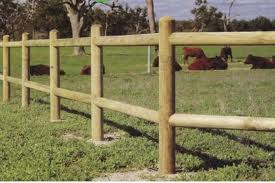
Post and Rail Fencing Durban

Click to enlarge

Post and Rail Fencing is quite common and often found in areas where horses are kept. It has become more popular in recent times in suburban areas where some sort of fence needs to be in place without obscuring the view. They don’t provide much boundary protection as they are not that high, and therefore are more popular where the fence doesn’t need to protect the boundary.
They can be covered with weldmesh to provide more of a barrier. On their own they have large openings that people and small animals can climb through but they prevent larger animals from moving through such as horses. They are often installed in gardens of secure estates where the main purpose is not to keep people out. They come in various heights from 900mm to 1.8m.

The posts and rails are normally all H4 CCA Treated so are able to live in the ground in constant contact with wet soil without rotting for up to 30 years. The best timber to use here is pine sourced from the Cape as they have fewer tendencies to split. Because the post or rail is machined from a single log, they are naturally more prone to splitting, but if sourced from the Cape, then the splitting is limited.

Picket Fencing Durban

Click to enlarge

PICKET FENCING

Picket fencing is a natural alternative to other materials that can be used to provide a barrier at boundaries of properties to keep both humans and small animals in or out. They can be installed as a solid fence (i.e. no gaps between pickets) or they can be installed with a slat’s width between pickets.

The pickets are normally 22mm x 72mm and are installed using gum poles set every 2m or so with rails on top and bottom to which the pickets are attached. The tops can be square or they can be shaped into sharp pickets. Again these wooden fences can vary in height limited only by the length of slats available.

The gum poles are normally H4 CCA treated gum and the slats and rails are normally H3 CCA treated pine. Hence they can last for 30 to 50 years without rotting.

DROPPER FENCING

This type of wooden fencing is similar to picket fencing in that it is installed using gum poles of H4 CCA Treated Gum, rails and pickets, or droppers. The main difference being of course that this fence is made entirely from round poles and not machined timber. All of it is gum so they are a bit stronger and the chance of a dropper splitting is less than the chance of a slat breaking.

Again the tops of each dropper can be left square or they can be machined to spikes, thus providing some security for would be intruders and also varying the visual appeal of them.

WELD MESH

Weldmesh fencing Durban

Click to enlarge

A weldmesh fence is one of the cheapest form of fencing. It is installed using gum poles and stays on either end with intermediate posts every 2m or so. The height can vary depending on your requirements. Straining wire is then pulled taut between the main posts and weldmesh is bound on to that. Various heights are available and various grades of weld mesh are available. The actual wire that the weld mesh is made from varies in gauge and the rectangles that this wire forms can vary in length and width. All poles used are H4 CCA treated gum poles.

For a free no obligation quote on your wooden fencing requirements please give us a call on 082 496 5444 or use the contact us form below.

Go back

Your message has been sent

Warning
Warning
Warning
Warning
Warning
Warning

Warning.

Stainless Steel Wire Rope Balustrades, Durban

This slideshow requires JavaScript.

Below is an article on wire rope balustrades to refresh the methods of installing them, display some pictures and highlight some pros and cons of this type of balustrade.

Wire rope balustrades are normally installed when one wants to avoid limiting the view as much as possible whilst still providing a barrier at the end of a deck. As opposed to solid timber balustrades which obstruct the view when in a seated position. A wire rope balustrade limits this as the cables are only 4mm thick.

On a standard 1m high compliant balustrade one would use 8 strands resulting in 9 gaps of 107mm each after taking into account that the capping is 30mm thick. Although the wire rope is tensioned on either end it is not tensioned to guitar string tension and can therefore be pulled open to create a bigger opening than 107mm. Care should therefore be taken when installing these wire rope balustrades if the property owner has small kids. They are not the safest and the height of the deck off the ground should be taken into account when choosing this style of balustrade.

As mentioned above the wire rope has a 4mm diameter. It consists of 19 smaller strands making up one larger strand (1 x19). The other type of wire rope is a 5mm wire rope. This is a 7 x 19. So it has 7 x 19 strands that make one 5mm strand. At The Wood Joint we use only the 4mm (1 x 19) wire rope as this is marine grade stainless steel and won’t tarnish as easily as the 5mm wire rope.

The 4mm rope doesn’t bend as easily as the 5mm rope so it cannot be used in conjunction with turn buckles where the rope needs to bend around the buckle 180º. Instead we make use of a swage and button head system where the wire rope is crimped into a swage on one end and a button head, which is sunk into the timber upright, on the other end. They are much neater than turn buckles but it does result in terminating the strands at a 90º corner and starting a new strand for the next run. As such, posts need to be doubled up so that a new button head can be installed where a swage terminates on the previous run. The end result is a slightly more expensive balustrade but one that won’t tarnish as easily and one that has a much neater appearance.

Care must be taken to cut the wire rope at the right length so as to have enough rope to insert it into the swage but not too much so that it can’t be tensioned properly. Once it is cut and crimped it can’t be re-cut or “uncrimped”.

The swage and button heads should be crimped towards the beginning and crimped twice to avoid failure later on. They can be finished off neatly with a stainless steel dome nut.

We are both suppliers and installers of wire rope balustrades. We own a crimping tool designed for 4mm wire rope which is also available for hire. Call us on 082 496 5444 or use the contact us form below for pricing and availability.

Go back

Your message has been sent

Warning
Warning
Warning
Warning
Warning

Warning.