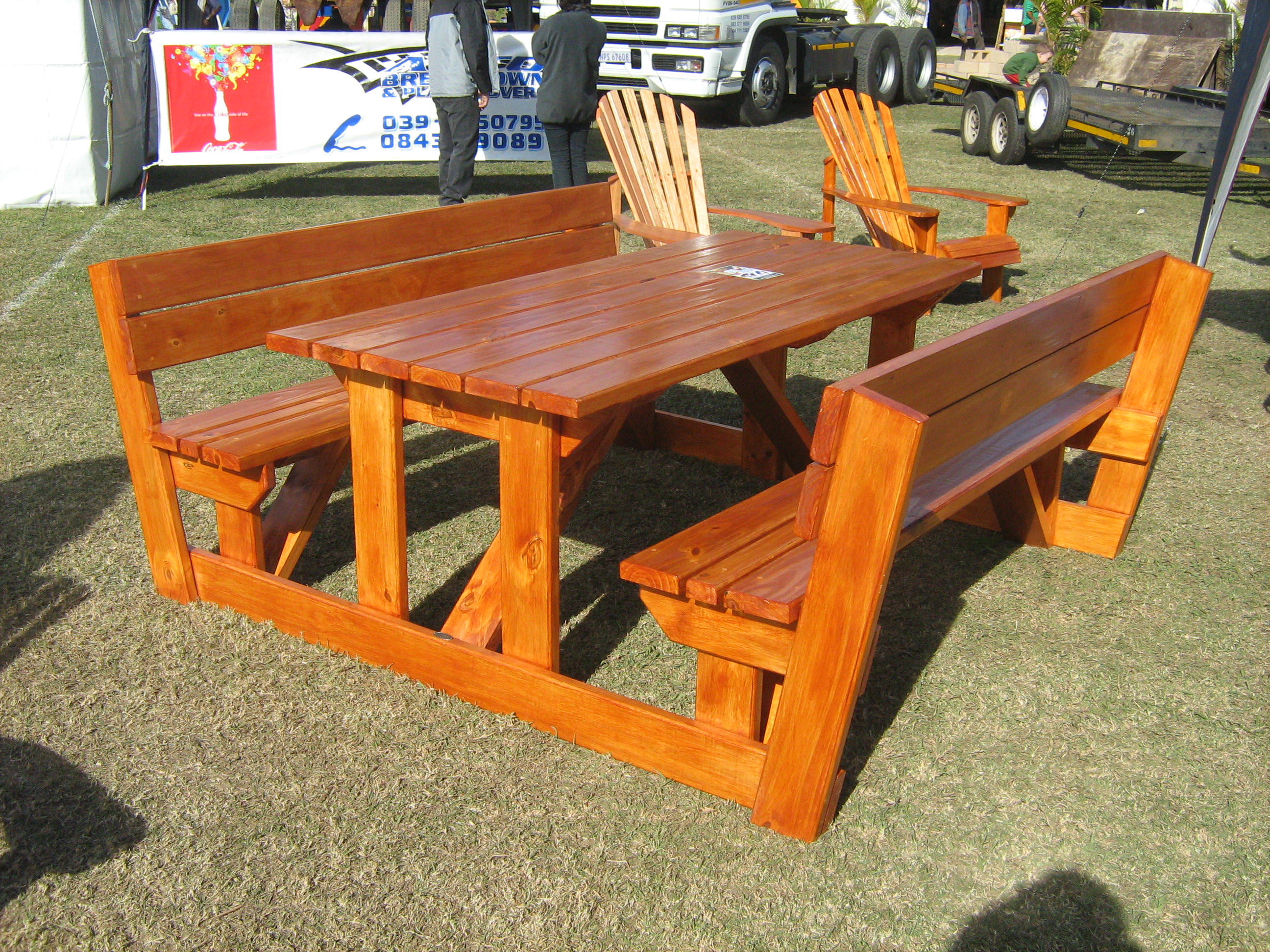
Outdoor Garden Patio Furniture – Adirondack Chairs

Outdoor Garden Patio Furniture just wouldn’t be complete without a set of Adirondack Chairs.

The Adirondack Chairs has been around for many years but today’s Adirondack chairs were designed by Thomas Lee is 1903. While on vacation in Westport, New York in the Adirondack Mountains, he needed outdoor chairs for his summer holiday home. He tested his design on his family first before arriving at a final design. He offered the final design to Harry Bunnell, a friend of his who was in need of winter income. Bunnell quickly realised the potential of the Adirondack Chair and quickly, without Lee’s knowledge or permission, registered a patent on the design and produced commercially them for the next 20 years.

Today’s Adirondack Chairs normally features a rounded back and seat with the backrest tilted backwards for comfort. There are numerous designs available today and they keep changing. We have kept ours as close as possible to the original design due to the appearance of them and the large armrests.

Outdoor Garden Patio Furniture Adirondack Chair

Click to enlarge

There is a range of timbers that can be used. Obviously the more durable and more expensive the timber the more the chairs will cost you. Saligna is widely used as an affordable fairly durable hardwood while top end users will request these in teak or balau. CCA Treated pine works well if treated to at least an H3 level which is suitable for outdoors and carries the manufacturers guarantee of up to 50 years. So they may even outlast the teak or balau.

The Adirondack Chair is slightly pricier than a normal outdoor garden patio chair because a lot of the pieces are curved and if one is not making use of a CNC router, then these invariably need to be cut by hand using either a band saw or jig saw and then shaped to their final shape. They are therefore quite labour intensive. A lot of companies have re-designed them slightly to avoid curved pieces and make use of straight cut pieces which speeds up cutting and assembly time. However we have stuck to the original curved pieces in order to keep our design as close as possible to the original. We also only produce them in timber obtained from sustainable forestry as we have found the plastic composites just don’t match up to a piece of solid wood.

Outdoor Garden Patio Furniture Adirondack Chair

Click to enlarge

The distinctive arm rests are larger enough to place a plate of food on with a drink on the other side. The backrest is tilted backwards and curved for comfort while the seat is contoured to fit around the legs.

We seal our Adirondack Chairs using a good quality outdoor timber preservative so that maintenance of them will be kept to a minimum. This requires no sanding and a mere clean and re-coat is all that is necessary. The timber preservative also allows the natural beauty of the timber to come through as opposed to a coating that covers that. They are also available in white-painted or any other colour really.

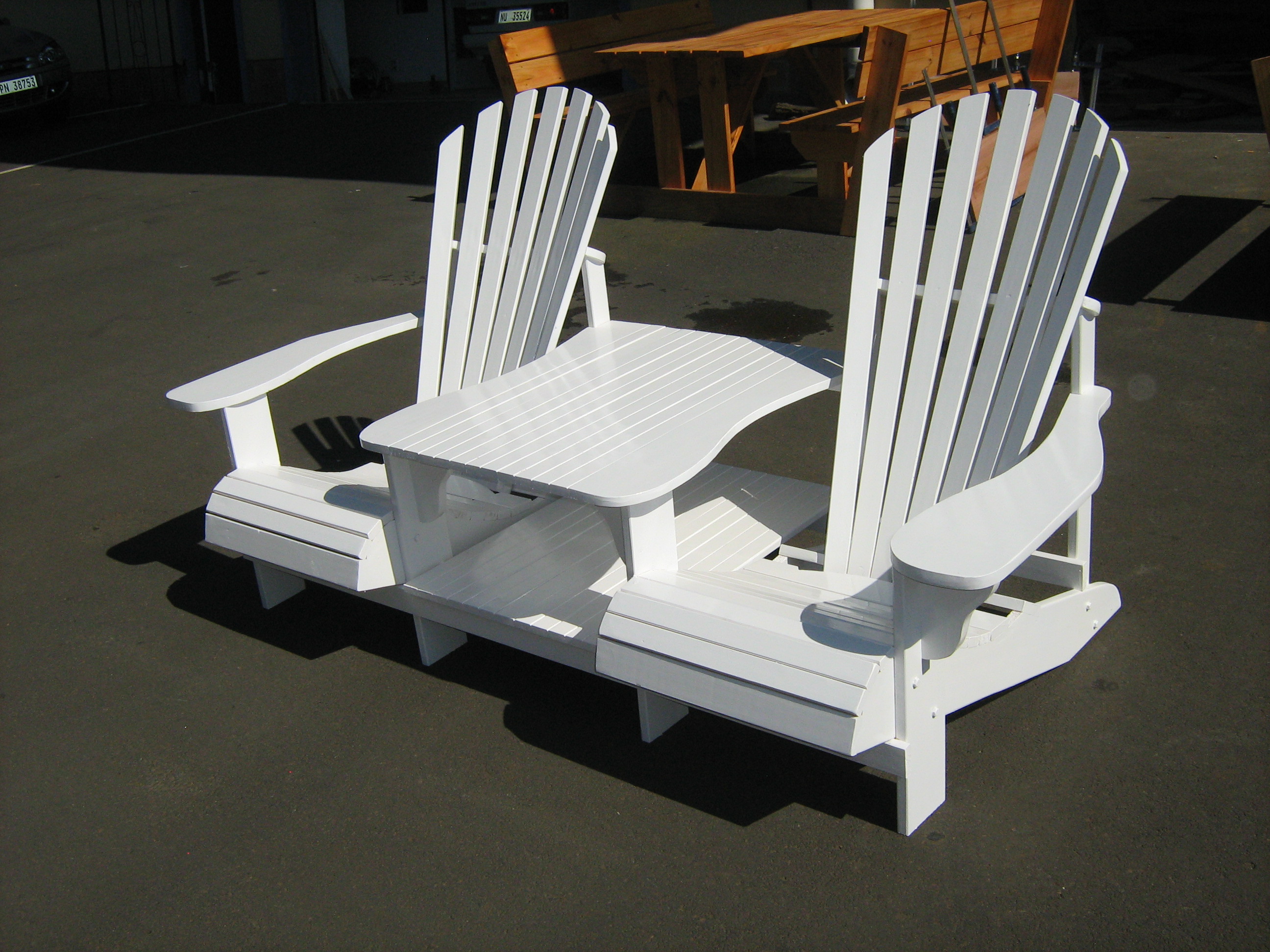
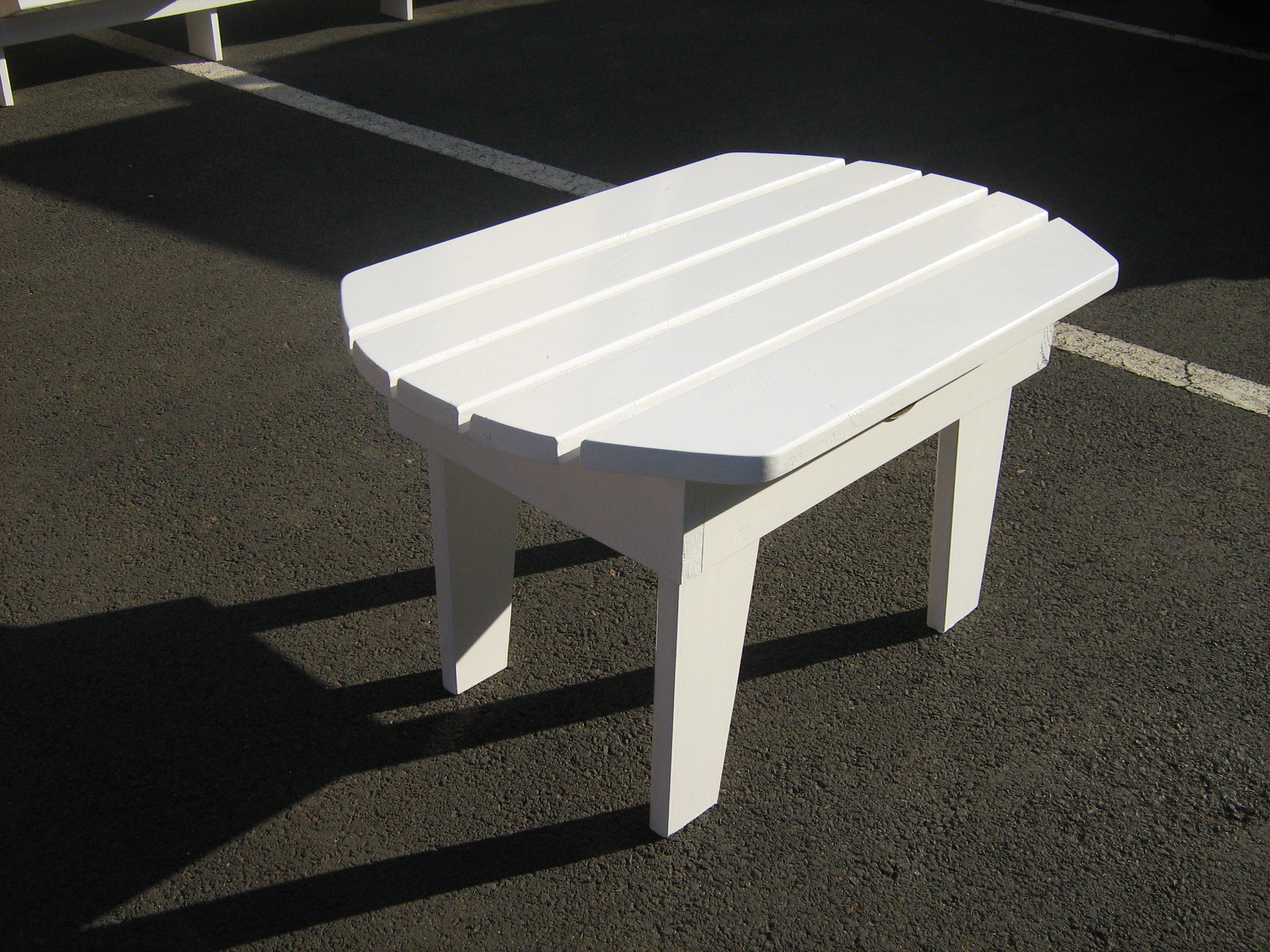
Other pieces are also available such as the double seater with table in the middle or without, a foot rest that is adjustable and a small side table all in the same style and design.

We don’t sell them as flat pack as we have found that flat pack will invariably break over time. Our chairs are made to last many years and I personally still have the first ones I made.

Outdoor Garden Patio Furniture Adirondack Chair

Click to enlarge

They are also available in children’s sizes as well as youth.

For a free no obligation quote on Adirondack Chairs and related outdoor garden patio furniture please complete the form below or contact us on 082 496 5444.

Go back

Your message has been sent

Warning
Warning
Warning
Warning
Warning
Warning

Warning.

Stairs and Steps

Wooden stairs are often built in conjunction with sun decks for access to the garden or another area of the house. We build our stairs primarily from balau but pine is a less expensive option.

There are two different types of stairs you can build. The standard stairway is about 900mm to 1m wide and has open risers (the vertical part) with treads of about 280mm wide. The open riser allows one’s foot to move slightly past the end of the riser. Closed risers are more common on wide steps which are normally built off the front of a deck. So for instance the full length of a 5m deck can have a closed riser step off of it using a substructure and deck boards. It then doubles up as a step and a seating area. They are quite common around pools or entertainment areas where a step is necessary but where the front of the deck needs to be kept open and a balustrade is not required or wanted.

For a free quote please contact us on 082 496 5444 or use the form to contact us below.

Go back

Your message has been sent

Warning
Warning
Warning
Warning
Warning
Warning

Warning.

Jacuzzi Cladding

Jacuzzi cladding that comes standard with most Jacuzzi is often made from meranti which is not that suitable for constant weathering and wet conditions.

Balau or Massaranduba cladding is a better alternative and will last many years in constant contact with water.

Cladding can take many forms from vertical cladding to cover pumps and filters to a small seating area around the Jacuzzi. They often contain hinged doors for access to pumps and filters.

Please contact us for a quote for your cladding requirements on 082 496 5444 or use the form below.

Go back

Your message has been sent

Warning
Warning
Warning
Warning
Warning
Warning

Warning.

Steel Gates and Guards Fabrication Durban

Due to an increased demand for steel driveway gates clad in balau deck boards, we have started fabricating the steel gates in-house. We previously outsourced that work but we find it better to fabricate the steel ourselves, in-house, as that we can then get the design flawless. We also attend to the galvanising and installation of the gates and automation.

As a result of setting up a steel fabricating workshop we also manufacture steel gates and guards and other mild steel fabrication. Our products include largely steel gates and guards but we are not limited in what we can fabricate.

For a free no obligation quote please call us on 082 496 5444 or use the contact us form below and one of our representatives will get back to you.

Go back

Your message has been sent

Warning
Warning
Warning
Warning
Warning
Warning

Warning.

Wooden Balau Deck, Plantations, Hillcrest Durban

We built this wooden balau deck in Plantations Estate in Hillcrest Durban recently for a client.

We needed to excavate a few hundred mm down in order to give us enough space in which to install our timber substructure. It is quite important to remove enough soil when building low-level wooden decks on top of soil. This is to give the deck enough space between the bottom of the timber substructure and the top of the soil so that the timber remains relatively dry. It is very important not to allow the timber to touch the wet soil unless it is H4 CCA Treated. CCA Treatment has various Hazard Classifications and each one is associated with specific applications. There are various articles on this site on the topic. You can find them by searching CCA in the search box at the top right of the screen. As a quick summary, H3 is good to go outdoors with periodic wetting and H4 is good to live in the ground in constant contact with wet soil. This is all according to www.sawpa.co.za. So if you are using H3 CCA Treated make sure there is sufficient space below to ensure the wood doesn’t touch the soil. If you are using H4 then it is ok to bury the timber in the ground.

Having said that the more space below the deck the better to allow air movement and keep as much moisture away from the balau deck boards which are not treated. Although balau is a very hardy wood and can withstand a certain amount of wetting, the more moisture around, the quicker the wood will deteriorate.

People often ask me about treating the pine before it goes in the ground or before we install deck boards above. There is no need. The pine is all pressure treated to the correct Hazard Classification and therefore no more treatment or sealing is necessary. In fact there is argument that coating it with, for instance bituseal, will in fact allow water in but won’t allow it out. Water will find a way in. A small stone scratching the bituseal off during installation, or a bump here and there, will allow water in and it won’t easily find its way out. Leaving it so the water can flow in and out quickly will result in a drier piece of timber for longer. There’s no need to do anything to your CCA treated timber.

Balau deck boards are then installed on the surface simply because balau is more stable and won’t crack, twist or warp as easily as pine. The cost difference between pine deck boards and balau deck boards is minimal, if anything. If you use pine deck boards you will use twice as much wood and although pine is relatively inexpensive, for deck boards you will need to use S7 (semi clears). The cost of semi clears negates any saving between pine and balau. Stick with balau as a deck board. It’s very stable. As a substructure, it is not cost-effective to use balau and S5 (industrial grade) pine can be used there at a much lower cost that both balau and semi clear pine.

This deck was left to grey naturally by leaving it as is. No oil, no sealer, nothing. Just leave it and periodically pressure wash it to remove any grime or dirt. If you choose to oil your deck then use an oil. Don’t use a product that will dry on the surface. If it dries it will peel and flake.

For a no obligation quote on building your wooden deck please use the contact us form below or you can contact us on 082 496 5444. We also offer a DIY service. We will supply you with all the correct materials you need to build your own deck and can advise on time-saving tips and tricks as well as recommended building practices.

Go back

Your message has been sent

Warning
Warning
Warning
Warning
Warning

Warning.

Stainless Steel Wire Rope Balustrades, Durban

This slideshow requires JavaScript.

Below is an article on wire rope balustrades to refresh the methods of installing them, display some pictures and highlight some pros and cons of this type of balustrade.

Wire rope balustrades are normally installed when one wants to avoid limiting the view as much as possible whilst still providing a barrier at the end of a deck. As opposed to solid timber balustrades which obstruct the view when in a seated position. A wire rope balustrade limits this as the cables are only 4mm thick.

On a standard 1m high compliant balustrade one would use 8 strands resulting in 9 gaps of 107mm each after taking into account that the capping is 30mm thick. Although the wire rope is tensioned on either end it is not tensioned to guitar string tension and can therefore be pulled open to create a bigger opening than 107mm. Care should therefore be taken when installing these wire rope balustrades if the property owner has small kids. They are not the safest and the height of the deck off the ground should be taken into account when choosing this style of balustrade.

As mentioned above the wire rope has a 4mm diameter. It consists of 19 smaller strands making up one larger strand (1 x19). The other type of wire rope is a 5mm wire rope. This is a 7 x 19. So it has 7 x 19 strands that make one 5mm strand. At The Wood Joint we use only the 4mm (1 x 19) wire rope as this is marine grade stainless steel and won’t tarnish as easily as the 5mm wire rope.

The 4mm rope doesn’t bend as easily as the 5mm rope so it cannot be used in conjunction with turn buckles where the rope needs to bend around the buckle 180º. Instead we make use of a swage and button head system where the wire rope is crimped into a swage on one end and a button head, which is sunk into the timber upright, on the other end. They are much neater than turn buckles but it does result in terminating the strands at a 90º corner and starting a new strand for the next run. As such, posts need to be doubled up so that a new button head can be installed where a swage terminates on the previous run. The end result is a slightly more expensive balustrade but one that won’t tarnish as easily and one that has a much neater appearance.

Care must be taken to cut the wire rope at the right length so as to have enough rope to insert it into the swage but not too much so that it can’t be tensioned properly. Once it is cut and crimped it can’t be re-cut or “uncrimped”.

The swage and button heads should be crimped towards the beginning and crimped twice to avoid failure later on. They can be finished off neatly with a stainless steel dome nut.

We are both suppliers and installers of wire rope balustrades. We own a crimping tool designed for 4mm wire rope which is also available for hire. Call us on 082 496 5444 or use the contact us form below for pricing and availability.

Go back

Your message has been sent

Warning
Warning
Warning
Warning
Warning

Warning.

Balau Duck Boards for Wooden Decks – Durban

Balau pot plant bases Durban

Balau pot plant bases for wooden decks

I have inspected many a wooden deck in Durban where the deck boards beneath a pot plant have started rotting. As can be imagined, rain water and water from watering the pot plant gets trapped below the pot plant and takes much longer to dissipate or evaporate than water collecting elsewhere on the surface of the wooden deck. This of course causes rot to accelerate below the pot plant resulting in premature and costly maintenance.

It can be easily prevented by placing something below the pot plant that is slightly raised off the deck surface and makes less contact with the deck itself. Water can then evaporate or run off more quickly which will slow the rotting process down. All wood will eventually rot and even though balau is more resistant to rot than other species of timber it is not immune to rot. The pot plant base can be moved periodically so that the water trapped between the pot plant base and the deck can also evaporate.

We manufacture pot plant bases in various sizes from balau deck boards that make as little contact with the deck surface as possible and are both pleasing to the eye and effective in resisting rot. They are inexpensive. At the time of writing this article (8 May 2016). they were retailing for approximately R150-00 each, depending on the size. They can be custom-made to fit the pot plant base and will save you a fair amount of money in future maintenance.

These pot plant bases are a joint venture between The Wood Joint and the staff. The builders make them in their spare time and the company recovers a bit for scrap off cuts. We split the proceeds equally.

You can contact us on 082 496 5444 or use the contact us form below. Please provide the size of pot plant base required or the size of the your pot plant so we can work out what will work best.

Go back

Your message has been sent

Warning
Warning
Warning
Warning
Warning

Warning.

Indoor Wooden Balau Pool Deck Built in Estcourt

Here’s an indoor wooden balau pool deck we built in Estcourt KZN recently.  The client had been doing some renovations on his house and had enclosed the pool with brick walls and windows resulting in an indoor pool.  He wanted a wooden deck around it to finish it off nicely.

Careful consideration was needed to ensure that any water from the pool could quickly drain away so as not to remain wet beneath the deck boards for too long.  Of course with an outdoor deck any rain water or pool water evaporates quite quickly and isn’t of that much concern.  Being indoors however this water can get trapped below the deck for some time resulting in premature failure of the timber.  Although the timber is H3 CCA treated, and as such can live outdoors with periodic wetting, it cannot remain wet constantly.  H4 CCA Treated timber is more suitable for damp conditions such as constant contact with wet soil.  But a fair amount of water on an ongoing basis is not a good idea.

In this instance the builder had done a great job in creating a small fall on all four sides of the pool so that any water dripping or splashing on the deck would fall back into the pool rather than sit below the deck.

The job was relatively easy as there was very little difference in distance between the walls and the sides of the pool.  If the wall is not parallel to the pool then it will result in a wedged shaped deck board either up against the wall or the pool.  To counter this one must “fan” the deck boards by making the gaps on one side 1mm smaller than the gaps on the other side effectively gaining 1mm per deck board.  After 20 deck boards you will gain 20mm to make up any difference.

In fibre glass pools one might also find that the edges of the pool are not straight.  Run a fish line along it to see if it bulges in or out and find the straightest side to start your decking.  If it does bulge then you will need to overlap your deck board on the pool side slightly to cover that and keep the deck boards straight.

A simple single deck board as a fascia board on the inside of the pool finished it off nicely.  It was oiled with a deck oil and this deck will require very little maintenance or re-oiling as it is indoors and won’t get any sun.

Call us on 082 496 5444 for a free quote on your decking requirements.  We also supply and install balustrades, pergolas, walkways, bridges, jacuzzi cladding and pool pump covers.

Go back

Your message has been sent

Warning
Warning
Warning
Warning
Warning

Warning.

Wooden Deck and Stairs Built in Umhlanga, Durban

This wooden deck we built for a client in Umhlanga, Durban was a suspended wooden deck about 2.8m off the ground. The idea was to make use of the flat concrete roof as a deck because the views from up there are of Durban Anchorage where ships anchor before proceeding to Durban port.  The views also extend all the way down the Golden Mile of Durban.

We didn’t want too many posts going to ground as the area beneath the wooden deck is still used as an outside patio. So we built our substructure using H4 CCA Treated pine in a 50 x 228 size rather than the normal 38 x 114. This way we could span our wooden joists of the deck across a longer distance without the need to support them below with another beam, and therefore posts. We attached the one end of the row of joists with a T joint to another 50 x 228 beams which carried the one side. The other side of each joist was hung in a custom-made galvanised steel joist hanger. The result was that our entire substructure was in one plane rather than having the joists sitting on top of a beam. It allowed us to keep the ceiling height of the deck higher, without having to increase the height of the top of the deck surface. These pine wooden joists were later sanded and sealed to make them look closer to the balau we installed on top of the pine.

The wire rope balustrade was fairly straight forward and we extended it past the deck on to the concrete slab flat roof.

The challenges in this wooden deck came in building the stairs. We had a fixed height to work with and a limited lateral distance in which we had fit all of our treads and risers whilst still keeping our risers and treads compliant. To add to this we had a window we had to pass to get down quick enough in our stair case in order to miss the window, plaster band and plumbing on the side of the house. The only way possible was to split the staircase into three flights with two landings where the flights turned at 90 degrees. We also had to split each landing into three windings in order to gain an extra two risers per landing in order to finish the stairs where they needed to finish. We adjusted the tread depth to shorten our treads and therefore total lateral distance to basically “sqwish” then all in. Normally we use 3 pieces of 30 x 102 balau for treads with two 5mm gaps between boards resulting a tread width of 316mm. We ripped the middle 30 x 102 to 50mm to reduce this lateral distance whilst still remaining compliant at 264mm but gaining some lateral distance in order to squeeze them all in. We finished it off with balau deck board cladding in order to cover all the pine structure. The job took time but it was well worth the wait. Stairs that look nice, work nicely and remain compliant.

It was all finished with an oil based sealer which penetrates the wood rather than drying on the surface.

Contact us for quotes on your wooden decking, stairs, balustrade and other outdoor timber construction. You can call us on 082 496 5444 or you can use the contact us form below.

Go back

Your message has been sent

Warning
Warning
Warning
Warning
Warning

Warning.

Timber Suppliers in Durban

As a spin-off of our deck building activities in Durban we started buying and selling decking timber. We found that due to the volume of timber we purchase we can secure it at a better rate and therefore provide it to the end-user, or contractor, at competitive rates.

We carry the most common decking timber sizes and species of timber. A brief outline of our stock follows.

H3 and H4 CCA Treated pine which is normally used for substructures. The most common sizes here are 38 x 114 used as joists and 50 x 228 used as beams. We stock them in various lengths to suit your needs. We also stock a 76 x 76 H4 CCA Treated pine square post. Other sizes are available with short lead times.

H3 treated timber is suitable for use outdoors where it is exposed to the elements and is subjected to occasional wetting (i.e. it gets wet, but has time to dry). Timber that is in constant contact with wet soil needs to be H4 CCA Treated. Timber living in fresh water is H5 treated and salt water requires H6 treatment.

We carry both 19 x 68mm and 19 x 90mm reeded (grooved) yellow balau deck boards. Again we stock various lengths to suit your needs from 2.4m to 4.2m lengths. They are all sourced from either Indonesia or Malaysia and are either MTCC (Malaysian Timber Certification Council) certified or PEFC Certified. (Programme for the Endorsement of Forest Certification).

We also stock a range of structural balau ranging from 30 x 40 to larger 30 x 102mm and 30 x 215mm pieces. Although we don’t carry larger pieces, they can be sourced relatively quickly.

Other decking products such as Massaranduba and Garappa are also available with relatively short lead times.

Decking screws, sealing agents and other timber decking supplies are also available to provide a one stop shop for all your decking requirements.

We will also assist in the design of your deck, if required, and we can assist in calculating quantities in order to limit waste.

For a quote on all your decking timber requirements please call us on 082 496 5444 or use the contact us form below.

Go back

Your message has been sent

Warning
Warning
Warning
Warning
Warning

Warning.